 Guide On Map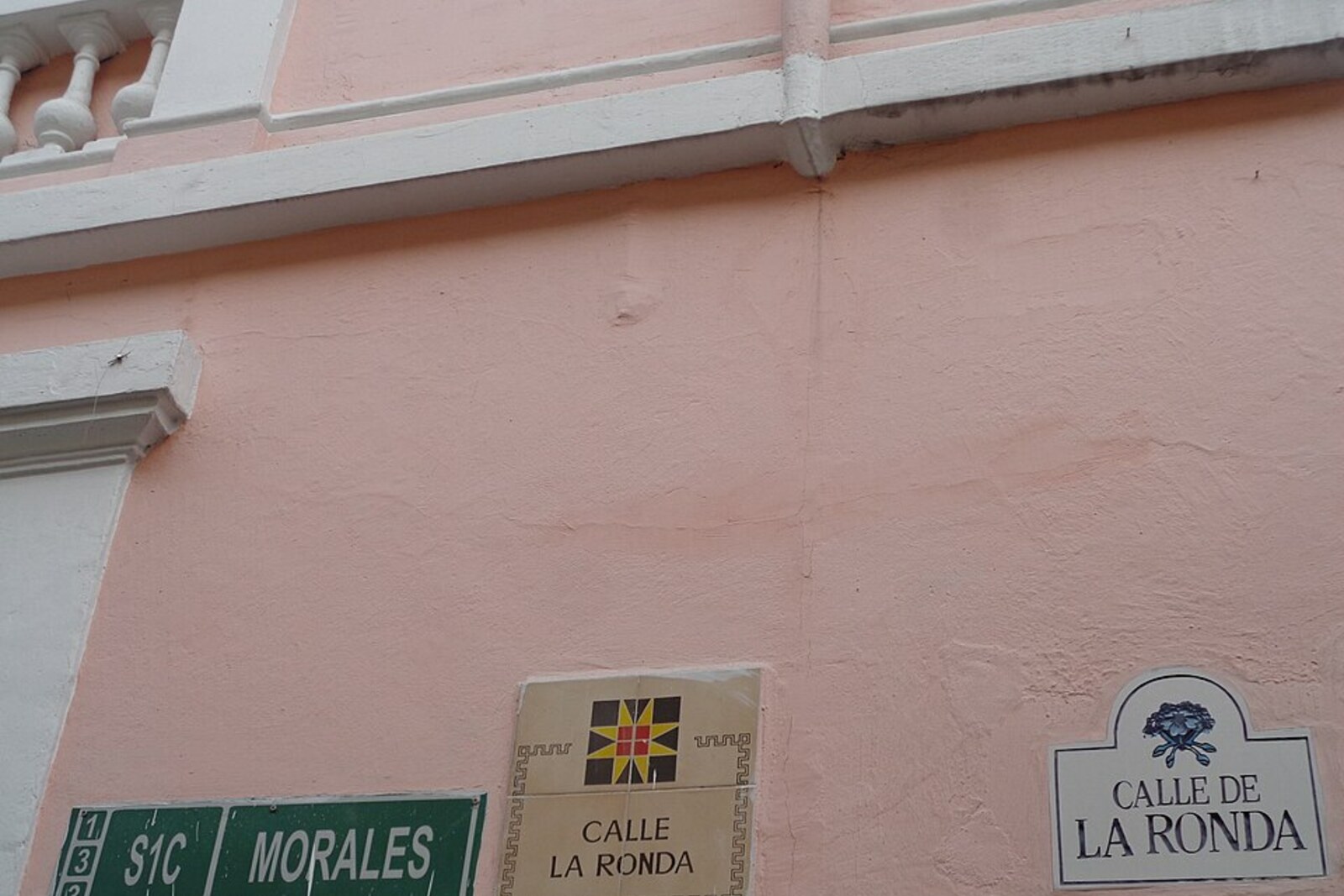
Look around first
What to notice
- The corner house of Murcielagario
- The La Negra Mala sign
- The old buildings of Juan de Dios Morales Street
The story of the place
La Ronda runs along the former southern edge of old Quito, beside Jerusalem Ravine, which once separated residential blocks from the undeveloped outskirts. Its name is associated with the nighttime rounds of patrolmen: they walked along this boundary, and their routine gave the street its name. Among the old facades, the house on the corner stands out; its fate preserves the memory of a time when this street brought together musicians and writers.
At the intersection of Juan de Dios Morales Street and Venezuela Street, the La Negra Mala restaurant is open. The house is called Murcielagario—a word that can be translated as “a dwelling place for bats.” The restaurant’s present name appeared after a family dispute over which old song of La Ronda should be returned to the sign.
On city signs, La Ronda is listed as Juan de Dios Morales Street. In eighteen eighty, it was named for one of the organizers of the coup of August tenth, eighteen oh nine. Morales joined Quito’s first junta, was arrested after its fall, and was killed in a prison cell during the reprisal already recounted. Residents did not abandon the old name. According to a common explanation, a ronda was a nighttime patrol: the city’s southern boundary ran here, beside Jerusalem Ravine. Patrolmen walked along the edge of the built-up blocks, and their activity became fixed in the street’s name.
In the middle of the twentieth century, the house at the intersection contained a room hidden from the street, where musicians and writers gathered. The cantina was run by a man known as Commander Antonio Alomía. He is also credited with the word Murcielagario: either a joking name for a shabby tavern or a comparison of visitors in dark cloaks to bats. Stories about a password and a secret exit into the ravine belong to family legend. Documents allow a more confident conclusion only that, by around nineteen forty-five, an inconspicuous cantina was indeed operating in the rear of the house.
By the early two thousands, the Carvajal family had lived here for several generations. During the restoration of La Ronda, they were offered the chance to sell the house. The family’s mother, Amparo Carvajal, refused: in her words, it had come to them at the cost of tears and sacrifices. Only then did the owners’ children learn what history was associated with their rooms. An information board appeared on the street, and the researcher Fernando Jurado, who wrote a book about La Ronda, entered the house for the first time, having previously judged it by other people’s memories.
After the restoration, the family opened a restaurant on the ground floor. The son suggested calling it Esta guitarra vieja—“This Old Guitar.” The poet Hugo Moncayo and the self-taught composer Carlos Guerra composed this albazo, a song for a pre-dawn serenade, here on La Ronda. Guerra worked as a government official, could not write down music, and kept melodies in his memory. Friends teased him about his secondhand guitar; Moncayo turned those taunts into verses about the old instrument, and Guerra found a melody for them. The song outlived both their circle and the guitar itself. The exact house where it was born remains disputed: some accounts place its composition in Murcielagario, others in Guerra’s own house farther along this same street.
Victoria Carvajal found the name too sad. She chose “Negra Mala,” the title of another song associated with a neighboring literary salon. According to a local story, the photographer and musician Sergio Mejía fell in love there with the married hostess Ana Luisa Muñoz. She did not return his feelings, and Mejía wrote a song about a woman he called a “beautiful, wicked Black woman.” This salon stood about five houses from Murcielagario. Victoria knew this, but she also liked the name because both she and her mother Amparo were dark-skinned. Thus the name of the woman who rejected the musician ended up above the door of another house.
In January two thousand eight, while a municipal parking lot was being built behind the house, its rear section collapsed. According to the female owner and a former resident, the dark room called Murcielagario was destroyed. The family restored the home and the restaurant. Today, the Murcielagario house and the La Negra Mala sign remain on the corner; the room where musicians gathered no longer exists.
Useful on site
The street is open as a public space. The Pichincha source indicates round-the-clock access without charge; galleries and shops are usually 10:00–18:00, restaurants and bars approximately 15:00–00:00; check individual establishments on site.
Checked: July 1, 2026. Check the official source before visiting.During the day, it is easier to examine the houses and look for working workshops; in the evening, the street becomes busier and louder. Remember that living spaces remain behind the restored facades.