 Guide On Map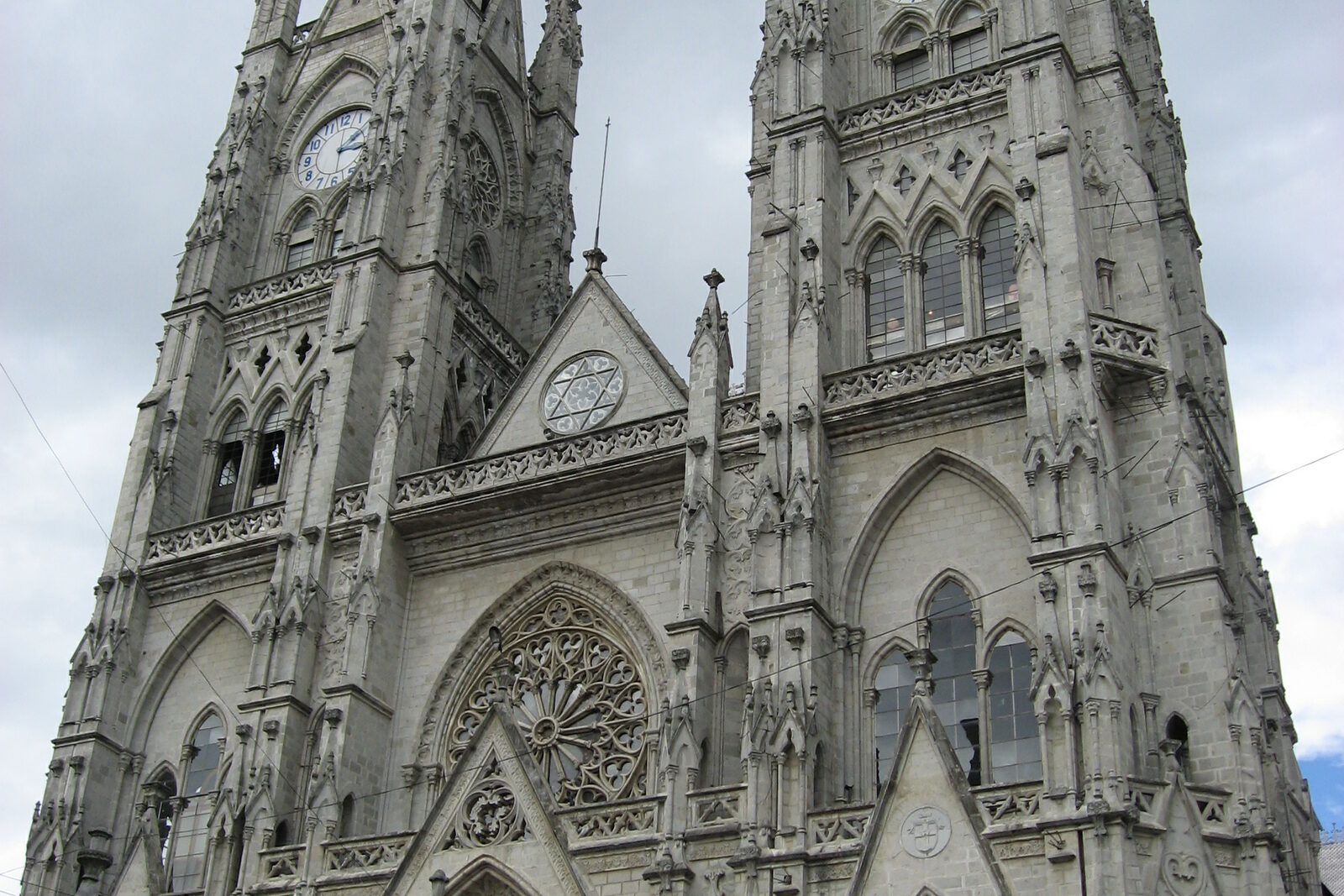
Look around first
What to notice
- Figures on the facade
- Surnames of donors on the stones of the apse
- The original painting of the Sacred Heart in the Oblates' chapel
The story of the place
On San Juan Hill stands a basilica with a facade where stone statues bring together saints and church and state figures. The church was officially opened only in nineteen eighty-eight; beside the apse, the surnames of families who took part in its construction can still be read in the stone. The Oblates' private chapel keeps the original painting of the Sacred Heart of Jesus.
The name of this church translates as “Basilica of the National Vow.” Here, the vow meant an obligation that the state and the Catholic Church undertook on behalf of the country.
On March twenty-fifth, eighteen seventy-four, President Gabriel García Moreno, who sought an official alliance between the republic and the Catholic Church, and Quito Archbishop José Ignacio Checa y Barba consecrated Ecuador to the Sacred Heart of Jesus. Such a consecration meant that the country solemnly recognized special religious patronage. No one made the vow personally on behalf of every Ecuadorian.
There was not yet a stone monument for this ceremony. It was needed by the priest and law teacher Julio María Matovelle nine years later, after the civil war. Opponents of General Ignacio de Veintimilla, who had proclaimed himself supreme ruler, overthrew his regime. Matovelle was elected a deputy from Azuay Province and explained the victory by God's help. He persuaded the provisional government to order the construction of a large basilica: the treasury was to provide land and money, while the faithful were to add donations.
Eloy Alfaro objected to him in the constituent assembly. Alfaro, a liberal general who had himself fought against Veintimilla, sought the restoration of the republic, but refused to turn the victory of one coalition into religious gratitude on behalf of the whole country. He reminded the assembly that the treasury had no funds, and that fratricidal wars should be consigned to oblivion rather than commemorated with basilicas.
At first, Matovelle prevailed. The construction was approved, and on July tenth, eighteen ninety-two, the foundation stone was laid on what is now San Juan Hill. Money was collected through parishes across Ecuador. Families that contributed received the right to carve their surnames into the stones of the apse.
The dispute, however, continued beyond the assembly. When Alfaro led the country after the Liberal Revolution, state funding for religious consecrations and churches was abolished. Matovelle then faced arrest: he went into hiding, left for Lima under a safe-conduct pass, and earned a living there as a chaplain at a girls' school. In nineteen oh two, a new president announced an amnesty. Matovelle returned and immediately went to Quito, because the government intended to take back the plot with the unfinished church.
The priest handed the construction over to the congregation of Missionary Oblates of Mary Immaculate that he had founded. The Oblates now collected donations themselves, hired craftsmen, and retained the land. Matovelle died in nineteen twenty-nine; the basilica was officially opened only in nineteen eighty-eight.
On the facade, among figures of saints and church and state figures, stand Matovelle and García Moreno. The surnames of donors remain on the stones of the apse. And in the Oblates' private chapel, the original painting of the Sacred Heart of Jesus is kept—the painting before which Ecuador was consecrated to it in eighteen seventy-four.
Useful on site
The facade can be read as an open urban landmark. Pichincha's tourism source lists visits to the basilica Monday through Friday 09:00–17:00 and on weekends 06:00–18:30, with a separate fee for foreign visitors; church events and local access controls may change the schedule.
Checked: July 1, 2026. Check the official source before visiting.The main local details are easy to make out from outside. The ascent and certain interior areas may have their own access rules; do not hurry when you are up high.