 Guide On Map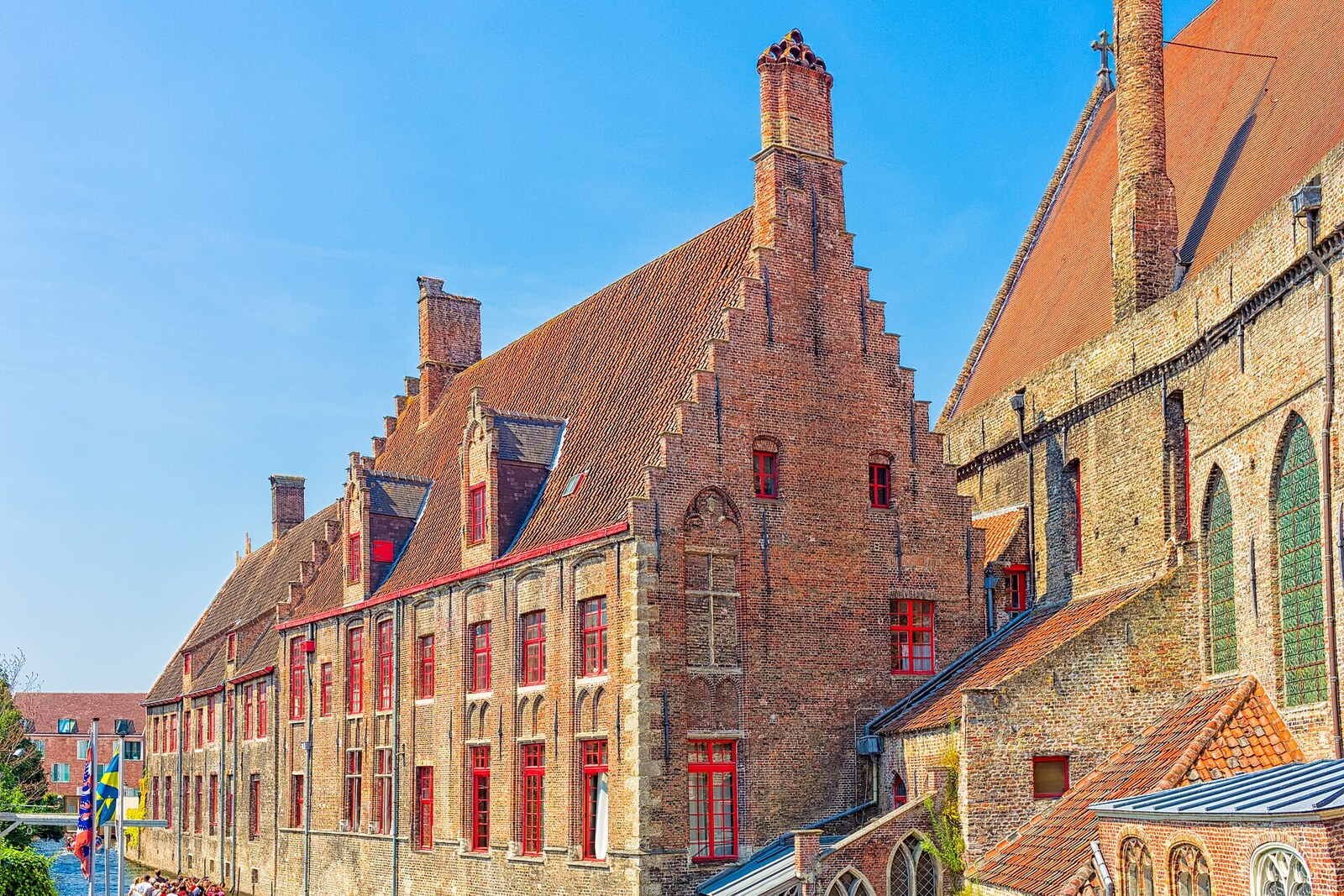
Look around first
What to notice
- St John Altarpiece
- The four patrons on the outer wings
- St John the Baptist with a lamb
- The city crane and wine barrels
The story of the place
The main painting inside was commissioned by a man who did not live to see it finished. Antheunis Seghers was master of St John's Hospital: he led the community of brothers and sisters that received poor sick people and travelers. When a new choir was built for the hospital church in the early fourteen seventies, Seghers and his three assistants decided to install an enormous winged altarpiece there. They commissioned Hans Memling, one of Bruges's most sought-after artists, to paint it.
Alongside Seghers, the patrons were Brother Jacob de Ceuninck, who managed the finances, Prioress Agnes Casembrood, who led the sisters, and Clara van Hulsen, who had served here for more than fifty years. The carefully compiled hospital accounts contain no payment to Memling. Researchers therefore believe that the brothers and sisters raised the money themselves, probably with help from benefactors. For a small community, commissioning a celebrated master required serious expense.
Its size was explained by the way the hospital worked. In the medieval sense, the word meant an institution where people were given shelter and care. Poor townspeople, sick travelers, pilgrims, and homeless people were received here. By the fifteenth century, the long wards contained about one hundred beds, intended for one hundred fifty people: sometimes two people lay together. The church and the wards formed a single space. The sick could hear Mass from their beds, and the altarpiece had to be visible across the entire hall.
Seghers died in fourteen seventy-five. Memling completed the triptych four years later, but retained the deceased patron on an outer wing. Beside him, the artist placed de Ceuninck, Casembrood, and van Hulsen. On weekdays the altarpiece usually stood closed, so those lying in the wards saw these four more often than the colorful scene inside. Behind each of them, Memling painted a patron saint bearing the same name.
The opened triptych explained the hospital's own name. In its charter of eleven eighty-eight, the institution is called the House of Blessed John. This referred to St John the Evangelist, whom Christian tradition considers the author of one of the Gospels and the Book of Revelation. His symbol, the eagle, appears on the oldest hospital seal. Documents do not say why the founders chose him. In the fifteenth century, St John the Baptist—the preacher who baptized Jesus Christ—was added to him. Memling placed both Johns on either side of the Virgin Mary: the Evangelist with a chalice, the Baptist with a lamb. The name remained from the first patron, while the main altar came to have two of them.
Between the columns behind St John the Evangelist, the artist included a city lifting crane, wine barrels, and two hospital brothers. This is a precise economic detail. The hospital had the exclusive right to measure Burgundian wine brought into Bruges and charged a fee for every barrel. The brothers oversaw the unloading, the sisters cared for the sick, and the income received helped maintain the wards. That is why a single panel contains patron saints, the people who ran the hospital, and the crane that brought them money.
The triptych remained in the complex for which it was painted. In eighteen thirty-nine, six works by Memling were displayed in the neighboring chapter house and Bruges's first museum was opened to the public; patients were still being treated in the other buildings. Medical services left the old hospital only in nineteen seventy-seven.
Now the former wards are occupied by the museum, and the altarpiece can be viewed up close. On its outer wings, the four patrons still stand, led by Seghers, who died four years before the work was completed. The opened altarpiece still contains both Johns and the wine crane, while the original frame bears Hans Memling's signature and the year: fourteen seventy-nine.
Useful on site
09:30-17:00; closed on Mondays; check the Musea Brugge calendar for holiday exceptions.
Checked: June 28, 2026. Check the official source before visiting.The medieval buildings can be appreciated from outside, but Memling's works are in a museum space with separate access. Inside, focus on the works created specifically for the hospital.