 Guide On Map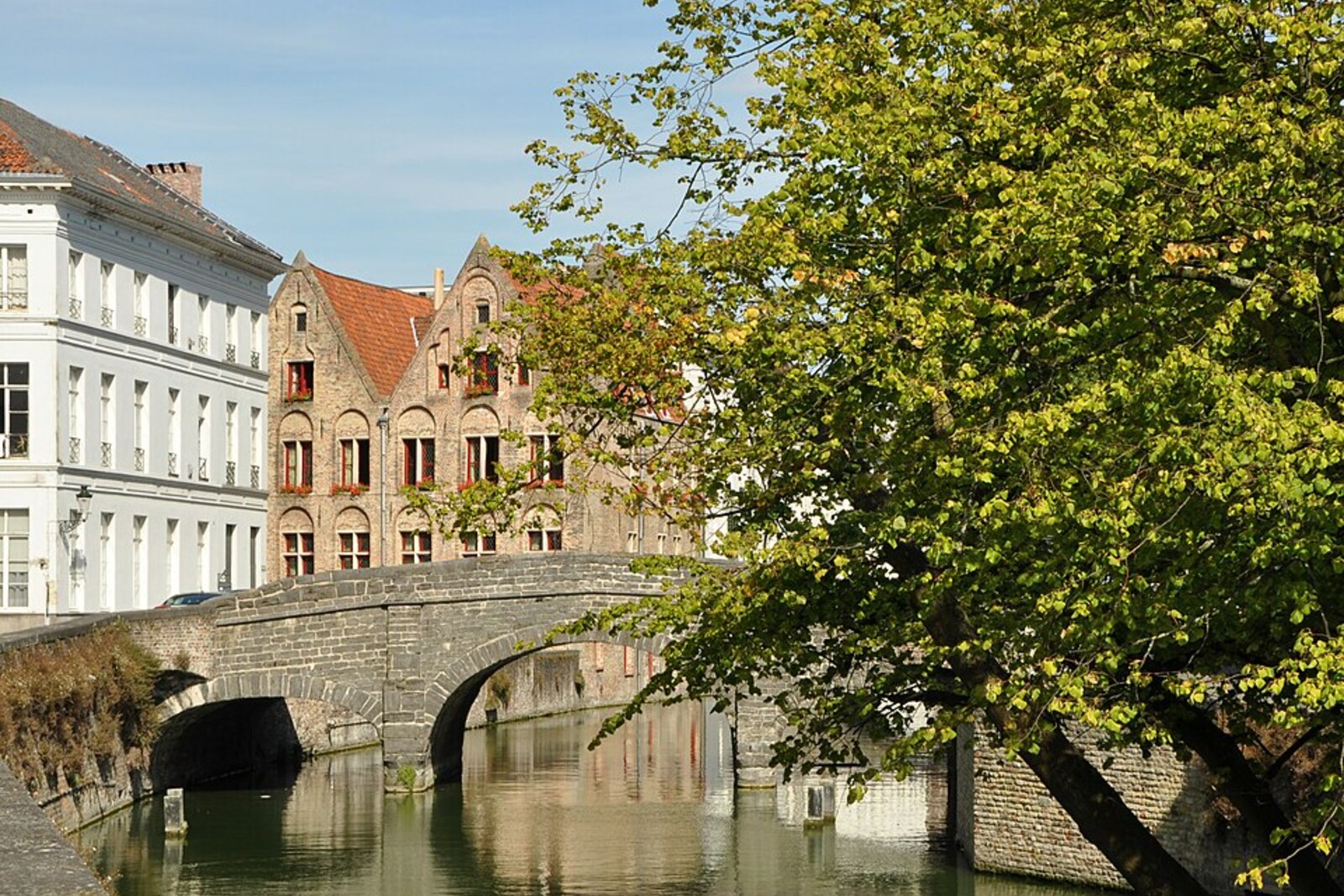
Look around first
What to notice
- Three stone arches
- Trees on the Hoedenmakersstraat side
- Parking lot beyond the bridge
The story of the place
The present stone crossing rests on three arches and crosses the canal beside the former Augustinian monastery. From here, a direct route led to its church for those who came to the monks from the merchant quarters. The names of the canal and bridge recall the monastery: at the end of the eighteenth century, its buildings were sold and almost completely dismantled. Trees now grow on the site of the church, with a parking lot beside them.
In twelve ninety-four, the Augustinian friars asked the Bruges magistracy to allow them a bridge directly in front of their monastery. Their house stood on the bank of the canal opposite the old center, and previously the monks had to reach the city by way of the neighboring Vlamingbrug.
For the Augustinians, this detour was a serious obstacle. They belonged to a mendicant order created for preaching and pastoral service in growing trading cities. The friars lived on donations from the same townspeople and visiting merchants whom they went out to meet every day. Later, the Masseria—the elected governing body of the Genoese merchant community—received several permanent places in their church. Surviving documents specifically praised the Genoese for their generous and steady support of the monastery.
The magistracy agreed to the bridge, but set two conditions. The Augustinians had to pay for the construction themselves, and the city councilors retained the right to order the crossing dismantled at any time if it began to cause an obstruction. The friars accepted the risk: a community dependent on benefactors spent money on a crossing that it was not even promised it could keep forever. In return, the route from the merchant quarters now led directly to the monastery church.
The crossing was preserved. In thirteen ninety-one, the Bruges master mason Jan van Oudenaerde built the present three-arched bridge in its place. The canal came to be called Augustijnenrei, and the bridge Augustijnenbrug, after the Augustinians. Saint Augustine himself was never here: both names recall the friars of his order.
The monastery beyond the bridge is no longer there. At the end of the eighteenth century, the Augustinians were expelled, and the church, school, and remaining buildings were sold and then almost completely dismantled. Trees and a parking lot now stand on the site of the church, on the Hoedenmakersstraat side. The stone crossing still leads over the canal along the very line for the right to establish which the Augustinians paid, without any guarantee that they would be allowed to keep it.
Useful on site
Free-access city canal and bridge; check only the weather and the condition of the paving.
Checked: June 28, 2026. Check the official source before visiting.Consider the parapet platforms to be former counters, not ordinary benches. On wet stone, keep farther away from the stairs and the canal edge.