 Guide On Map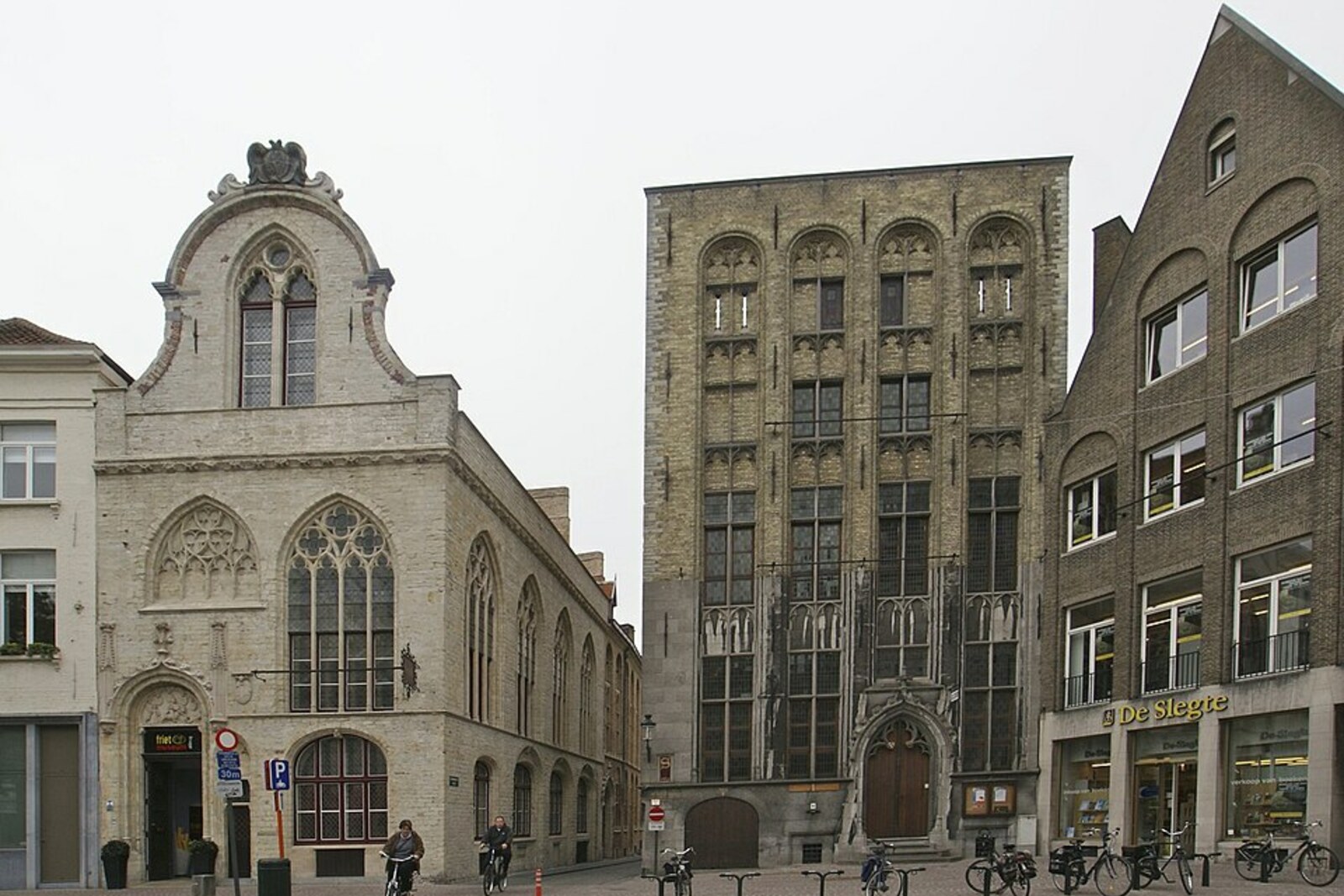
Look around first
What to notice
- The Gothic façade of Ter Beurze
- The façades of the Nation Houses
- The stone inscription on the Genoese house
The story of the place
This narrow bend in the streets brings together the Gothic façade of Ter Beurze and the houses of three trading communities. Italians settled here for long periods, kept their own houses for visiting compatriots, and conducted shared business from them. The address brought a practical advantage: buyers, brokers, and information about the value of bills of exchange converged nearby. The present façade of Ter Beurze was assembled after the Second World War from old images and traces of masonry, while the Genoese house retains the commissioners' own carved inscription.
In twelve eighty-five, Robert van der Beurze ran an inn on this corner. He earned money from visiting merchants, but did not limit himself to providing lodging: he helped foreigners conclude deals, explained local rules, gave business advice, and sold goods himself as an intermediary. A mistake would have cost him his clients’ trust and his own trading income, so the innkeeper’s surname served here almost as a recommendation.
Shares were not traded then. Merchants negotiated consignments of goods, exchanged coins, and determined the value of bills of exchange—written orders to pay money in another city, often in another currency. Later, rates for such papers were set daily in the square before the inn, and Bruges brokers reported them to their Italian colleagues. In thirteen oh two, a money changer bought the corner house: the owner changed, but the place’s financial trade remained.
The van der Beurzes rose to the top of Bruges society; members of later generations became city councilors and mayors. Their surname first became attached to the inn complex and meeting place, then to trading itself. From here, the Dutch word “beurs” spread into European languages; the Russian word “birzha” belongs to the same word family. That is why this bend in the streets, which was never a spacious, regular square, is called Oude Beursplein—the Old Exchange Square.
Over time, Italian merchants ceased to be temporary lodgers here. Genoese, Florentines, and Venetians joined together into trading “nations.” These were communities of compatriots with their own representatives and houses, where they conducted shared business and received fellow countrymen who came to town. Keeping such representative offices near Ter Beurze was convenient: only a few steps separated their own house from brokers, buyers, and the latest exchange rate for bills of exchange.
From thirteen ninety-seven, the Venetians leased the former van der Beurze inn and used it for more than a century. In thirteen ninety-nine, Genoese merchants built the neighboring lodge, while the Florentines occupied the corner house opposite from about fourteen twenty. Thus the Nation Houses grew up around the place where an innkeeper became a trusted intermediary.
When the main trade flows moved to Antwerp, the brokers followed them. The present Gothic façade of Ter Beurze does not date from Robert’s time: it was recreated in nineteen forty-seven from old images and discovered traces of masonry. A more direct record of those active here survives on the Genoese house: a stone inscription says that the merchants of Genoa who lived in Bruges ordered this building constructed in thirteen ninety-nine.
Useful on site
Freely accessible open space; the businesses and museums around it have their own schedules.
Checked: June 28, 2026. Check the official source before visiting.Stop at the edge of the square, keeping doorways and passageways clear. All the key connections are revealed through the exterior appearance and placement of the buildings; no special entry is required to complete the route.