 Guide On Map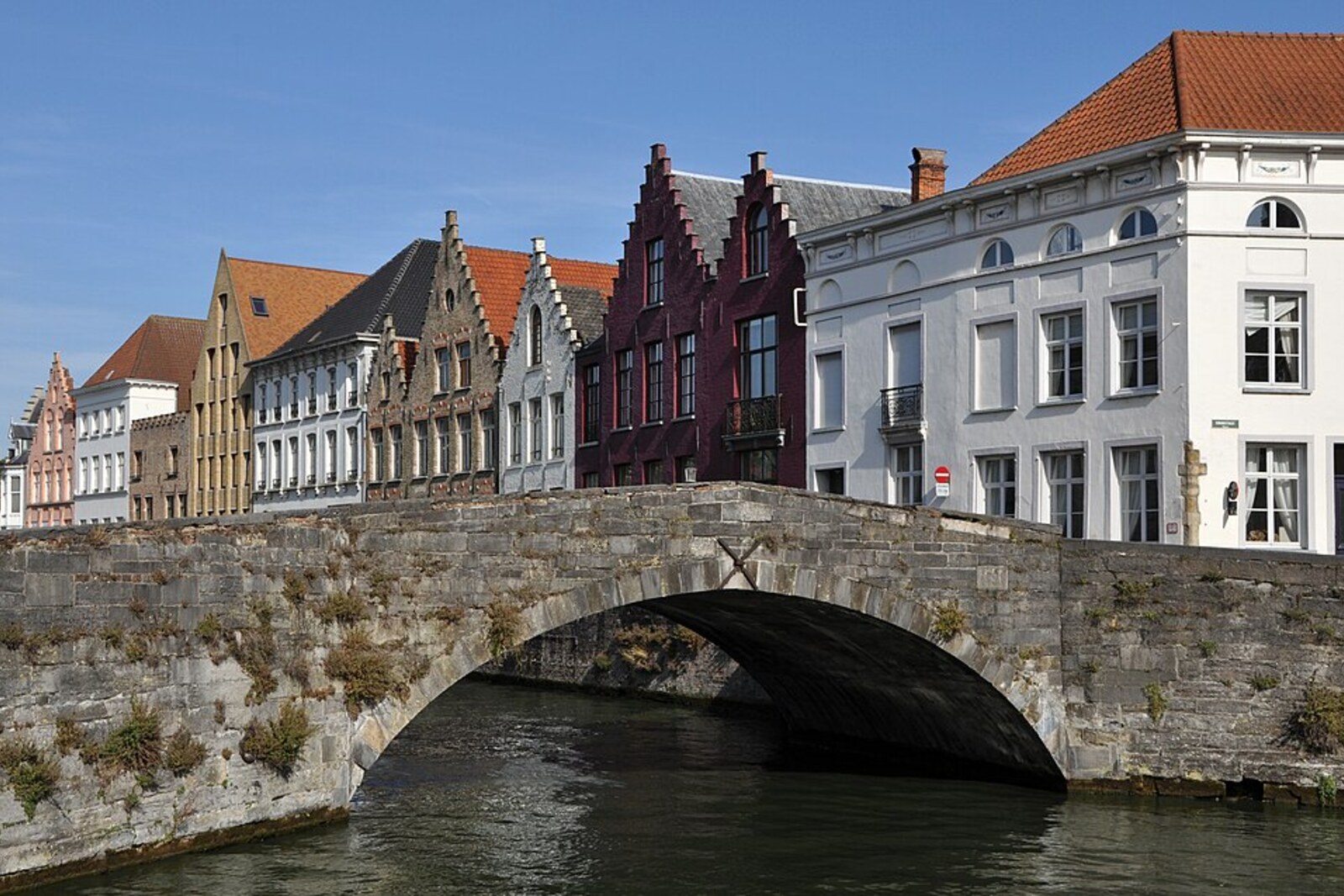
Look around first
What to notice
- The stone arch of Koningsbrug
- The water of Spiegelrei
- The row of houses along the canal
The story of the place
The stone arch of Koningsbrug crosses Spiegelrei, a narrow canal between rows of old houses. The present bridge was built on the foundations of a medieval crossing; before it, a swing bridge operated here, letting vessels pass to the quays. Cargo boats still approached along this water in the early twentieth century, and the shore remained part of Bruges's trading network. Today, sightseeing boats turn around by the arch.
In eighteen forty-seven, the city architect Jean-Brunon Rudd was commissioned to turn the water between the Burghers' Lodge and Koningsbrug into a building site. Bruges needed a new municipal theater.
The old theater was called De Comedie. It held about six hundred spectators, and its boxes served as a sign of status for wealthy families. At first, the city planned to buy the neighboring house and enlarge the auditorium, but there would still not have been enough space. The council then asked Rudd to prepare an estimate for filling in this part of Spiegelrei and building the theater directly on the former channel bed. The bridge marked the outer boundary of the future site.
The project met with many objections, and the estimated cost proved too high. The city abandoned the plan to fill in the canal. However, the twenty-four-year-old architect Isidore Alleweireldt continued the debate over the theater. A year later, he published a pamphlet that considered six possible sites and argued that a large public construction project would bring commissions and earnings to the residents of Bruges—at the time, the city was among the poorest municipalities in Belgium. For the theater, Alleweireldt chose the area around the old De Comedie, rather than the canal.
In eighteen forty-nine, the city council limited itself to another repair of the old auditorium. The townspeople did not get a new theater until two decades later; it was built elsewhere. Rudd's drawings remained on paper, and the stretch of Spiegelrei intended for the foundation was preserved as water.
Both names here invite interpretations that are too literal. Koningsbrug—“Royal Bridge”—is not dedicated to a known monarch. Beside the crossing stood De Koning, meaning “the King”; the neighboring Koningsstraat took its name from it, and the same name became attached to the bridge. The origin of the word “Spiegelrei” has not been conclusively established. It has been linked to the old word “spegele,” meaning an elongated body of water, to a house called the Great Mirror, and to the craftsmen who made mirrors here in the fifteenth and sixteenth centuries. The calm reflection of houses in the water provided a convenient later explanation, but not a proven etymology.
The present stone arch of Koningsbrug appeared in nineteen twelve. The city engineer Clément Salmon built it on the discovered foundations of a bridge from thirteen thirty-two. Between these two stone bridges, a swing bridge stood here: it was installed in seventeen fifty-three to let vessels pass to the quays of Spiegelrei. Cargo boats still moored here in the early twentieth century; then commercial traffic ceased, and Salmon restored the fixed arch.
Today, sightseeing boats turn around by Koningsbrug. They pass through the very stretch that Rudd had already assigned in his drawings as the foundation of the municipal theater.
Useful on site
A freely accessible city bridge and canal; check only the weather and the condition of the paving.
Checked: June 28, 2026. Check the official source before visiting.Listen to the story at the edge of the sidewalk, without blocking the passage across the bridge. It is better to take in the view of the two quays one at a time, rather than going close to the water.