 Guide On Map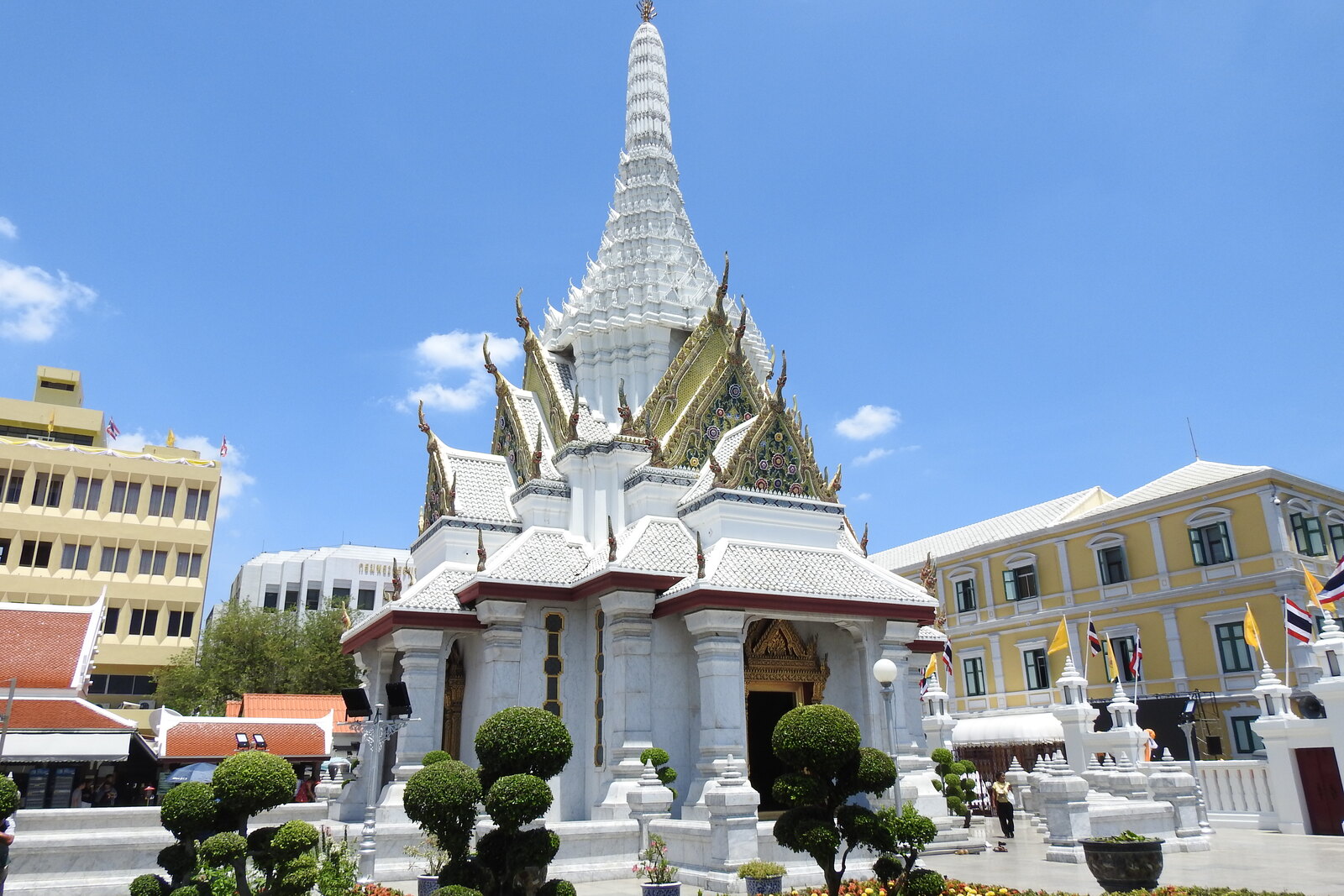
Look around first
What to notice
- Pillar with a bud-shaped finial
- Pillar with a stepped finial
- Five gilded guardians
The story of the place
The tall pavilion on the eastern bank of the Chao Phraya River holds two wooden city pillars. One is crowned with a carved lotus bud, while the other ends in a stepped little tower; in the first, cassia is hidden beneath sandalwood, while in the second, a teak core is enclosed in cassia. The pillars were installed at different times: when the old one had deteriorated, a new one appeared beside it, and during the anniversary renovation of the complex, the earlier one was preserved here as well. This site was chosen before the palace, temples, walls, and canals appeared in Rattanakosin.
Following the custom here, a visitor first places flowers before the Buddha statues, then ties three colored ribbons onto one of the replica pillars and covers it with gold leaf. The actual city pillars are touched differently: garlands are offered to them. In a separate pavilion stand five gilded guardians, entrusted with protecting the city from enemies and misfortunes. This sequence preserves the meaning of the place: this is where people worship the day Bangkok was assigned its destiny.
Fifteen years earlier, Burmese troops had destroyed Ayutthaya, the former capital of Siam. King Taksin reunited the fragmented state and established his court in Thonburi, on the western bank of the Chao Phraya River. In seventeen eighty-two, he was replaced by the commander Chao Phraya Chakri—the new King Rama I, founder of a new dynasty. He needed a capital that was easier to defend and could accommodate the court, the army, and government institutions.
King Rama I moved the capital to the eastern bank. To the west, this territory was shielded by a bend in the Chao Phraya River, while to the east lay a marshy plain; later, people dug canals, turning the city center into the water-ringed island of Rattanakosin. But before the palace, temples, and fortress walls, an auspicious place and time for the city's birth had to be determined.
Court Brahmins calculated the time down to the minute. On April twenty-first, seventeen eighty-two, at six fifty-four in the morning, a wooden pillar was lowered into the ground here by order of King Rama I. Its core was made of cassia, reinforced on the outside with sandalwood, and its top was carved in the shape of a lotus bud. The horoscope of the new capital was laid together with the pillar. That is why Bangkok's founding is counted from this ceremony, although major construction continued for several more years.
A legend is connected with the installation itself. It is said that four small snakes crawled into the prepared pit. The Brahmins noticed them when the appointed minute had already arrived. Stopping the ceremony would have meant missing the calculated time, so they continued and covered the snakes with earth together with the base of the pillar. King Rama I summoned court scholars, Brahmins, astrologers, and Buddhist hierarchs. They considered what had happened a bad omen, after which the king ordered a rite to avert misfortune. This is a legend, not a fact established by archaeologists. One thing is certain: the work did not stop, and the chosen minute remained the official moment of the capital's birth.
Seventy years later, the first pillar had deteriorated. King Mongkut, King Rama IV, who ascended the throne in eighteen fifty-one, discovered another problem: according to court astrological calculations, his personal horoscope did not align with the date of the city's founding. He sought to ensure that the new reign did not begin under the sign of such a discrepancy.
King Mongkut ordered another pillar to be made—with a teak core and an outer casing of cassia—a new horoscope for the capital to be drawn up, and it to be placed inside. On December fifth, eighteen fifty-two, the pillar was installed, and a pavilion with a tall tower-like finial was built for the shrine. The first pillar was not destroyed. During the renovation of the complex for Bangkok's bicentennial in nineteen eighty-two, it was placed beside King Mongkut's pillar.
The two wooden trunks in the central pavilion belong to different ceremonies. King Rama I's pillar has a bud-shaped finial; the top of King Rama IV's pillar resembles a stepped little tower. On April twenty-first, the annual Brahmanic rite of the city's founding is still held beside them, and on an ordinary day garlands are offered to both.
Useful on site
The official page lists 06:30–18:00 in its header and 06:30–18:30 in the text; on sacred days and during ceremonies, visiting arrangements may change.
Checked: June 28, 2026. Check the official source before visiting.This is an active shrine: do not block the way for people carrying offerings, and take photographs only where permitted.