 Guide On Map
Royal Bangkok: Rattanakosin and Thonburi
From Sanam Luang through the Grand Palace and Wat Pho to Wat Arun
Guide On Map on your phone
Open the walk like a regular app
It takes about 10 seconds to install. No app store needed.
The whole path
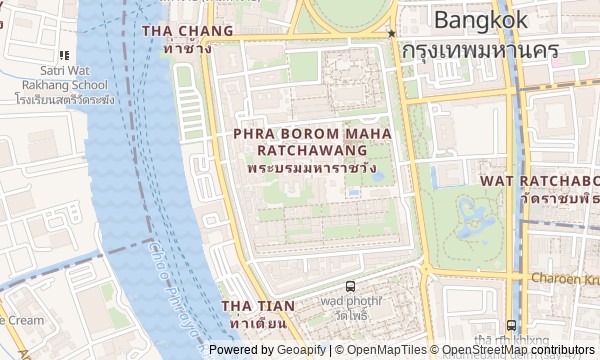
Route map
About the walk
You will begin on open Sanam Luang and walk along the palace walls toward Rattanakosin's main shrines. Then the streets will lead you to old trading rows, a pier, and a short crossing. On the other bank, the route ends at Wat Arun—the temple of the former capital.
This will not be a list of famous temples. You will trace how royal Bangkok changed its bank, its ceremonies, and the purpose of its buildings. Questions will come up along the way: why did the city need 2 pillars, why does the palace temple have no monks' quarters, and where did the boards from a temporary pavilion go after a farewell ceremony?
The story will stay with specific things and human decisions. Legends will remain legends, and verified events will remain events. After the walk, you will be able to read the Chao Phraya River as the boundary between 2 capitals and explain why Wat Arun stands opposite the new royal center.
Why this order
Sanam Luang first shows the open field before the royal center; at its southeastern corner, the city pillar marks the point from which that center began to be built. From the pillar, the palace wall leads to the Grand Palace and Wat Phra Kaew—the place where the founding of the capital gained a residence and its main shrine. Just beyond the palace, Wat Pho shows another outcome of royal construction: knowledge placed on walls for the city's residents. From the temple galleries, the route goes to Tha Tien, where the palace district meets trade and river traffic. The crossing completes the route's logic: from the new capital's bank, you arrive at Wat Arun, the former palace temple of Thonburi, and see the transfer of the capital from the side it left behind.
For a first introduction to Bangkok's historic center For those who want to understand the connection between temples, the palace, and the river For lovers of stories about the fate of buildings and shrines For those ready to end the route on the other bank
Those looking only for modern Bangkok Those who prefer short stops without historical context Those for whom a river crossing is not suitable
Before you go
Start early: there is little reliable shade on Sanam Luang and near the palace walls, and the stone noticeably heats up by midday. The Grand Palace, Wat Pho, and Wat Arun require clothing that covers shoulders and knees; a light cover-up is not always considered an adequate substitute for suitable attire. Inside shrines, speak quietly, do not point your feet toward Buddha images, and do not disturb worshippers for a photograph. Entry to paid complexes and the river crossing are paid separately; it is best to check current conditions on the day of the walk. Bring water and sun protection. The route is mostly level, but crowds, narrow passages, boarding the ferry, and the steep sections at Wat Arun may be inconvenient for people with limited mobility.
When to go
It is best to set aside the morning and early afternoon, leaving time for security checks, lines, an unhurried visit to Wat Pho, and the crossing. If you enter all 3 major temple and palace complexes, the walk can easily take several hours; the exterior route without detailed visits is noticeably quicker.
Backup plan
If the Grand Palace is closed for a ceremony, the line is too long, or the dress code prevents entry, view the walls and roofs from outside and continue to Wat Pho: the route's river logic remains intact. If the crossing is unavailable, end the walk at Tha Tien with a view of Wat Arun across the water—this is exactly the distance from which the prang's silhouette reads clearly. If heat or fatigue gets in the way, shorten your visit to the inner courtyards, take a break before the river, and do not try to make up for missed stops with a rushed run through the temples. Entry conditions and pier operations may change, so it is best to make decisions on site according to official signs.
Route conditions
Surface. Paved — 1.1 km (data covers 32% of the route)
Stairs. Flights: 3, 21 m in total
Access. Wheelchair — no; stroller — limited (stairs)
Facilities. Toilets — 14; drinking water — 2
Elevation. Ascent — 12 m; descent — 12 m
OpenStreetMap extract of June 23, 2026: database data, not a check on the ground. Data © OpenStreetMap contributors, ODbL licence
Walk plan
Open in maps ↗- 1
Sanam Luang
The square sets the route through a place that becomes empty again after royal ceremonies. - 2
Bangkok City Pillar Shrine
Here, the birth of the capital is given an exact minute and two surviving physical witnesses. - 3
Grand Palace and Wat Phra Kaew
The palace complex links the new capital, the new dynasty, and a sacred object brought across the river. - 4
Wat Pho
The temple will show how knowledge was brought out of manuscripts and onto walls accessible to ordinary townspeople. - 5
Tha Tien and the river crossing
The pier returns the route to the everyday city—trade, the market, and the way across the river. - 6
Wat Arun
The finale on the far bank will show what a royal temple loses when the capital moves away.
Route features
Everything you need stays in the browser
Progress, saves and your trip plan are stored on this device.
Add Guide On Map to your home screen so the walk opens outside the browser.
How we handle sources, maps and corrections: our editorial standards