 Guide On Map
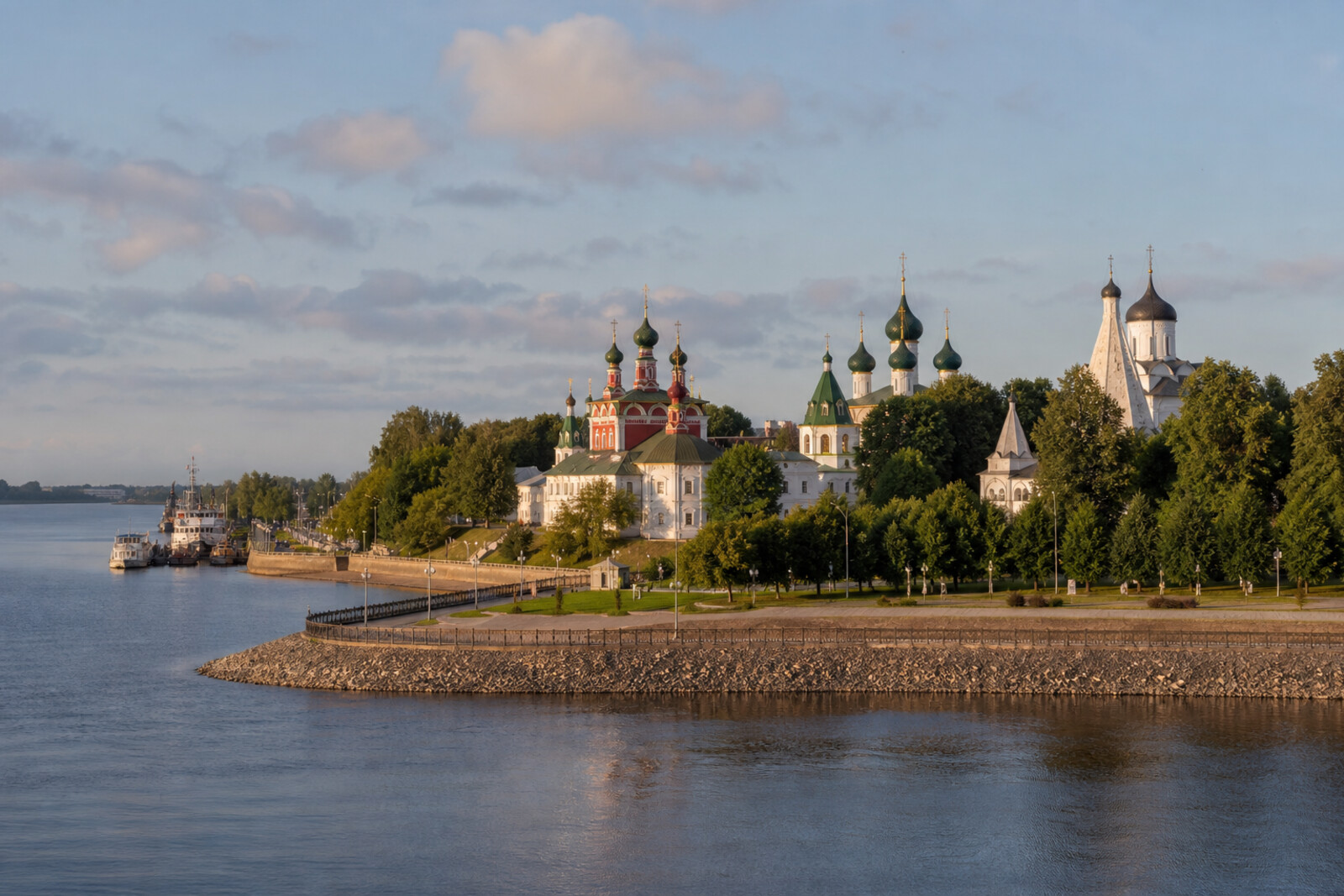
Merchants' Churches and the Volga Riverbank of Yaroslavl
From Spaso-Preobrazhensky Monastery through the posad to Strelka
This entire route and all recorded chapters are free.
Guide On Map on your phone
Open the walk like a regular app
It takes about 10 seconds to install. No app store needed.
The whole path
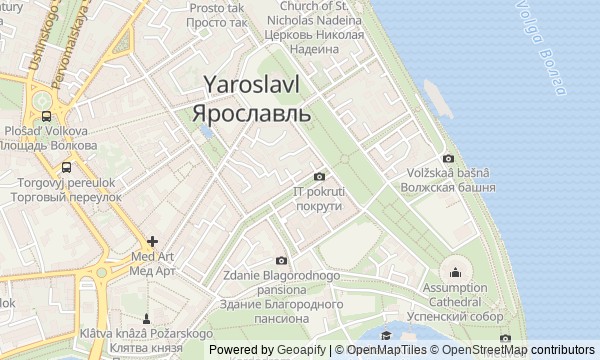
Route map
About the walk
You will begin at Spaso-Preobrazhensky Monastery, cross the former merchants' posad, and reach the Volga River. First, the road gathers four seventeenth-century churches: red brick, tiles, family side chapels, and a lower level beneath a church. Then you will pass through an administrative square into the riverside quarters, turn along the embankment, and finish between the Volga River and Kotorosl River.
What matters here is not style and dates on their own, but the decisions people made. Why would a merchant leave a promise behind if the inscription bearing it disappears? Why would one unsigned piece of paper prove more important when a church needs saving? How did city gates become an inn, then a warehouse?
Documents will remain documents, a museum legend will remain a legend, and later tradition will remain tradition. By the end, you will understand why Yaroslavl's merchants' churches stand in a chain between the monastery, the trading posad, and the Volga Riverbank.
Why this order
Spaso-Preobrazhensky Monastery and the Church of the Epiphany stand on opposite sides of one square: the first crossing immediately sets monastic protection beside a merchants' parish. Next, the Church of the Prophet Elijah shows how a private church became the center of an administrative square. From there, the route reaches the Church of St Nicholas Nadein and then the Church of the Nativity of Christ: two neighboring merchants' stories make it possible to compare a family tomb with the memory of a city shrine at the Volga River edge of the posad. After the northern section, the route turns south along the embankment. Volzhskaya Tower marks the river boundary of these quarters and the point where a defensive wall gave way to a continuous road. From the former gates, the walk continues to Assumption Cathedral and Strelka: first to the princely court, then to the cape where tradition and archaeology tell different stories about the city's beginning.
Those who want to understand seventeenth-century Yaroslavl through the fates of its churches Lovers of urban history, not just architectural styles Those ready to walk from old fortifications to a river cape
Those looking for a short overview of the main postcard sights Those tired by a succession of church monuments Those expecting above all a story of the modern city
Before you go
Choose a dry day: access to paintings in museum churches is restricted in high humidity and rain. Check the visiting conditions for the Church of the Nativity of Christ in advance—its interior is not open all the time, and viewing may require a pre-arranged group tour. Assumption Cathedral is an active church, so services may be taking place inside; dress and behavior should suit the setting. Before you set out, also check the state of the paths at Strelka: improvements and barriers can change the usual route to the lower level.
When to go
Start in the morning or early afternoon, leaving time for museum interiors and an unhurried look at the frescoes. Dry days from Wednesday through Sunday work best for the full version of the route; Monday and Tuesday can noticeably reduce the number of accessible interiors.
Backup plan
If it starts raining, do not try to enter interiors closed to protect their paintings: the route's architectural line reads well from outside. Spend more time in the grounds of the former monastery, Soviet Square, the merchants' facades, and the embankment. The Church of the Nativity of Christ can be viewed for its tiled inscription without going inside. If the path to lower Strelka is closed, end the walk on the upper level by Assumption Cathedral: you can still see the cape, the courses of the two rivers, and the logic of the place that makes this finale work.
Route conditions
Surface. Paved — 2.9 km (data covers 74% of the route)
Stairs. Flights: 1, 44 m in total
Access. Wheelchair — no; stroller — limited (stairs)
Facilities. Toilets — 6
Elevation. Ascent — 25 m; descent — 44 m
OpenStreetMap extract of July 7, 2026: database data, not a check on the ground. Data © OpenStreetMap contributors, ODbL licence
Walk plan
Open in maps ↗- 1
Spaso-Preobrazhensky Monastery
It will show why the monastery protected not only the monastic community, but also the southern approach to the city. - 2
Church of the Epiphany
Connects a merchant’s wealth with a vow, whose material trace became an entire church. - 3
Church of the Prophet Elijah and Soviet Square
It will show how a private church came to stand at the center of an administrative square and survived an attempt to clear the space around it. - 4
Church of St Nicholas Nadein
It will place side by side the first stone parish church of the posad and the reckoning that later caught up with its patron. - 5
Church of the Nativity of Christ
It traces how several weeks with one icon determined the side chapel and frescoes of the future church. - 6
Volzhskaya Tower and the Embankment
Explains the shift from defending the city gates to reinforcing the high riverbank. - 7
Assumption Cathedral
Returns the route to the princely center and to the remains that were taken away and returned to this site. - 8
Strelka
It compares a later legend about the beginning of Yaroslavl with what archaeologists were able to find.
Route features
Everything you need stays in the browser
Progress, saves and your trip plan are stored on this device.
Add Guide On Map to your home screen so the walk opens outside the browser.
How we handle sources, maps and corrections: our editorial standards