 Guide On Map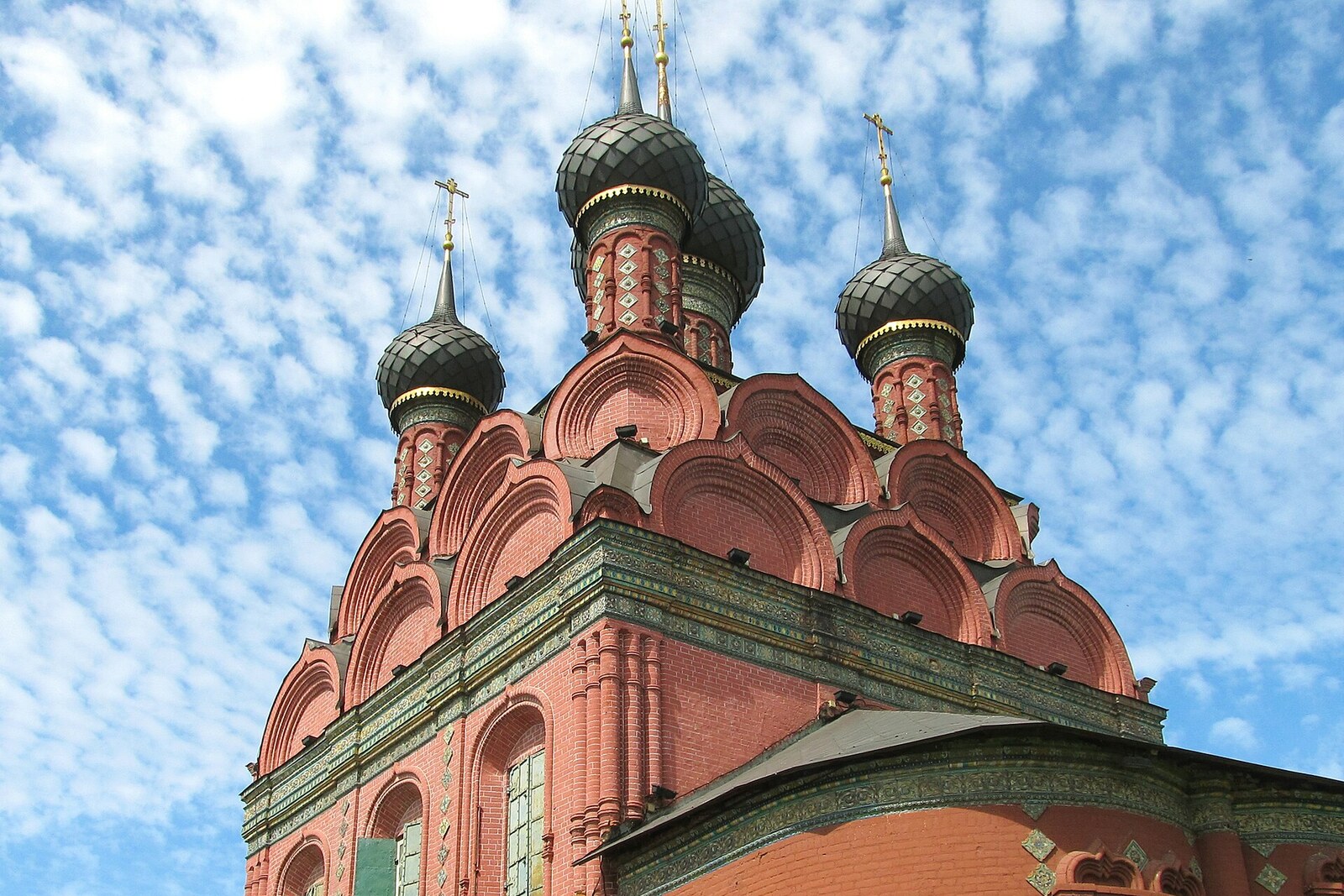
Look around first
What to notice
- Red-brick facades
- Multicolored tiles
- Five domes
- Tall windows
The story of the place
Red brick beneath five domes forms a compact church with tall windows and a single spacious hall without interior pillars. It stands in Epiphany Sloboda, where there was once a wooden church connected with the Spaso Monastery across the square. The new church’s dedication preserved the memory of the earlier one: on the Feast of Epiphany, the city’s religious procession went from here to an ice hole on the Kotorosl River. The multicolored tiles on the facades and the paintings from floor to vault remain from a design that included side chapels and a bell tower from the very beginning.
An inscription once could be read on the altar wall: “I, Alexei Zubchaninov of Yaroslavl, son of Avraam and a member of the Gostinaya Sotnya, built this holy church in fulfillment of my vow.” The inscription disappeared, but researchers preserved its text. What event made the merchant give this vow is unknown. What he paid for it, however, is clear.
Alexei Zubchaninov traded in expensive tanned leather—yuft. He owned twenty-four shops in the Yaroslavl market rows. He belonged to the Gostinaya Sotnya, a privileged merchants’ community second in rank only to the sovereign’s merchants. Behind this title lay large turnovers, distant deals, and a personal duty to answer for assigned state affairs.
The Zubchaninov family lived here for several generations. His father and grandfather were trading people of the Spaso Monastery, standing across the square. They were called zakladchiki: they placed themselves under the monastery’s legal protection and were exempted from part of the urban taxes and duties. This arrangement helped the family rise from trading peasants into the city elite. The Zubchaninovs’ household stood in Epiphany Sloboda, and its old wooden church belonged to the same monastery.
Alexei began fulfilling his vow in sixteen eighty-four. He replaced the wooden parish church familiar to him since childhood with a stone one. Construction lasted nine years. The craftsmen did without interior pillars: the vault rested on the outer walls, leaving worshippers a single spacious room with tall windows. They covered the facades with rows of multicolored tiles and, before the consecration, painted the walls from floor to vault. The merchant’s money was enough for the entire church, two side chapels, and a bell tower.
In Orthodox tradition, Epiphany is the Baptism of Christ in the Jordan River, when the Trinity was revealed to people. The stone church inherited the dedication of its wooden predecessor. There was water nearby: for the Feast of Epiphany, a Jordan was made on the Kotorosl River—an ice hole for the blessing of water. The city’s religious procession went to it, and once a year the Church of the Epiphany became Yaroslavl’s principal church. The church also gave its name to the square.
Alexei Zubchaninov died before seventeen ten. He was buried opposite the church he had built, in the Spaso Monastery. A fragment of a carved white-stone slab with his name has survived there. The original inscription about the merchant’s vow has been lost, but the vow itself stands on the other side of the square—in red brick, with colorful tiles and five domes.
Useful on site
Wed–Sat 10:00–18:00, Sun 09:00–17:00; technical break 12:00–13:00. Mon, Tue, and rainy days—closed. Adult ticket—200 ₽.
Checked: June 24, 2026. Check the official source before visiting.In damp weather, count first of all on the facade: the old wall paintings are protected from excess moisture.