 Guide On Map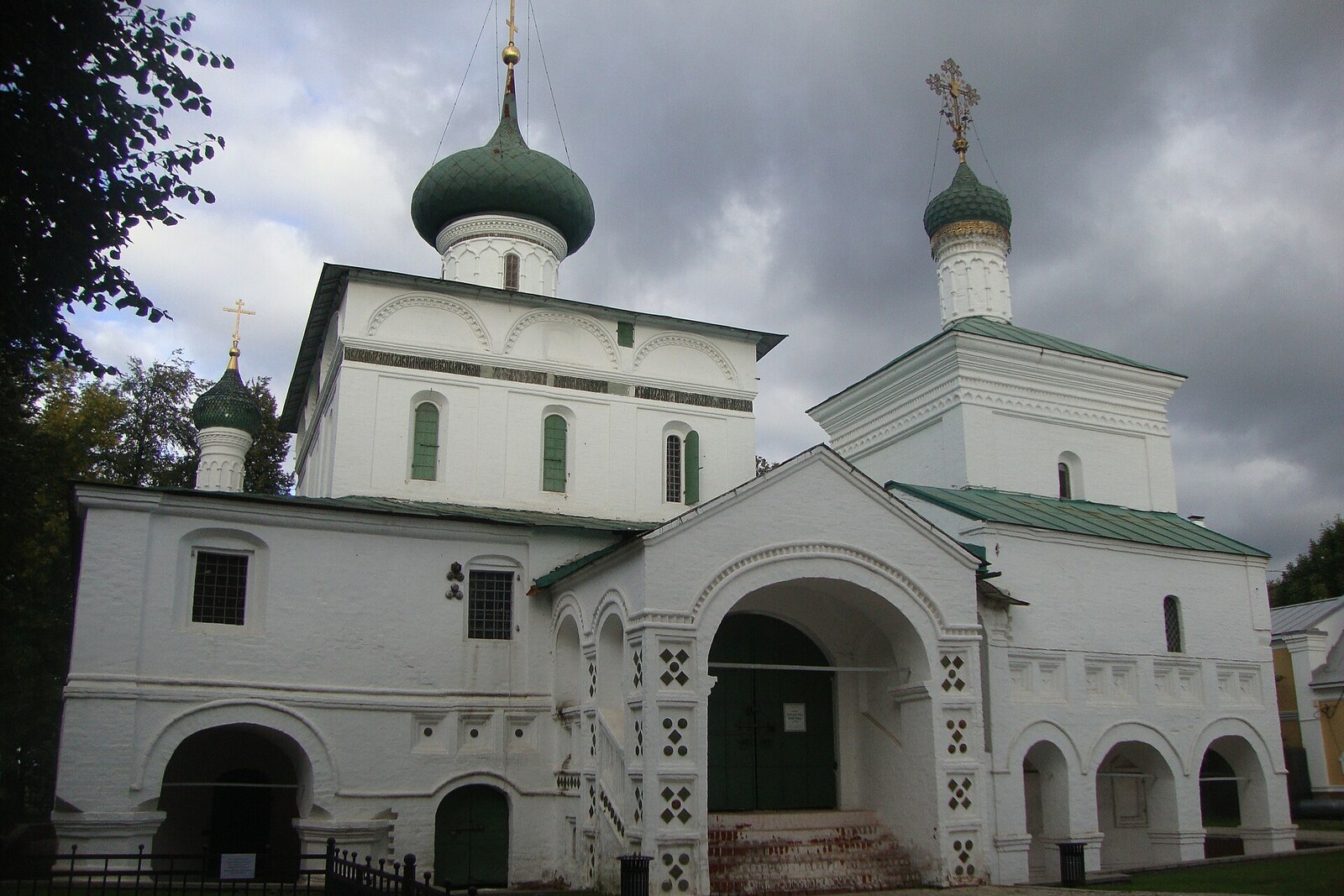
Look around first
What to notice
- The church's stone walls
- The Kazan Side Chapel
- Four fresco scenes on the north wall
The story of the place
The present stone church stands on the site of the wooden one, and its main altar retained the dedication to the Nativity of Christ. The Nazaryev-Guryev family of merchants completed this church thirty-five years later and created a separate Kazan Side Chapel within it. Four fresco scenes remain on the north wall of the stone church.
The history of the Kazan Side Chapel in the present church began with the theft of an icon.
In March 1609, a military detachment devastated the town of Romanov—present-day Tutaev. Lieutenant Yakov Lyubsky, a junior officer in that detachment, took from St Nicholas Church a small venerated copy of the Kazan Icon of the Mother of God, together with its kiot—a cabinet for the image—and church vessels. He brought the loot to Yaroslavl.
Vasily Lytkin, a Yaroslavl merchant and elected local elder, wanted to obtain the icon. The townspeople elected the local elder: Lytkin managed communal affairs and took part in preparing the defense. He made his money through large-scale trade, and later he donated a substantial sum to the militia. Sources differ on an important detail. Church tradition claims that Lyubsky gave the image away without payment; Lytkin himself said that he had redeemed it.
At first, the icon was placed in the Church of the Praise of the Mother of God. On the night of April thirtieth to May first, when a new assault on Yaroslavl began, priests carried it beyond the wooden fortifications of the small fort and placed it here, in the Church of the Nativity of Christ on the Volga River bank. At that time, the church was wooden. Its main altar was dedicated to the Nativity of Christ—the birth of Iisus; the patrons of the later stone church retained that dedication.
The icon remained here while the siege continued. According to church tradition, Deacon Eleazar and the monk Galaktion saw the Mother of God and received an order to build a separate church for the image. This is specifically a tradition, but the townspeople's subsequent actions are known from documents. After the siege was lifted, they chose a site by the earthen rampart, obtained the archbishop's permission, and built the wooden Kazan Church. Beside it, they founded a women's monastery, to which seventy-two nuns from a devastated monastery relocated.
The icon was ceremonially carried from here, from the Church of the Nativity, to that place. The residents of Romanov demanded the image's return, but the church and tsarist court kept it in Yaroslavl. A copy was sent to Romanov. Lytkin achieved what he had sought when he either redeemed the sacred object or accepted it from a soldier: it remained in the city, though now in a new church.
Thirty-five years later, the Nazaryev-Guryev family of merchants completed the present stone church on the site of the wooden one. In memory of the icon's stay, the builders created the Kazan Side Chapel. Four fresco scenes from the history of the image remain on the north wall. The icon itself was stolen in nineteen twenty-five; its later fate is unknown. What remain here are the side chapel and frescoes, created because it spent several weeks in the wooden church on this very site.
Useful on site
Closed from 1 October to 1 May. From 1 May, interior visits are possible only with a guided tour arranged at least 5 days in advance. Exterior viewing is unrestricted.
Checked: June 24, 2026. Check the official source before visiting.The inscription can be clearly viewed from outside; arrange an interior visit separately and well in advance.