 Guide On Map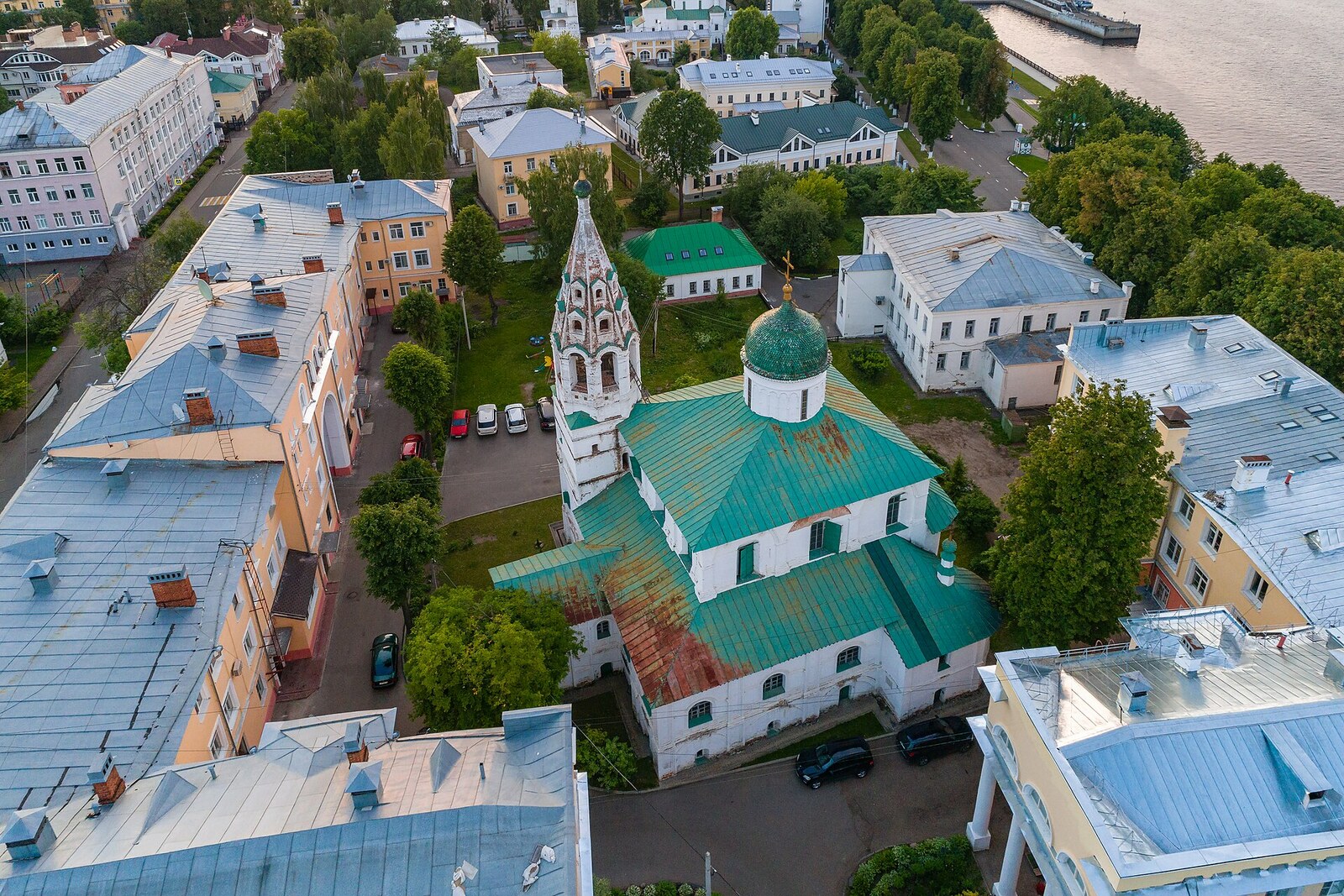
Look around first
What to notice
- White-stone plaques at the western entrance
- High lower level
- Annunciation Side Chapel
The story of the place
Beside the Volga River, a stone church rises above a high lower level, arranged on a cathedral scale. Below, merchants' goods were once stored and family members buried, while the parish gathered above; a separate Annunciation Side Chapel was reserved for the owners. A wooden Church of the Annunciation once stood here, and the side chapel preserves its memory. White-stone plaques recording the church's construction are still visible at the western entrance.
Nadeya in this church's name is a person. This was what people in Yaroslavl called Epifaniy Andreyevich Sveteshnikov (Nadeya), one of the wealthiest Russian merchants of the first half of the seventeenth century. Nicholas is Saint Nicholas, the patron of travelers and merchants. Of Yaroslavl's several churches of Saint Nicholas, only this one retained the name of its commissioner.
Sveteshnikov rose after the Time of Troubles. He supplied the militia with weapons and money, and in sixteen thirteen he received the title of Sovereign's Guest—the highest merchant rank of the time. A Guest was allowed to trade abroad and own land, but was entrusted with state goods, tax collection, and the management of state enterprises. He was liable for any shortfall with his own property.
Sveteshnikov earned money from salt and furs, bought expensive fabrics for the tsar's court, and ran a copper-smelting plant. He had his estate here, by the Volga River. A wooden Church of the Annunciation stood beside it. In its place, the merchant decided to build a large stone church, laid out like a cathedral. Its high lower level served as a storehouse for his goods and as a family burial vault; the parish church stood above, while the small Annunciation Side Chapel was intended for the owner's family.
The white-stone plaques at the western entrance record the course of the work. Construction began on June fifth, sixteen twenty, the building was completed the following year, and it was consecrated on June twenty-third, sixteen twenty-two. This was the first stone parish church of the Yaroslavl posad—the trading and craft quarters beyond the fortified center. Following Sveteshnikov, other merchant families began commissioning stone churches of their own.
The business that enabled Nadeya to pay for such construction later ruined him. In sixteen forty-five, he owed six thousand five hundred seventy rubles for state furs taken for sale. After the previous tsar's death, the new tsar, Alexei Mikhailovich, demanded the money back. Sveteshnikov was summoned to Moscow and subjected to pravezh: every day, the debtor had to report to government offices, where he was beaten on the legs with rods for hours until he himself or his guarantor came up with the required sum.
Nadeya died under pravezh without paying the debt. His son Semyon Sveteshnikov, who was trying to preserve the family's salt works, obtained an installment plan and repaid it. His father's body was brought to Yaroslavl and buried in the southern part of the church's lower level—the very floor where Sveteshnikov's goods had once been kept.
The church is now part of the Yaroslavl Museum-Reserve and opens in summer as a museum exhibition. Above the merchant's grave, the church he built survives, and its name preserves not Epifaniy's baptismal name, but his secular one: Nadeya.
Useful on site
Mon, Tue, Fri–Sun 10:00–18:00; technical break 13:00–14:00. Wed, Thu, and rainy days — closed. Adult ticket — 200 ₽.
Checked: June 24, 2026. Check the official source before visiting.If you cannot get inside, compare its current single-dome silhouette with the account of its original five domes.