 Guide On Map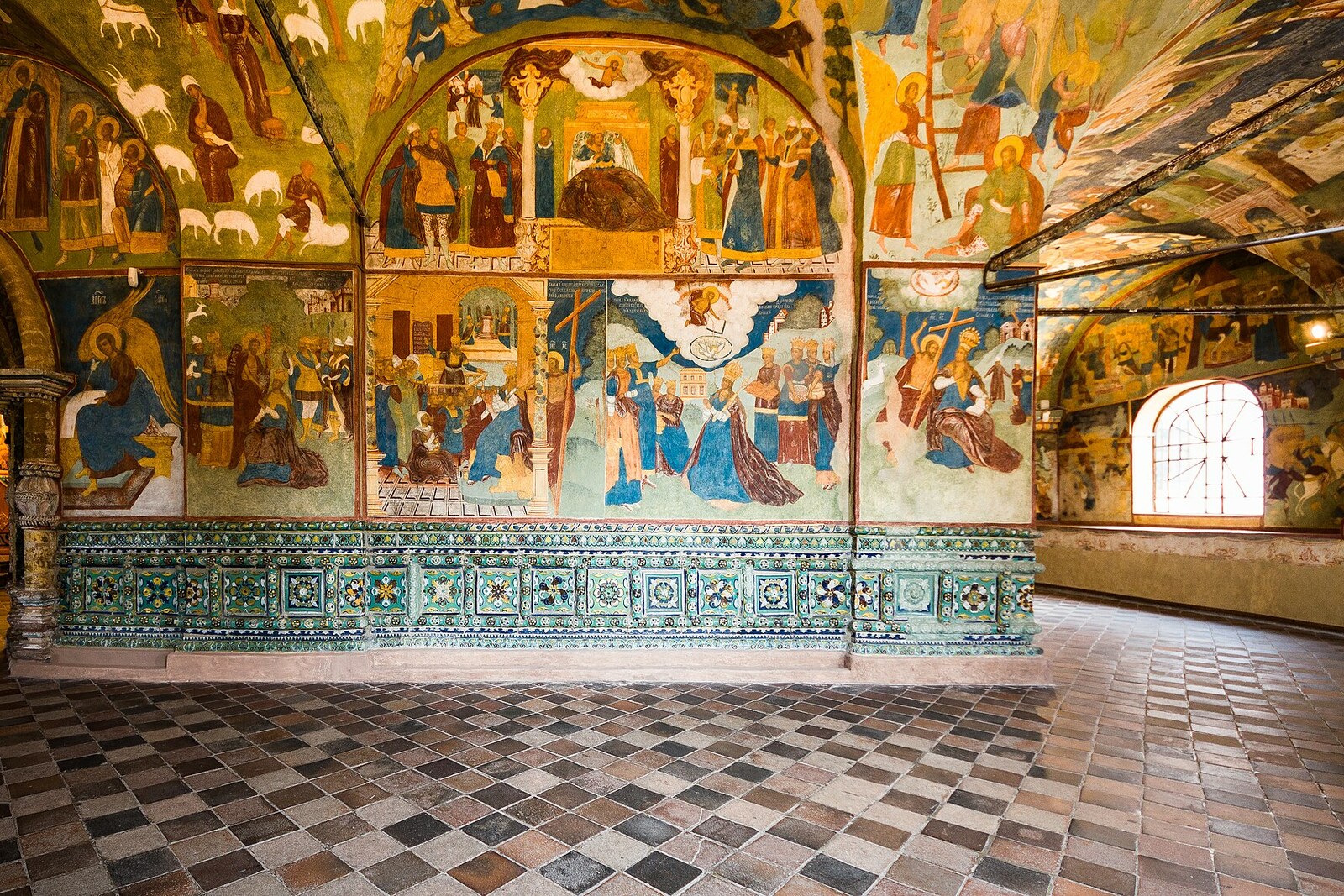
Look around first
What to notice
- Church of the Prophet Elijah
- Belfry
- Soviet Square
- Buildings of provincial institutions
The story of the place
The stone Church of the Prophet Elijah appeared here in the middle of the seventeenth century, when there was still no square around it. It was the compound of the brothers Ioannikiy Skripin and Bonifaty Skripin—wealthy Yaroslavl merchants who traded in furs. In place of two wooden parish churches, they built a family church in three years, from sixteen forty-seven to sixteen fifty, and established a burial vault beside it. Nine members of the Skripin family were buried by these walls.
The church inherited the name of Ilya from one of the earlier wooden churches. Ilya was an Old Testament prophet and an opponent of the priests of Baal; part of the frescoes inside is devoted to his deeds. The second old church was the Church of the Intercession, so the Skripins also preserved its dedication in one of the side chapels.
In seventeen seventy-eight, the makers of Yaroslavl’s new plan chose the Church of the Prophet Elijah as the center of the rebuilt city. The private merchants’ compound was cleared away, Ilyinskaya Square appeared around the church, streets radiating from it were laid out, and buildings for provincial institutions were erected on its sides. This is how the church came to stand exactly in the middle of an administrative space.
In April nineteen eighteen, Ilyinskaya Square was renamed Soviet Square. Here, Soviet meant a specific institution: the executive committee of the Soviet of Workers' and Peasants' Deputies was housed in the former provincial buildings. A few years later, this name nearly decided the church’s fate.
The church was closed in nineteen twenty and transferred to the museum as a monument of architecture and painting. But in late nineteen thirty-one and early nineteen thirty-two, several thousand signatures calling for its demolition were collected at Yaroslavl enterprises. The city council asked for the church to be removed from the museum register: the building occupied the middle of the square, hindered mass demonstrations and parades, and was to be replaced by a monument to those killed in revolutionary battles.
The decision required the signature of the museum’s head. At the time, Nikolai Kuznetsov was acting as director—a museum naturalist, taxidermist, and head of the nature department. He earned money by preparing museum specimens and assembled a natural-history exhibition almost without funds, with his own hands. The frescoes at the Church of the Prophet Elijah were outside his specialty, but Kuznetsov refused to sign authorization for the destruction of a museum building.
While the question of demolition was being decided, he remained inside the church. According to a museum legend, Kuznetsov locked himself in the belfry, expecting that the church would not be blown up with a person inside it. His refusal to sign and his constant presence in the building are documented; the story of the locked belfry was preserved by the museum’s oral history.
At the same time, the restorers Pyotr Baranovsky and Nikolai Pomerantsev sought to preserve the monument through central institutions, while staff of the Yaroslavl Museum-Reserve sent protests. The city council did not receive permission for demolition. Kuznetsov remained a museum employee and by the end of the decade was again heading the nature department.
In nineteen thirty-eight, an Anti-Religious Museum opened in the surviving church. A Foucault pendulum was hung beneath the dome, figures of scientists were placed by the pillars, and the frescoes were covered with display panels. This exhibition lasted three years; traces of its fastenings remain on the paintings. Later, restorers returned the interior to its museum appearance, and in nineteen eighty-nine the main altar was consecrated again. The building is now jointly used by the Yaroslavl Museum-Reserve and the Yaroslavl Eparchy.
The name “Soviet” remained from the institution that needed an unobstructed square for parades. The church still stands in its middle, and the belfry where, according to museum tradition, Nikolai Kuznetsov locked himself up occupies the very point the city council intended to clear.
Useful on site
Daily 09:00–21:00; closed on rainy days. Adult ticket — 250 ₽. Tickets are sold at the church ticket office.
Checked: June 24, 2026. Check the official source before visiting.First, walk around the square and take in its layout; turn to the frescoes only when the museum interior is accessible.