 Guide On Map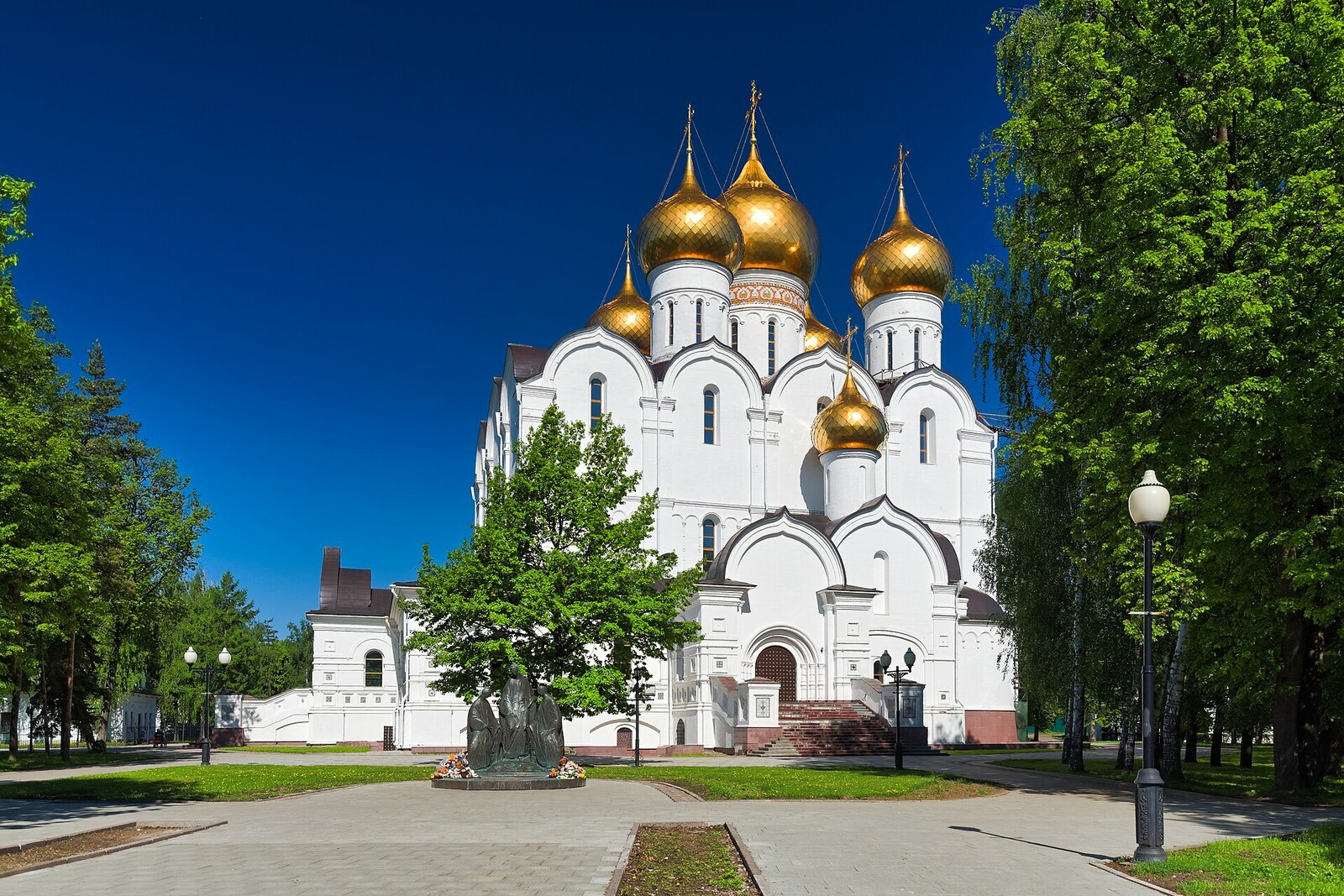
Look around first
What to notice
- The present cathedral building
- The reliquaries of Vasily and Konstantin
- The high bank of the Volga River
The story of the place
The high bank of the Volga River is occupied by the present Assumption Cathedral, built where the princely court of the ancient city fortress stood in the early thirteenth century. Yaroslavl's first stone church was built here then; it became the city's main church and the burial place of its rulers. The modern building stands on the former site, but it is noticeably larger than the old cathedral and does not repeat its appearance. It is now the seat of the Metropolitan of Yaroslavl, and daily services draw parishioners here.
In fifteen oh one, people were clearing away the vaults that had collapsed here after a fire when they discovered two stone tombs beneath the floor. The slabs bore the names of the Yaroslavl princes Vasily and Konstantin Vsevolodovich. These burials turned the city cathedral into a place of pilgrimage and, five centuries later, determined that the remains would be returned to a new building on the same riverbank.
Yaroslavl's first stone church was founded here in twelve fifteen, at the princely court of Rubleny Gorod. It was dedicated to the Dormition of the Virgin Mary—the term the church uses for the death of the Virgin Mary, understood as sleep before her ascent into heaven. The cathedral became the main church of princely Yaroslavl and the burial place of its rulers.
The elder of the brothers found here, Vasily, received Yaroslavl as a child: his father was killed in twelve thirty-eight in a battle with Batu's army. To preserve his inheritance, Vasily had to travel to the khan twice. He sought recognition of his rights to the city, from whose lands and levies he supported his court and retinue. Losing Yaroslavl would have left him without princely income or men. Batu let Vasily return with his father's domain.
At about twenty-two, Vasily died in Vladimir. His body was taken to Yaroslavl; the funeral procession was accompanied by princes, among them Alexander Nevsky. In February twelve fifty, Vasily was buried beneath the floor of this cathedral. About seven years later, his younger brother Konstantin, who succeeded him in Yaroslavl, was laid beside him. The circumstances of Konstantin's death are unknown: a detailed account of his death appeared much later in local tradition.
After the fire of fifteen oh one, the grave slabs made it possible to identify the remains found with the brothers. Researchers warn that the inscriptions were made much later than the burials themselves. A life of the brothers, compiled in the following generation, claimed that the bodies had been found incorrupt and attributed fifteen miraculous healings to the discovery. This is evidence of church tradition, recorded not by eyewitnesses to the fire.
Tikhon, Archbishop of Rostov, who also oversaw Yaroslavl's churches at the time, ordered the remains to be moved temporarily to the nearby wooden Church of Saints Boris and Gleb. Ivan III, Grand Prince of Moscow, sent craftsmen to build a new cathedral. When the work was complete, the reliquaries were placed between the pillars beneath the family icons of the princes. In fifteen oh four, Ivan III came here himself to venerate the brothers. From the beginning of the sixteenth century, Vasily and Konstantin were venerated as saints, and their remains became one of the cathedral's principal shrines.
A new fire in seventeen forty-four damaged the remains; the surviving parts were gathered into separate reliquaries. In nineteen nineteen, the provincial executive committee, a local Soviet governing body, seized them and transferred them to the historical museum. The cathedral itself was blown up by decision of the city council in nineteen thirty-seven.
The present building was constructed in two thousand six to two thousand ten. It does not reproduce the former cathedral: it is a much larger church built on its historic site. It is now the seat of the Metropolitan of Yaroslavl, and services are held here daily. At its consecration in two thousand ten, clergymen returned the reliquaries of Vasily and Konstantin here—to the same princely court from which their bodies had been taken after the fire five hundred nine years earlier.
Useful on site
An active cathedral with daily services. According to the official parish schedule: on weekdays, the Hours are at 08:00, the Liturgy at 08:15, and the evening service at 17:00; on Sundays and the Twelve Great Feasts, the Hours are at 08:40 and the Liturgy at 09:00. No separate museum schedule has been published.
Checked: June 24, 2026. Check the official source before visiting.This is an active cathedral: during services, do not speak loudly while looking around, do not photograph people without permission, and do not block passageways.