 Guide On Map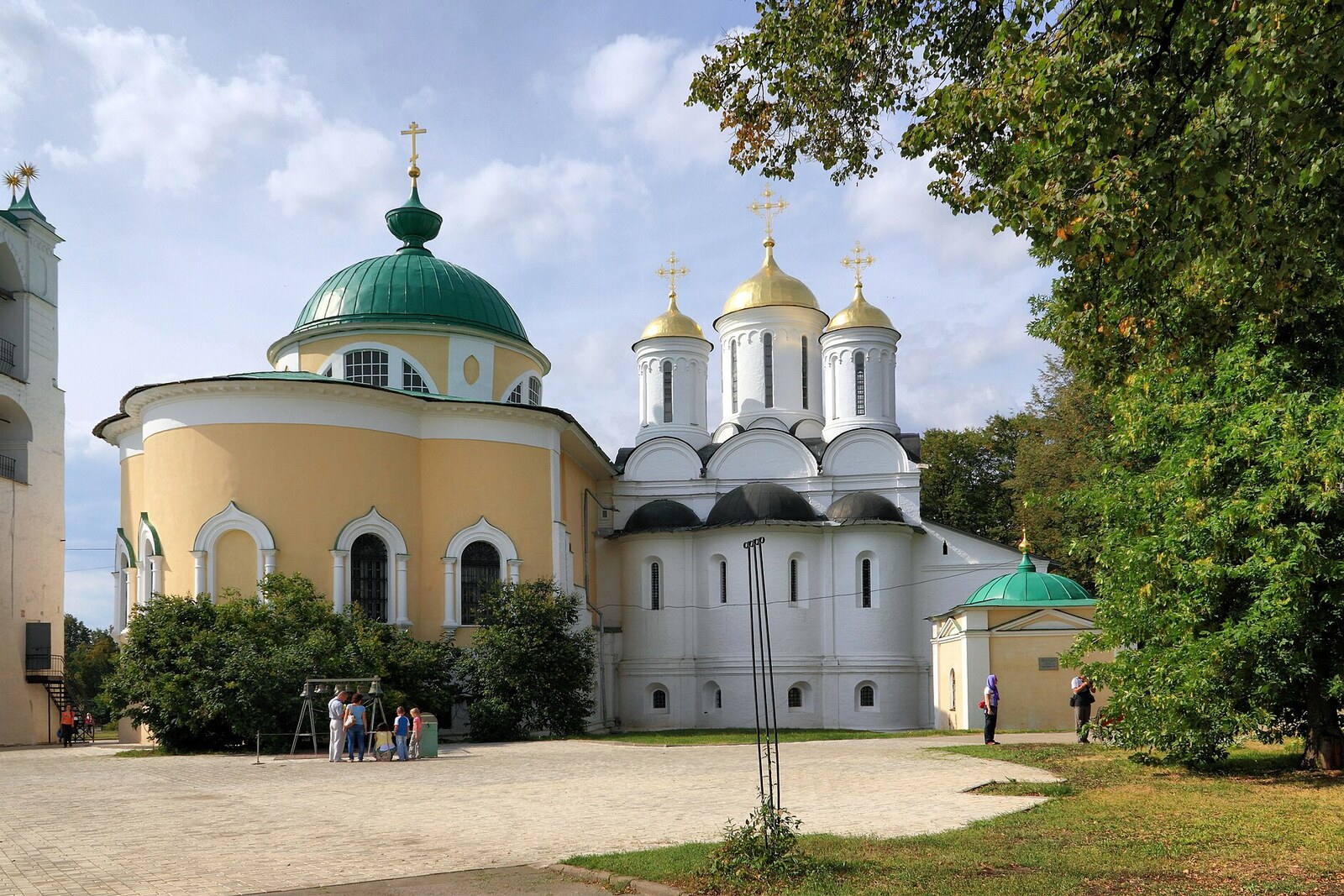
Look around first
What to notice
- Holy Gates
- Stone wall
- Spaso-Preobrazhensky Cathedral
The story of the place
Behind the stone wall stands the former men's Spaso-Preobrazhensky Monastery, now the Yaroslavl Museum-Reserve. Its name comes from the main cathedral, dedicated to the Transfiguration of Christ—the Gospel event in which Christ appeared before his disciples in a changed form. In twelve sixteen, Prince Konstantin Vsevolodovich founded the monastery by a crossing over the Kotorosl River, beyond the city fortifications. The monastery walls protected both the monks and the road by which people approached Yaroslavl from the south.
They fulfilled that purpose in the spring of 1609. Half a year earlier, Yaroslavl had sworn allegiance to False Dmitry II—an impostor seeking the Russian throne. The city's envoys asked his supporters not to loot houses or touch wives and children. The promise quickly lost its value: merchants and craftsmen began to be made to hand over money, food, and horses. An attempt by the townspeople to drive out the garrison was suppressed.
Nikita Vysheslavtsev, the military leader of a militia from northern cities, came to help. He was a son of a boyar—a service landowner who received the right to an estate in return for military campaigns and was required to appear armed. For him, war was a service on which his status and income depended. Vysheslavtsev wanted to restore Yaroslavl to Tsar Vasily Shuysky. His small detachment fought its way toward the city for twenty-two days, defeated the impostor's supporters near the village of Grigoryevskoye, and entered Yaroslavl in early April.
Vysheslavtsev's men and the townspeople immediately began repairing the fortifications. They restored the wooden walls of Zemlyanoy Gorod—the fortified center—and built a new log stockade around the outer quarters. They had less than a month.
At the end of April, detachments led by the Polish commander Iosif Budzilo and the Russian voivode Ivan Naumov, who served the impostor, approached Yaroslavl. They intended to return the city to False Dmitry II. At night, the attackers broke into the outer stockade, killed many residents and fighters, and burned the settlements from the Kotorosl River to the Volga River. The defenders held Zemlyanoy Gorod and Spassky Monastery. The garrison included local noblemen, merchants, craftsmen, and warriors who had come from Vologda, Kostroma, Galich, Rostov Veliky, and other northern cities.
The siege lasted twenty-four days. The attackers repeatedly launched assaults, but the monastery gates were designed for close defense: the narrow passage held people beneath loopholes and openings through which the defenders struck from above. Three other Yaroslavl monasteries were plundered. They could not take Spassky Monastery. On May twenty-third, Budzilo's and Naumov's detachments withdrew. The outer quarters lay burned, but the people inside the two surviving fortifications remained alive. For Vysheslavtsev, the liberation and defense of Yaroslavl became the high point of his military career; soon he returned to Novgorod, continued his service, and later received the rank of Moscow nobleman.
Most of the walls visible today were rebuilt after the siege, in the first half of the seventeenth century. The Holy Gates retained an earlier foundation, built in fifteen sixteen. Today, visitors enter the museum through this passage; in 1609, the besiegers never entered through it.
Useful on site
Grounds: Mon–Thu and Sun 09:00–20:00, Fri–Sat 09:00–21:00; on the first and third Tuesday from May–September, opening is at 12:00. Spaso-Preobrazhensky Cathedral: Mon–Thu and Sun 10:00–20:00, Fri–Sat 10:00–21:00; closed from 1 October to 1 May and on rainy days. Adult ticket for the grounds — 100 ₽, for the cathedral — 250 ₽.
Checked: June 24, 2026. Check the official source before visiting.Treat the grounds as a museum complex; in rain, choose the covered exhibitions instead of the cathedral frescoes.