 Guide On Map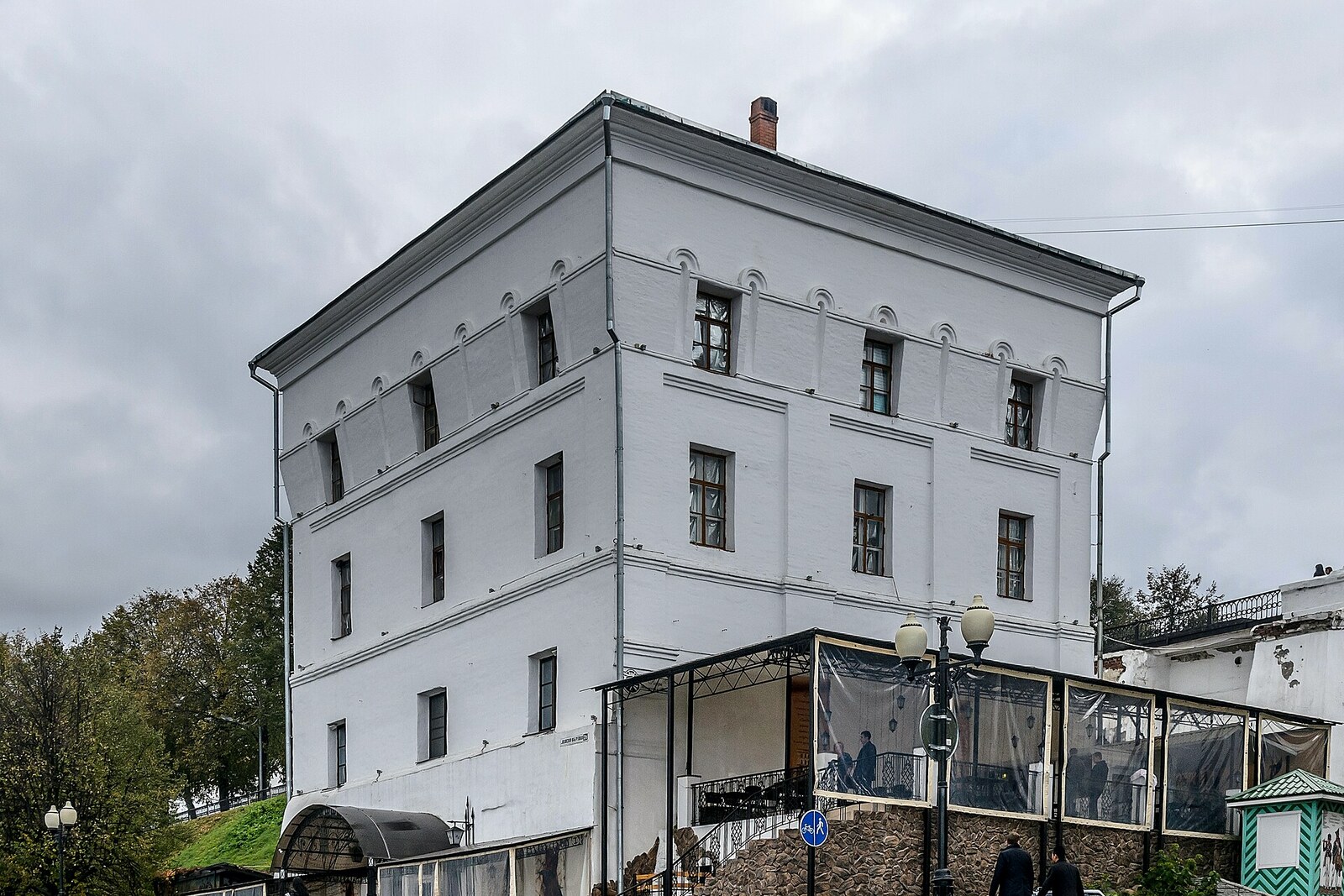
Look around first
What to notice
- The brick-sealed passage
- Enlarged windows
- The added upper floor
- The reinforced embankment slope
The story of the place
Volzhskaya Tower stands at the former mouth of Medveditsky Ravine. The ravine separated the fortress on Strelka, known as Rubleny Gorod, from the commercial Zemlyanoy Gorod. In the seventeenth century, a through passage to the Volga River ran through the tower. At the gate, four guards from Yaroslavl's posad population rotated daily—artisans and merchants required to perform city service. The tower's name was literal: it guarded the road to the wharves and the entrance from the river side.
After the Great Fire of sixteen fifty-eight, the wooden walls and towers burned down. Tsar Alexei Mikhailovich ordered them replaced with stone ones. Over the following decade, Yaroslavl residents built brick gates here with fighting tiers and an outer firing tower—an additional fortification in front of the passage. Of the entire line of defenses along the Volga River, only this tower survives.
By the beginning of the nineteenth century, the city needed protection from the river as well. Spring floodwater and ice eroded the high bank, cut through by ravines, and crept toward the buildings. Yaroslavl Governor Alexander Bezobrazov sought money to reinforce the slope. Before Emperor Alexander I arrived in the summer of eighteen twenty-three, at Bezobrazov's order the descent by Volzhskaya Tower was hastily leveled, covered with turf, fitted with eight lanterns, and the wooden bridge was plastered.
After inspecting the bank, Alexander I approved a large embankment project. Merchants arriving in Yaroslavl with goods along the Volga River were required to bring stone. The earthworks were carried out by prisoners from the Korovnitskie penal companies and the city's forced-labor houses. Every day, one hundred fifty people were brought here. They worked without pay and, as the documents record, even without food from the treasury: filling in ravines, leveling slopes, laying stone and turf, and planting linden trees. In eighteen twenty-four, Bezobrazov prohibited leg irons from being put on those sent to public works. The prisoners remained under guard and unpaid, but now moved along the slopes without iron on their feet.
The main work continued for about ten years. The reinforced slope acquired a level upper path, stone protection at the water, and bridges across the ravine descents. Later builders changed the surface, the railing, and the lower tiers, but by the tower the embankment's original purpose is still visible: to carry an uninterrupted road over the former ravine and hold the high bank in place.
The tower itself also lost its former passage during this time. In eighteen fourteen, city administrators bricked up the gates, dismantled the forward fortification, cut windows, and rented the rooms out as an inn. After a fire in the early eighteen thirties, all that remained of the tower was a burned-out stone shell.
Emperor Nicholas I saw it during a trip through Yaroslavl and, ten months later, ordered the tower adapted for storing weapons and military equipment. The rebuilding was completed in eighteen forty-eight: an upper floor was added, the windows were enlarged, and the former gates were permanently sealed. Military warehouses occupied the building until nineteen seventeen, and ever since the tower has had a second name: Arsenalnaya.
A café now operates again on the first floor. The passage to the Volga River is bricked up, there have been no weapons inside for a long time, and the word “Arsenalnaya” remains from Nicholas I's decision to turn the burned-out inn into a military warehouse.
Useful on site
Exterior viewing without museum hours. The interior spaces are not part of the route and may be occupied by an organization or closed.
Checked: June 24, 2026. Check the official source before visiting.The tower is easiest to take in from outside; if a venue is open inside, treat it as a separate public space.