 Guide On Map
Northern Cannaregio: Ghetto, Crafts, and Confraternities
From Ponte delle Guglie to Church of Madonna dell'Orto
Guide On Map on your phone
Open the walk like a regular app
It takes about 10 seconds to install. No app store needed.
The whole path
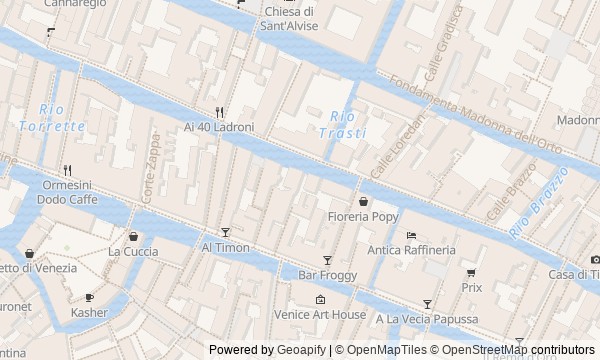
Route map
About the walk
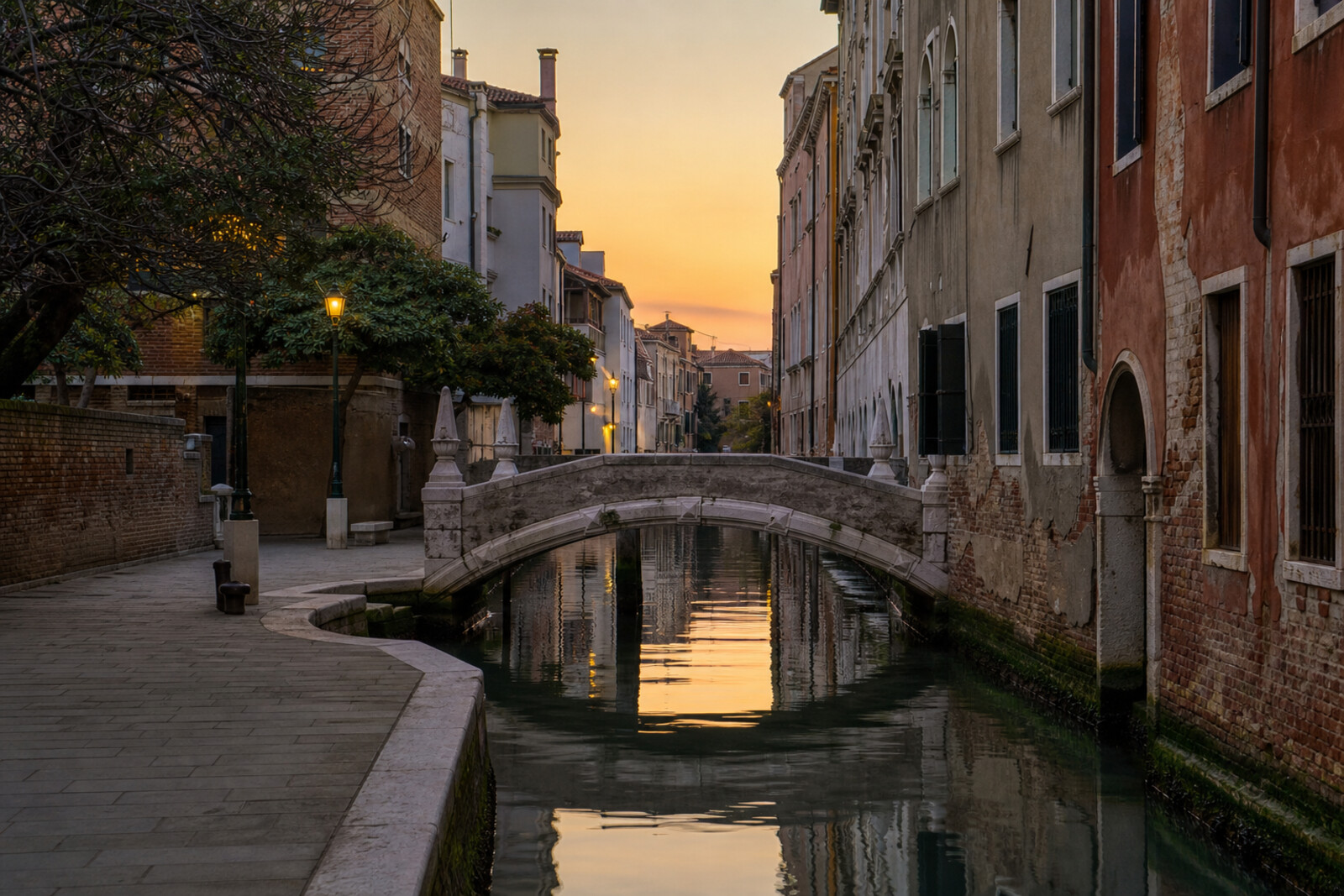
You will begin at the bridge over Cannaregio Canal, then leave the road toward San Marco at once for the northern quarters of the ghetto, long waterfronts, and small campi. The walk moves from tightly packed tall houses to former workshops, then along the water to confraternity buildings, evening tables, stone figures, and a brick church.
Instead of Venice at its ceremonial best, you will find a city of agreements, prohibitions, and well-placed stubbornness. Why are four spires younger than the bridge itself? What made merchants seek the right to live here with their families? How did one osteria change an entire waterfront? And why does a talking statue need an iron nose? The answers emerge where the traces of those decisions can still be seen.
The story rests on documents, human choices, and the things before you. Legend remains legend. By the end, you will be able to read northern Cannaregio through vanished gates, fabric names, an unfinished facade, and a church's garden nickname.
Why this order
The bridge over Cannaregio Canal sets the route's first theme: how the city reconciled a pedestrian way with life on the water. Just beyond it, Campiello delle Scuole shows who secured the right to settle nearby, and on what terms. Only then does the crossing into Ghetto Nuovo reveal the other side of that permission: enforced isolation and entrances locked shut.
Through the former bridge entrance, you reach Fondamenta degli Ormesini. After the enclosed island, another way a community took shape comes into view here: artisans relocating together with their craft. The same line of canal leads to the Misericordia complex, where the route moves from support within a group to a large urban organization of mutual aid.
From the complex, you turn back along the waterfront that took its name. Repeating this stretch shifts the time frame: in place of the confraternity, an evening neighborhood appears, one that began with a single osteria. From its sign, a short passage through Calle Larga and across the bridge leads to Campo dei Mori, where a private nickname became a public voice. The last bridge brings you to Church of Madonna dell'Orto: the route ends at a church whose official name also grew from an everyday story, a rejected commission and a neighboring garden.
Those who want to see Venice beyond its ceremonial center Those interested in urban minorities, crafts, and mutual aid Those who enjoy reading history in bridges, street names, and facade details
Those looking for a route through Venice's main palaces and squares Those seeking a walk focused mainly on painting and church interiors Those who dislike historical stories of prohibitions and persecution
Before you go
Historic synagogues are not visited like freely accessible churches: check separately whether entry and an official tour are available, taking Saturday and Jewish holidays into account. Scuola Grande della Misericordia is used for events, so plan mainly to see it from outside. For the final stop, it is best to confirm access to Church of Madonna dell'Orto in advance: Tintoretto's principal paintings and burial place are inside. Wear shoes suited to stone bridges and uneven waterfronts. Do not block passage in narrow lanes, and allow time for a quiet stop at the memorials in Campo del Ghetto Nuovo.
When to go
Allow about 2–2.5 hours for eight stops and a visit to Church of Madonna dell'Orto. Plan an official synagogue visit separately: it adds roughly an hour and may require adjusting the start of the walk to an available time slot.
Backup plan
Closed interiors do not mean cancelling the walk. At the synagogues, focus on the layout of the square, the height of the houses, and the differences between the parts of the ghetto; at Misericordia, on the scale of the brick mass and its proximity to Abbazia della Misericordia. If you cannot enter Church of Madonna dell'Orto, finish outside the church with the story of its popular name and its connection to the Robusti family. If time is short, do not cut the first three stops or Campo dei Mori: they preserve the progression from a boundary imposed by the authorities to trade, legend, and the personal story of an artist.
Route conditions
Surface. Paved — 1.6 km
Stairs. Flights: 11, 62 m in total
Access. Wheelchair — no; stroller — limited (stairs)
Facilities. Toilets — 1; drinking water — 6
Elevation. Ascent — 10 m; descent — 12 m
OpenStreetMap extract of June 25, 2026: database data, not a check on the ground. Data © OpenStreetMap contributors, ODbL licence
Walk plan
Open in maps ↗- 1
Ponte delle Guglie
You will see how a pedestrian crossing of the canal was combined with passage for boats. - 2
Campiello delle Scuole and Ghetto Vecchio
This stop will show what it cost merchants to secure the right to an open communal life. - 3
Campo del Ghetto Nuovo
Here you will see the boundaries of the forced quarter and traces of their abolition. - 4
Fondamenta degli Ormesini
The waterfront links the exile of artisans to the emergence of a new craft in the city. - 5
Scuola Grande della Misericordia and the abbey
The complex explains how private aid grew into a major confraternity and an enormous construction project. - 6
Fondamenta della Misericordia
This stretch is here to show where the present-day evening life of northern Cannaregio begins. - 7
Campo dei Mori
You will trace how a merchants' legend gave the townspeople an anonymous voice. - 8
Church of Madonna dell'Orto
The ending will reveal how a master's rejected work changed the church's name.
Route features
Everything you need stays in the browser
Progress, saves and your trip plan are stored on this device.
Add Guide On Map to your home screen so the walk opens outside the browser.
How we handle sources, maps and corrections: our editorial standards