 Guide On Map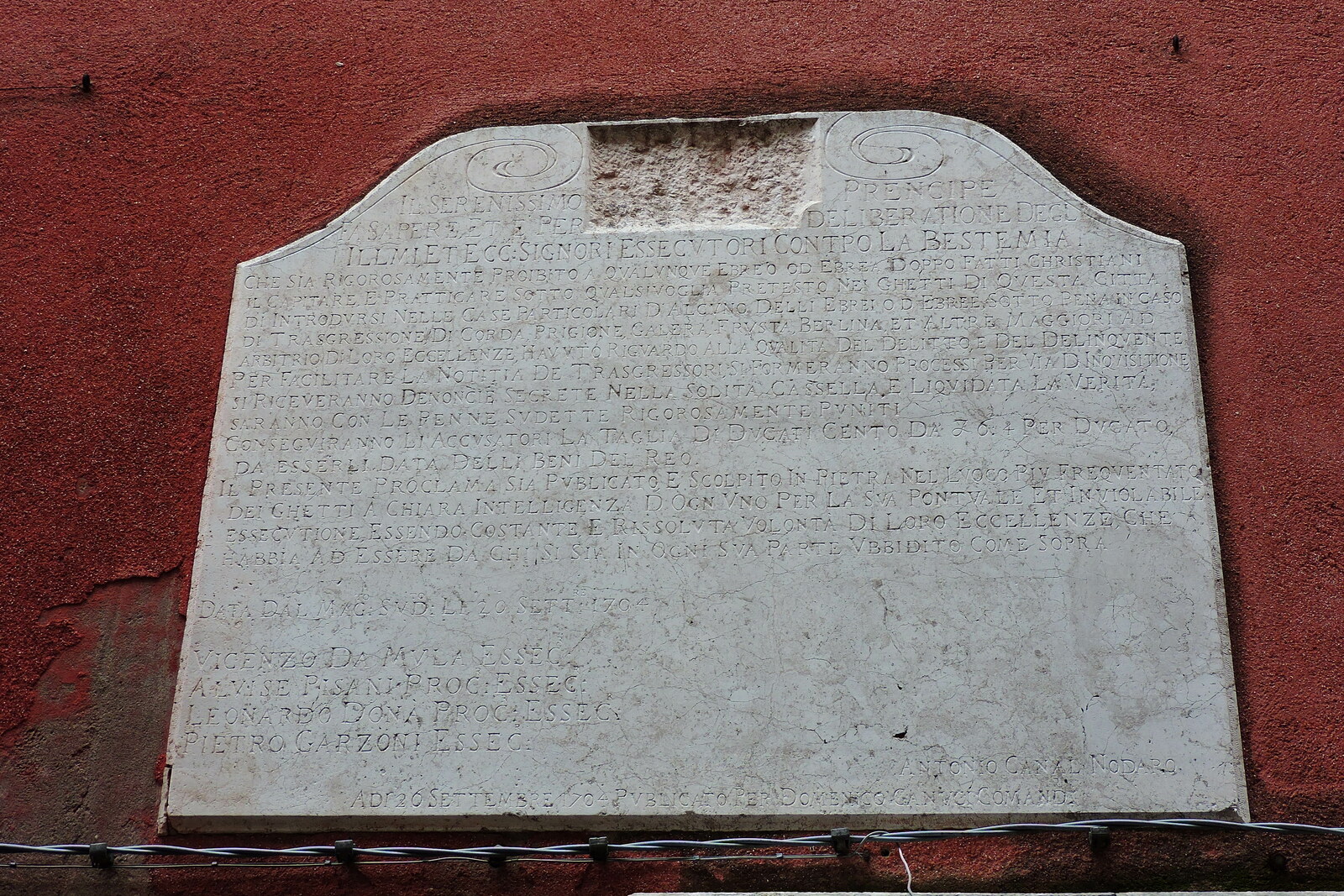
Look around first
What to notice
- The carved wooden portal of the Spanish Synagogue
- Large stained-glass windows
- The facade of the Levantine Synagogue
- The small square between the synagogues
The story of the place
The small square is squeezed between residential buildings, and on either side stand two communal houses, almost dissolved into the ordinary Venetian fabric. Local Jews used the word scola for both the community and the place of prayer, so the square's name preserves two such communities at once: eastern and western merchants. Ghetto Vecchio recalls an even earlier layer, a former foundry site; the very name ghetto is associated with the Venetian word for the casting of metal. The furnaces disappeared, giving way to houses, but the narrow space between the synagogues remained as a trace of those who prayed here.
The carved wooden portal beneath the large stained-glass windows belongs to the Spanish Synagogue. It was founded by people who had once had to secure the right to openly call themselves Jews.
In June fifteen seventy-nine, Daniele Rodriga, a Portuguese Jewish merchant, proposed that the Venetian Senate bring fifty merchant families into the city. Each was prepared to pay one hundred ducats. Rodriga himself dealt in long-distance shipping and established a trade route through Spalato—the name then used for present-day Split. He expected to channel goods from the Ottoman Empire and the Balkans through Venice, and in return he wanted the merchants and their families to receive the right to settle here.
Rodriga represented two groups. Levantines were Jews from the Ottoman Empire, who controlled an important share of eastern trade. Ponentines, or westerners, were people from Spain and Portugal. Among them were people whose families had lived as Christians after expulsions and forced baptisms, while preserving Judaism. Venetian officials feared the reaction of Spain and Rome: allowing such settlers to return to an openly Jewish life would mean recognizing precisely what they were persecuted for elsewhere.
The Senate rejected two of Rodriga's petitions. The third time, he was supported by the Cinque Savi alla Mercanzia—city officials responsible for merchants, ports, and duties. They calculated that the newcomers would bring back to Venice's harbor goods that had been passing it by. On July twenty-seventh, fifteen eighty-nine, the senators approved a ten-year charter. Levantine and Ponentine, that is, western, merchants received the right to live here with their families, immediately engage in overseas trade, and pay duties on terms close to those of Venetian merchants. Within the Republic of Venice, officials were forbidden to persecute them for practicing Judaism.
Nine years later, Rodriga secured a renewal of the charter. He died in sixteen oh three, and the privileges for Jewish merchants that he had secured remained in force until the fall of the Republic of Venice in seventeen ninety-seven. The Ponentines settled in the surrounding houses and prayed in the Spanish Synagogue—the largest in Venice's ghetto. Here they long preserved the Sephardic rite, the Spanish language, and their own prayer books.
Venetian Jews used the word “scola” for both a religious community and its synagogue. Opposite the Spanish Synagogue stands the Levantine Synagogue, which belonged to eastern merchants. These two communal houses gave the small square its plural name, Campiello delle Scuole.
The name Ghetto Vecchio is older than the Jewish quarter. “Vecchio” referred to a former foundry site, and the word “ghetto” is associated with the Venetian name for the casting of metal. This area became a Jewish place in fifteen forty-one, when Levantines were settled here; the Ponentines came later. Nothing remains here of the old smelting furnaces. Houses took their place, and between the two synagogues a square named after the communities of eastern and western merchants has survived.
Useful on site
Open urban space. The synagogues and study rooms are accessible only under the rules of official tours and the community.
Checked: June 28, 2026. Check the official source before visiting.Do not mistake the inconspicuous exterior for free access: the interiors are included in a separate visiting program.