 Guide On Map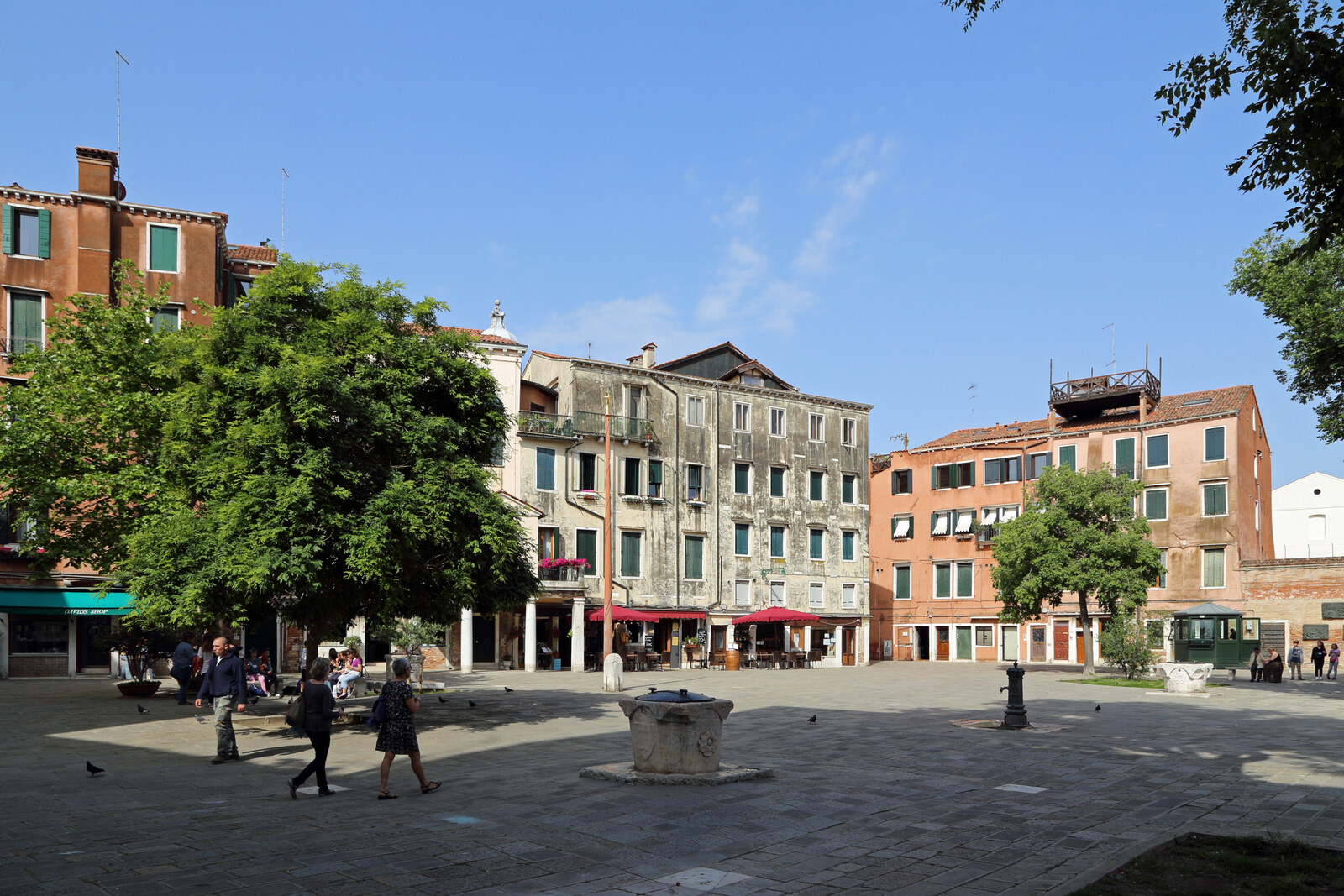
Look around first
What to notice
- Tall multi-storey houses
- Two bridge entrances
- Canals around the edges of the square
- Lower floors of former shops
The story of the place
The square's name appeared before the Jewish quarter: a state foundry where copper was worked stood on the small island, while the old yard for such work lay nearby. From the craft came the word “geto,” which later entered languages far beyond Venice. The unusually tall houses around the edges of the campo reveal the long-standing crowding: homes were divided by additional partitions, and storey was added after storey. Shops and loan offices occupied the lower floors, while families lived above.
In March fifteen sixteen, Zaccaria Dolfin, a senior councillor of the Republic of Venice, proposed that the senators resettle all the city's Jews here. He sought to separate them from Christians and chose a small island which, in his words, was arranged like a fortress: water surrounded it, and two bridges made it possible to lock its entrances.
Jewish families had appeared in Venice with the permission of the republic itself. After the military defeat at Agnadello, the city needed money and admitted refugees from the mainland, requiring the community to pay six and a half thousand ducats each year. Most Jews were not admitted to craft guilds and were not allowed to buy real estate. They earned their living through loans secured by pledges, medical treatment, and trade in second-hand goods. Townspeople needed their services, yet Franciscan preachers demanded that Jews be removed from Christian quarters. Dolfin proposed leaving them in the city but gathering them behind gates.
On March twenty-ninth, the senators accepted his proposal. Representatives of the Jewish community objected unsuccessfully. About seven hundred people were required to move into the houses around this campo and pay the owners one-third more than the previous tenants. Gates were installed by the bridges: they were locked in the evening and unlocked in the morning. Four Christian guards lived at the entrances, others kept watch in boats, and the wages of them all were collected from the residents kept behind the gates. On the canal side, the senators ordered high walls to be built and the water doors of the houses to be bricked up, so that no one could leave by boat at night.
The name “Ghetto Nuovo” existed before this decision. According to the most widely accepted version, “geto” was the name for a place where metal was cast. Until the middle of the fifteenth century, the new state copper smelter stood here; the old one stood on the adjacent plot. Thus, “Nuovo” meant the new foundry site, not a new Jewish quarter. After the decree, the island's name passed to the very practice of forced settlement and spread to other cities and languages.
The number of residents grew, while the boundaries remained unchanged for a long time. Families added storeys to the houses, divided floors with low partitions, placed shops and loan offices below, and synagogues above. This explains the unusual height, for Venice, of the buildings on three sides of the campo.
In July seventeen ninety-seven, after the fall of the republic, fighters of the National Guard and representatives of the Jewish community removed the gates from their hinges, chopped them up, and burned them in the middle of the square. The obligation to live here disappeared. The gates themselves are gone; what remain are the two bridge entrances they locked, the ring of canals, and the cramped multi-storey houses that rose above it.
Useful on site
The square is open as an urban public space. The historic buildings of the ghetto are accessible only on official tours; as of the date checked, tours are listed from Sunday through Thursday and on Friday with a reduced schedule, while Saturday is closed.
Checked: June 28, 2026. Check the official source before visiting.Speak more quietly at the memorials, and do not block the inscriptions. Visits to the synagogues are arranged separately through an official tour.