 Guide On Map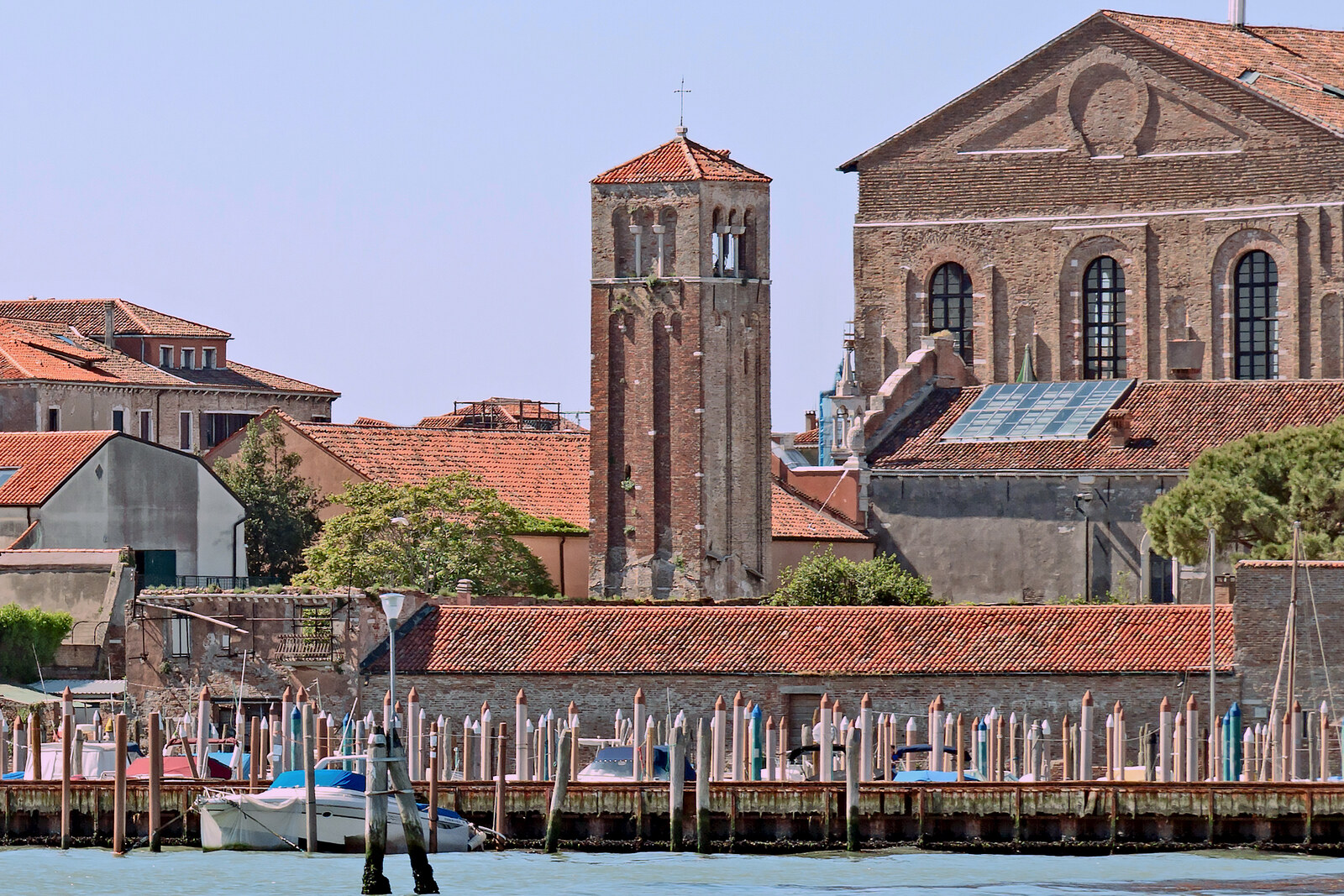
Look around first
What to notice
- The red-brick façade of Scuola Nuova della Misericordia
- The unfinished stone facing
- The abbey church
- The Gothic building of Scuola Vecchia della Misericordia
The story of the place
The red-brick mass by the bridge is Scuola Nuova della Misericordia. The church and the Gothic building on the other side of the canal make up the old complex. The name Abbazia della Misericordia remains from the Augustinian priory that existed at the church. In thirteen oh eight, its prior, Pietro Civran, allowed laypeople to establish here the confraternity of Santa Maria di Valverde, the Mother of Mercy.
The scuola here was a Christian confraternity of mutual aid. It included craftsmen, merchants, prosperous townspeople, and patricians. Members prayed and held processions, but membership also provided very practical protection: a sick person was supported, a deceased person was buried, and an elderly person without family was given shelter. A person could make a living from a craft and lose everything because of illness, misfortune, or city taxes. It was precisely such people whom documents called “the poor from good homes”: they already needed help, but were ashamed to beg for alms in the street.
In thirteen eighty-six, Francesco di Fiorenza, a member of the confraternity, offered its leaders several houses he owned beside the shelter. He gave up the property in order to expand the shelter and house elderly brethren who had fallen into extreme poverty. The leaders obtained permission from the Great Council of Venice and set up a hospital in these houses—at the time, the word meant a charitable home where people in need were given lodging and care.
Ninety years later, it became clear how many people depended on such aid. In the plague year fourteen seventy-eight, the scuola’s board reported in a petition that it had six hundred sixteen ordinary members and another four hundred patricians. More than four hundred brethren were poor and in need: some had been ruined by illness, others by taxes or an accident. Francesco’s houses were already serving a large urban organization, while Scuola Vecchia della Misericordia by the abbey church could not hold its gatherings.
In fourteen ninety-eight, the leaders received permission from the Council of Ten to build a new residence. The poor brethren were moved to other houses in Corte della Misericordia, and the hospital site was set aside for an enormous hall for meetings and worship. Construction required such expense that in fifteen seventy the building still lacked a roof, the floor of the upper hall, and a grand staircase. To complete the work, Misericordia was united with the wealthy confraternity of merchants at the Church of Madonna dell'Orto. The scuola opened under Doge Nicolò da Ponte, but the planned stone facing of the façade was never carried out.
Today, Scuola Nuova della Misericordia hosts exhibitions and other events, while Scuola Vecchia della Misericordia houses the restoration and research workshops of the Gallerie dell'Accademia. The church retains the name of the vanished abbey; across the bridge from it stands the building that took the place of the shelter created thanks to Francesco di Fiorenza’s houses.
Useful on site
There are no regular museum hours: the complex is used as a venue for exhibitions, pavilions, and events. The exterior can be viewed as part of the urban space.
Checked: June 28, 2026. Check the official source before visiting.Plan on a thorough exterior visit. Access inside depends on the events taking place here.