 Guide On Map
Sarnath: The Birth of the Buddhist Community
From the Ashoka Pillar through ancient stupas to Deer Park
Guide On Map on your phone
Open the walk like a regular app
It takes about 10 seconds to install. No app store needed.
The whole path
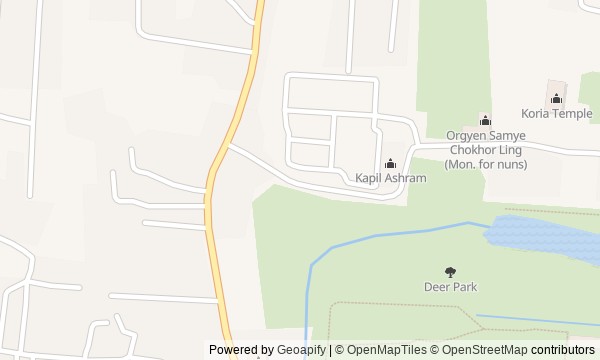
Route map
About the walk
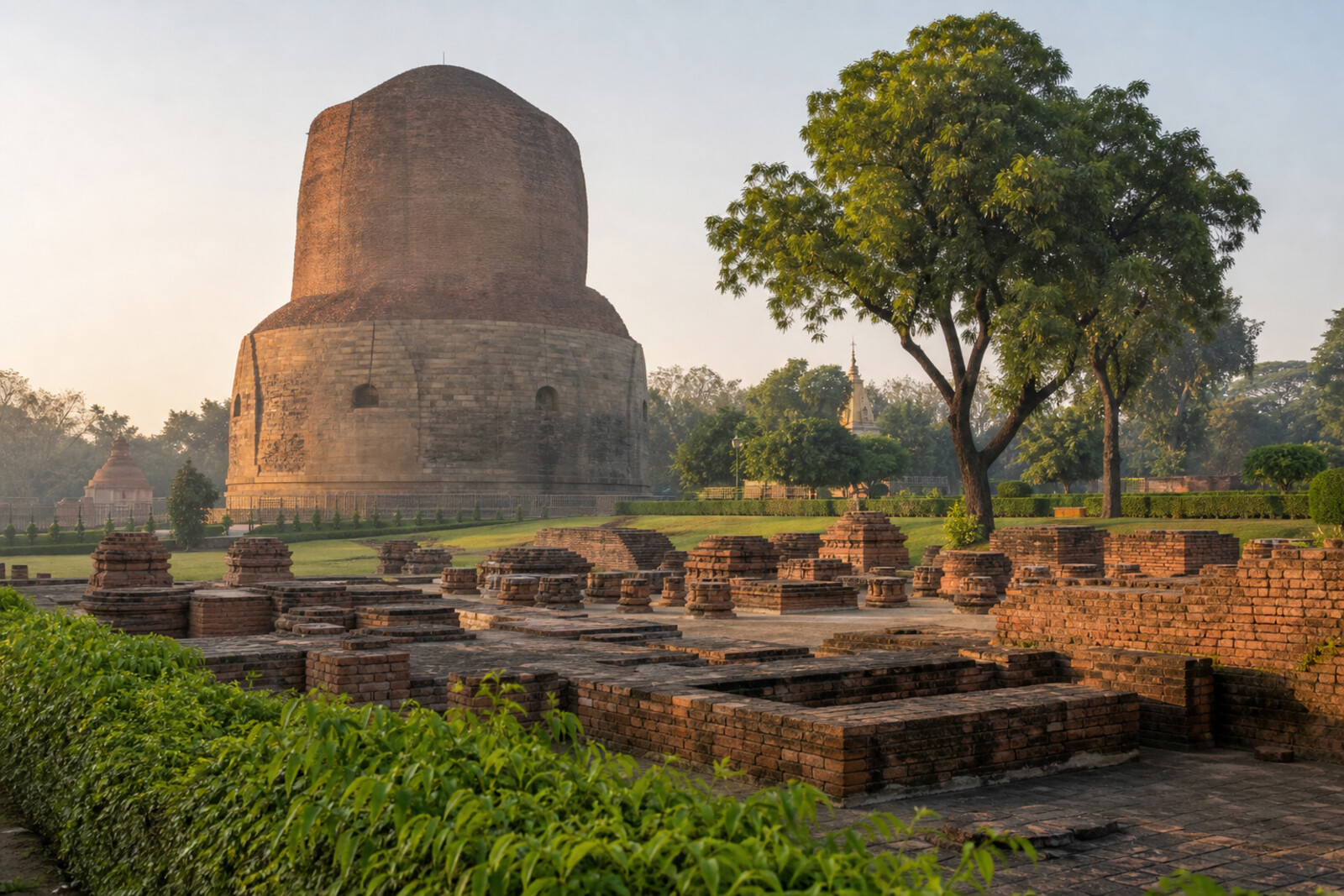
You will begin among the excavated foundations of Sarnath, then head out to the freestanding Chaukhandi Stupa before returning to the archaeological complex. The route runs from a broken pillar and the square base of a vanished temple to two great stupas, a museum, a working vihara, and the fence of Deer Park.
What awaits are not ready-made answers, but exact questions. Why did an imperial order survive at the base of a pillar? What was found inside a stupa instead of what people were looking for? Where did the green casket go? The story will test Buddhist tradition against inscriptions, masonry, and excavation records. It follows not only the ancient monuments, but the fate of the stones that were found.
By the end, you will be able to see five ways Sarnath holds one place in memory: an edict, a stupa, a museum label, temple recitation, and a story about deer.
Why this order
First, the base of the Ashoka Pillar shows a community already formed and in need of rules against division. Then the Chaukhandi Stupa, standing on its own to the south, takes you back to the moment when the community consisted only of its first listeners. From there, the route reenters the main archaeological zone: the ruins of Mulagandhakuti raise the question of how later generations identified the sites of ancient events. Nearby, Dhamekh Stupa continues the archaeological inquiry inside a stupa enlarged many times over, while Dharmarajika Stupa to the west reveals the opposite fate of a monument—dismantling rather than investigation. The museum then gathers objects taken from the ground and shifts the conversation from structures to the fate of finds. Modern Mulagandha Kuti Vihara brings living religious practice back beside the ruins, and neighboring Deer Park closes the route with the tradition from which Buddhism derives the ancient name of the area.
Those making their first trip from Varanasi to Sarnath Those who enjoy archaeology, inscriptions, and the fates of finds Those who want to understand the origins of the sangha without a religious lecture
Those looking for a route through the ghats and old Varanasi Those expecting only active temples, without excavations or a museum Those who do not want to sort through disputed versions and archaeological caveats
Before you go
Before setting out, check current access separately for the archaeological zone, museum, temple, and Deer Park: their visiting rules may differ, and entry to one part does not automatically grant access to the others. Bring water and sun protection—there is little shade between stops, and seeing the ruins takes time outdoors. For the working temple, choose clothing suitable for a religious space and be ready to follow local rules on silence, shoes, and photography. At the museum, ask about restrictions on cameras and belongings as soon as you enter.
When to go
Allow around 2.5 hours for the full route, including the museum, time to read the details, and unhurried stops. If the museum is unavailable, the walk will be noticeably shorter, but the connection between the pillar base and the lion capital will remain only in your imagination.
Backup plan
If the museum is closed or entry is temporarily restricted, visit the open monuments in order and spend more time with the pillar base, the carvings of Dhamekh Stupa, and the traces of destruction at Dharmarajika Stupa; it is better to postpone the museum section than replace it with random reproductions. If you cannot enter the modern vihara, view it from the permitted area and continue to Deer Park without disturbing a service or prayer. If access to individual ruins is limited, stay on the marked paths: the route is designed for reading the form and relative positions of the monuments, not for climbing ancient masonry.
Route conditions
Elevation. Ascent — 3 m; descent — 2 m
OpenStreetMap extract of June 18, 2026: database data, not a check on the ground. Data © OpenStreetMap contributors, ODbL licence
Walk plan
Open in maps ↗- 1
Foundation of the Ashoka Pillar
Here you will learn how imperial power tried to prevent a schism in the monastic community. - 2
Chaukhandi Stupa
This stop brings the route back to the meeting after which five former companions became the Buddha’s first disciples. - 3
The Ruins of Mulagandhakuti
Here, the monument’s familiar name turns out to be an archaeological hypothesis rather than a discovered inscription. - 4
Dhamekh Stupa
The search for a reliquary will lead to discoveries that reveal the rebuilding of the stupa itself. - 5
Dharmarajika Stupa
The low foundation makes it possible to trace the fate of the dismantled stupa and the reliquary found inside it. - 6
Archaeological Museum of Sarnath
Here, finds from the excavations will become a collection, and one capital will become a national symbol. - 7
Mulagandha Kuti Vihara
This active temple will explain how regular Buddhist practice returned to the ancient monuments of Sarnath. - 8
Deer Park
The finale will tell the jataka through which Buddhist tradition explains the name of the ancient Deer Grove.
Route features
Everything you need stays in the browser
Progress, saves and your trip plan are stored on this device.
Add Guide On Map to your home screen so the walk opens outside the browser.
How we handle sources, maps and corrections: our editorial standards