 Guide On Map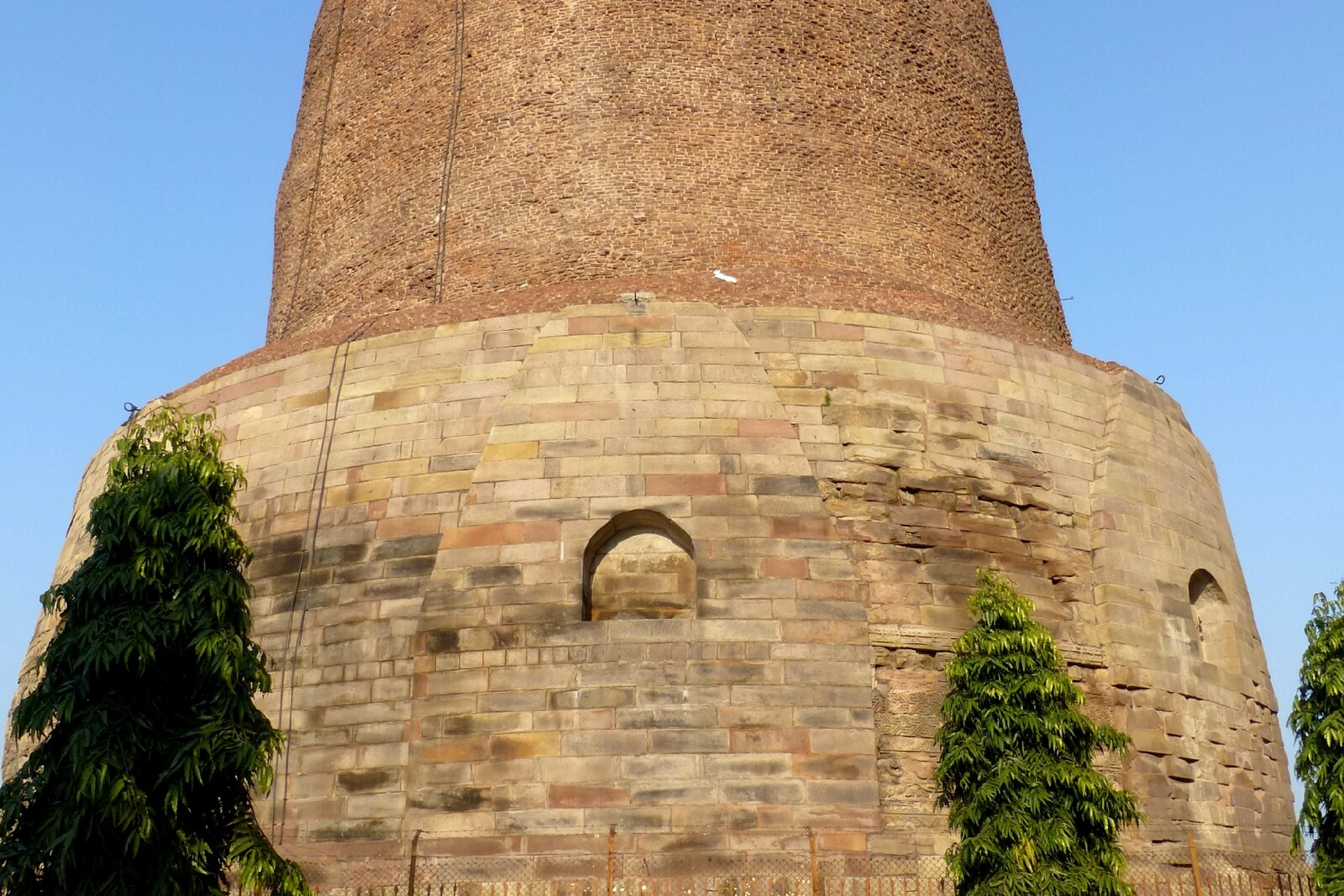
Look around first
What to notice
- Carved stone facing
- Exposed brickwork
- Eight empty niches
- The cylindrical volume of the stupa
The story of the place
Dhamekh Stupa has no hall and no door. The stupa is a solid commemorative mound; it is venerated from outside. Buddhist tradition links this spot to Gautama’s first teaching after his meeting with five ascetics. Archaeology cannot establish the exact place where he sat. The name “Dhamekh” is usually derived from the word “dharmeksha”—meditation on the teaching; another old name, “Stupa of the Wheel of the Dharma,” refers to the same event.
On January eighteenth, eighteen thirty-five, Alexander Cunningham climbed to the top. He was twenty-one years old. He received the pay of a military engineer with the East India Company, while investigating antiquities on his own initiative. Cunningham knew that the remains of the Buddha or his disciples could be entombed inside stupas, and he wanted to find a reliquary.
Workers began driving a vertical shaft from the top through the center of the structure. Cunningham ordered two more horizontal galleries to be laid out. The method was destructive, but for antiquities hunters of that time it was considered usual: the most important thing was to reach the chamber and remove its contents.
Cunningham had to leave for Mirzapur on official duties. The workers continued digging without him. They did not find a reliquary. Later, Cunningham allowed that the object he sought might have been accidentally broken and thrown away during his absence, but there was no evidence for this.
Instead, about three meters below the top, a stone slab from the sixth or seventh century was found. A short Buddhist formula was carved on it: everything that arises has a cause; the Tathagata explained both the cause and cessation. Deeper down, the shaft passed through early brickwork that archaeologists date to the Mauryan period. This means that people expanded the original stupa many times, until it became the present huge cylinder.
For Cunningham, the excavations at Sarnath became his first major fieldwork. By comparing what he found with the accounts of Chinese pilgrims, he helped restore Sarnath’s identity as the place of the Buddha’s first teaching. A quarter of a century later, Cunningham headed the newly established Archaeological Survey of India.
His shafts are not visible from outside. What can be seen are eight empty niches where images of the Buddha once stood, the carved stone casing below, and the exposed mass of brick above. The earliest structure remains inside, at the center of Dhamekh Stupa; beside it lay the slab with words about cause and cessation.
Useful on site
Access to the open-air ASI monument is regulated and depends on the season; check current opening hours/tickets before relying on a fixed 06:00-18:00 interval.
Checked: June 26, 2026. Check the official source before visiting.Walk around the stupa only along the permitted path and keep away from the walls. Camera zoom can help with the details of the lower carving, but check photography rules on site.