 Guide On Map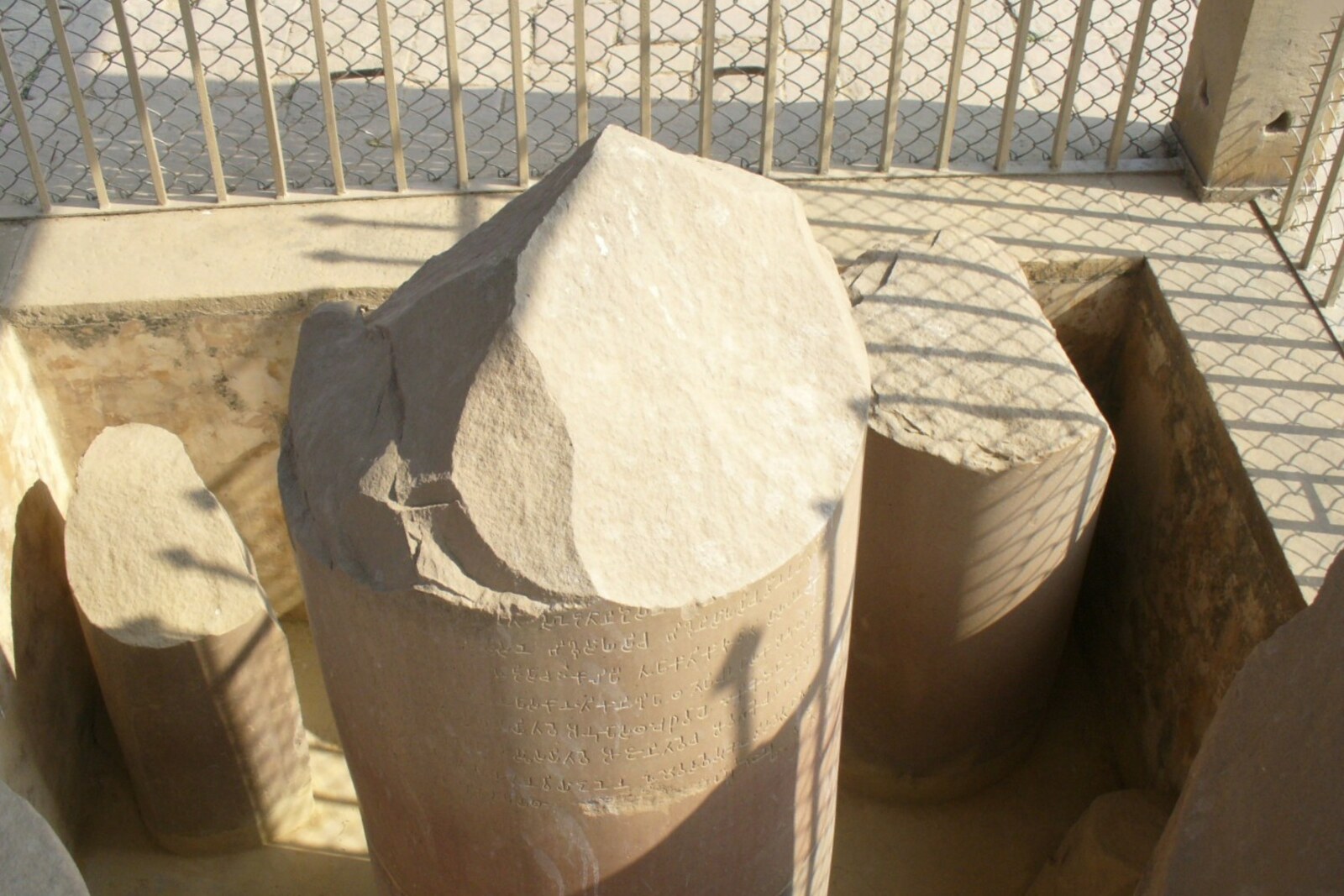
Look around first
What to notice
- The round base of the pillar
- Fragments of polished sandstone
- The fence around the fragments
The story of the place
In the Sarnath monastery complex, this pillar stood among the dwellings of a Buddhist community whose life depended on donations from laypeople. Emperor Ashoka ordered it erected in the third century BCE, when Sarnath was already revered as the site of Buddha's first sermon. The polished fragments behind the fence remain from a structure that later collapsed and was broken up; by whom and when is unknown.
Behind the fence lie fragments of polished sandstone, while a round shaft rises from the ground. This is the lower part of a single stone pillar about as tall as a five-story building. Beneath it, far below the current level of the site, remains a massive slab on which builders set the pillar more than two thousand years ago.
Ashoka, emperor of the Maurya dynasty and patron of Buddhist communities, ordered the pillar erected in the third century BCE. Sarnath was already associated with Buddha's first sermon and the emergence of the sangha—the community of monks and nuns. Under Ashoka, people lived here who had left their families and ordinary livelihoods: laypeople gave them food, the monastery gave them shelter, and their clothing showed that they belonged to the community.
The inscription on the Ashoka Pillar is addressed precisely to these people. Ashoka tries to keep the sangha from splitting. He orders a monk or nun who divides the community to put on white clothing and live outside the monastery. Laypeople wore white; monastic robes were yellow or ochre. Changing clothes meant expulsion from the order. The person lost a monastic home, recognized standing, and their former way of life.
The matter did not end with a threat alone. The emperor instructed the mahamatras—senior officials who supervised religious communities—to keep the text of the order and provide another copy to laypeople. On the days of Uposatha, regular gatherings determined by the lunar calendar, laypeople were to come and acquaint themselves with the edict. Officials were ordered to be present there as well, then to travel through the lands under their authority and ensure compliance. A dispute within the monastery became the concern of the imperial administration and of those on whose donations the monks depended.
The inscription names no one who was expelled and does not prove that the punishment was actually applied in Sarnath. It preserves something else: a ready procedure for a schism, involving clothing, eviction, public reading, and official inspection. It made sense to place such an order precisely among an active community.
Over time, the monastery's residents laid new floors around the Ashoka Pillar, one on top of another. The ground level rose, and the lower lines disappeared beneath it. In the seventh century, the Chinese pilgrim Xuanzang still saw the pillar intact and compared its sheen to jade. Later, the Ashoka Pillar was toppled and broken. Who did this and exactly when is not reliably known.
During the nineteen oh four–nineteen oh five excavation season, the engineer Friedrich Oscar Oertel ordered the later layers near the ancient Main Shrine removed. His team found the lower part of the Ashoka Pillar in its original place, three fragments of the inscription, the lion capital, and pieces of a stone wheel. The capital was moved to the Sarnath Archaeological Museum, while the base was left where Ashoka's builders had set it.
The successive monastery floors hid the emperor's words and thereby protected them. The Ashoka Pillar disappeared almost entirely, but the order about white clothing and eviction survived at its very base.
Useful on site
The open-air ASI ruins have regulated access to the monument; Kashi states that the archaeological ruins are usually accessible from sunrise to sunset / depending on the season, so check the entry rules that same day.
Checked: June 26, 2026. Check the official source before visiting.View the stone from the permitted side, and do not test the famous polish with your hands. The full appearance of the Ashoka Pillar will become clearer after seeing the capital in the museum.