 Guide On Map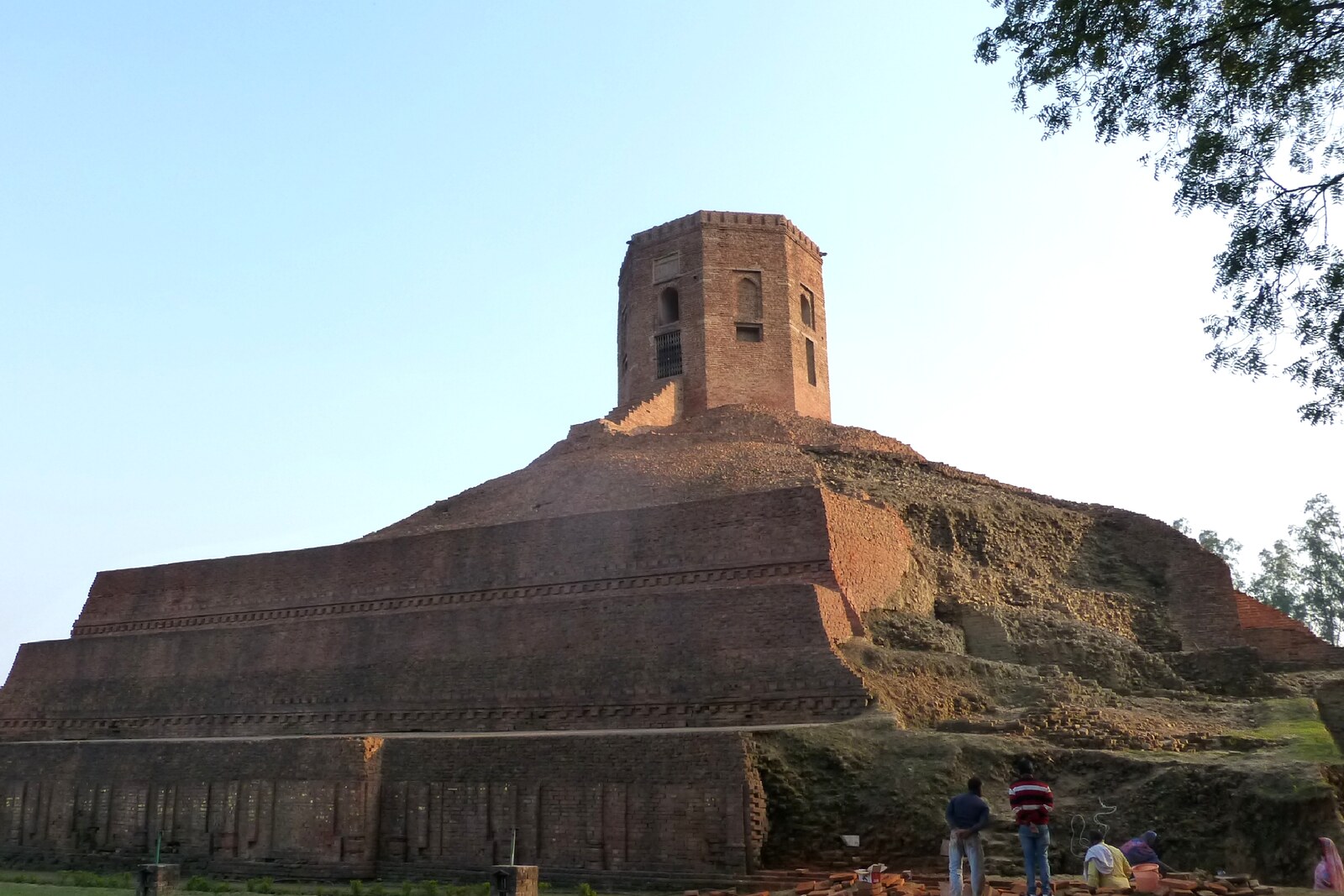
Look around first
What to notice
- Stepped brick base
- Octagonal tower
- Northern entrance
- Arabic inscription
The story of the place
Chaukhandi Stupa marks the place where Gautama came for the people who had left him. After awakening, he sought his first listeners and chose five wandering ascetics. They had once cared for him during his harshest trials and expected him to attain liberation first, then teach them.
In Uruvela, Gautama almost stopped eating. He brought himself to such exhaustion that he would fall when trying to stand, but he understood that pain by itself does not bring one closer to the goal. When he accepted rice and porridge again, the five decided that their companion had given up and returned to a comfortable life. To them, this was a betrayal of their shared path. They had left home, lived on alms, and tied their hope of liberation precisely to renouncing bodily needs. The five left for Isipatana, as this area near Varanasi was then called.
When they saw Gautama again, they agreed not to rise to meet him or take his bowl and robe. They allowed themselves only to prepare a seat: let him sit if he wished. But when he approached, the agreement fell apart. One took the bowl and robe, another spread out the seat, and a third brought water to wash his feet. Even so, they continued to call the newcomer simply Gautama and friend—as an equal who had once failed to endure the trial he had chosen.
Gautama declared that he had attained awakening and could show them the path. The five objected: if the previous painful exercises had brought no result, where had the result come from after his return to food? They repeated this reproach three times. Gautama then asked whether they had ever heard such a declaration from him before. The five acknowledged: no, never. After that, they agreed to listen.
While two or three went out for alms, Gautama taught those who remained. All six ate what they managed to gather. According to an early Buddhist account, the five attained the liberation for which they had left home and became the Buddha’s first disciples, the core of the sangha.
Chaukhandi Stupa marks the place of this meeting in Buddhist tradition; archaeologists cannot prove the exact location of the ancient scene. The brick monument appeared much later—around the fifth or sixth century. It was built as a stepped memorial, not as a tomb. The name “Chaukhandi” is usually linked to the four-armed plan of the base.
The octagonal tower on top dates to the Mughal period. In fifteen eighty-eight, Govardhan, the son of Raja Todar Mal, ordered it built up in memory of the Mughal emperor Humayun’s visit to this place. An Arabic inscription above the northern entrance reports this. Later accounts turned Humayun’s visit into a rescue from pursuers, but the inscription contains no such story.
Nothing remains of the bowl, the seat, or the water for his feet. The stupa stands alone, south of Sarnath’s main ruins: where tradition places the Buddha’s meeting with the people who had intended not to receive him.
Useful on site
Access to the guarded ASI monument may vary depending on the gate or ticket sales; check local opening hours that same day before assuming it is open.
Checked: June 26, 2026. Check the official source before visiting.Step back a few paces to distinguish the two parts of the structure. Do not climb onto the masonry or try to approach closed areas.