 Guide On Map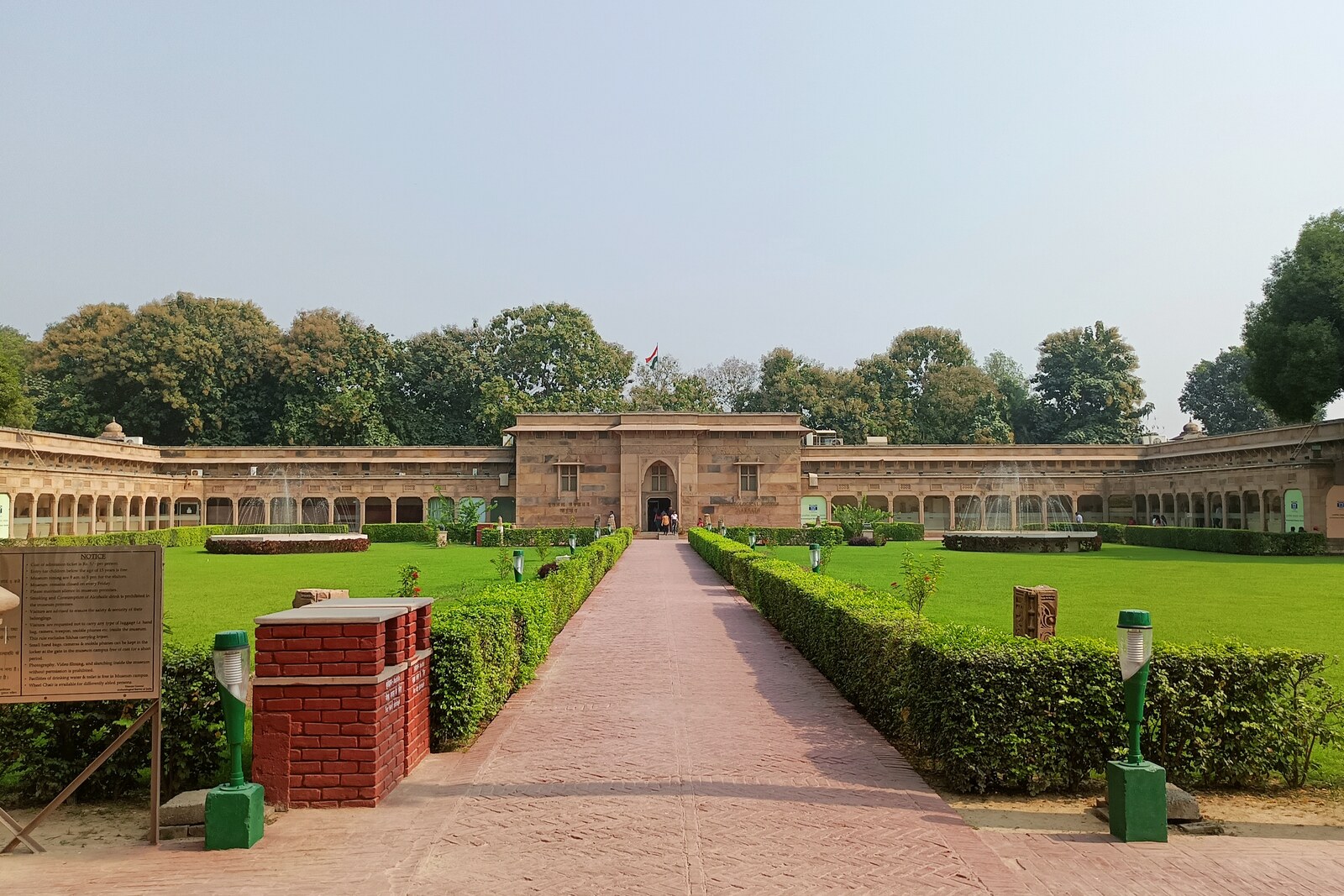
Look around first
What to notice
- Lion capital of the Ashoka Pillar
- Four stone lions
- Stone lotus
- Figures of Buddha
The story of the place
Behind the low walls stands only half of the planned quadrangle: rooms surround an inner courtyard, as in the ancient Buddhist monastery whose plan was used as a model. This is the archaeological museum, built beside the Sarnath excavations so that the objects found there would remain on site. In the main hall, among stone figures, stands the lion capital with four lions and a lotus, preserved intact.
In the mid-nineteenth century, the military engineer Alexander Cunningham excavated Sarnath and selected the best finds for the Asiatic Society in Calcutta—present-day Kolkata. He left more than forty statues at the site: they were to be moved later to suitable storage. A city official, the magistrate of Benares—as Varanasi was then called—Mr. Davidson, needed heavy stone so that the current would not wash away the ground around the bridge piers. On his orders, the statues were loaded onto carts, taken to the Varuna River, and thrown beneath the arches. What Cunningham had managed to send to Calcutta has survived in the museum collection. The sculptures he left behind became bridge reinforcement.
Almost seventy years later, Friedrich Oscar Oertel sought new excavations at Sarnath. Archaeology was not his main post: he received his salary as the Executive Engineer of the Benares district, responsible for public works. Before the excavations began, Oertel built a storage building here for sculptures returned from Queen's College in Benares. He then persuaded John Marshall, head of the Archaeological Survey of India, to grant him one field season.
The excavations of nineteen oh four to nineteen oh five yielded so many statues, inscriptions, and architectural fragments that the old storage building was no longer enough. Among the finds was the lion capital of the Ashoka Pillar. Oertel could not continue the work: the provincial authorities no longer agreed to release their engineer and sent him to construction and restoration work in Agra.
Marshall took over the excavations and secured a government decision to build a permanent museum beside them. The intention was to store, study, and display the objects where archaeologists had found them, rather than send another collection to Calcutta or Lucknow. The government architect based the building on the plan of an ancient Buddhist monastery uncovered in Sarnath: a rectangle with rooms around a courtyard. Only half of the planned quadrangle was built. In nineteen ten, the first full-fledged museum at the excavations of the Archaeological Survey of India opened here.
When the building was almost ready, Marshall left on a long vacation. The task of arranging the finds was entrusted to Daya Ram Sahni, an archaeologist from Marshall's expedition, who was to link each stone with the place and circumstances of its discovery. Sahni spent the following cold season arranging the exhibits and providing them with labels, then compiled a detailed catalog. Thus the discovered figures of Buddha, stupa fragments, inscriptions, and everyday objects became an archaeological collection in which not only the image on the stone matters, but also the point of excavation.
The lion capital was placed in the center of the main hall. On January twenty-sixth, nineteen fifty, independent India adopted its adapted image as the national emblem. On the flat emblem, the fourth lion is hidden behind the other three, and the lower stone lotus has been removed; in Sarnath's main hall, the original capital retains both the fourth lion and the lotus.
Useful on site
ASI Museum: 09:00-17:00, closed on Fridays; on the museum’s planning page, the ticket is currently listed as Rs. 5/free for visitors under 15.
Checked: June 26, 2026. Check the official source before visiting.Consider access to the museum separately from walking around the ruins. At the entrance, check the rules for photography and belongings; the original capital cannot be seen from outside.