 Guide On Map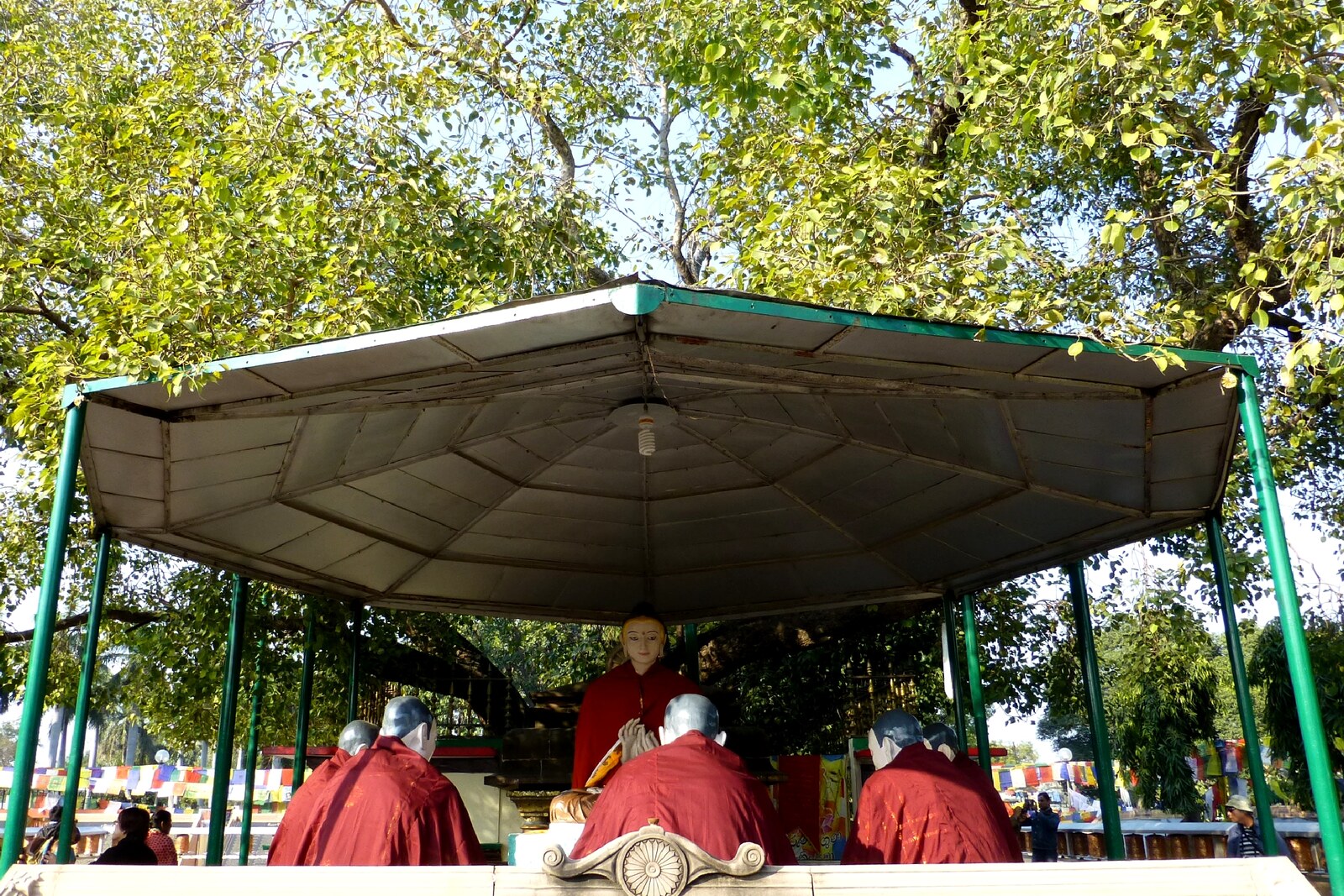
Look around first
What to notice
- Central image of Buddha
- Wall murals
- Image of the five ascetics
- Main temple hall
The story of the place
The name Mulagandha Kuti Vihara refers to the ancient Mulagandhakuti, of which ruins remain in the archaeological zone of Sarnath. The present temple was built by the Mahabodhi Society in the twentieth century, outside the excavated area. In the main hall, the Japanese artist Kosetsu Nosu covered the walls with murals; in one of them, Buddha meets the five ascetics.
Every evening, monks recite the text of Buddha's first sermon here. On the full moon of Kartik, relics are brought out from storage, and the ordinary temple hall becomes a place of public worship. This is because the first Buddhist community arose in Sarnath, and this building was erected specifically to restore regular religious life here.
Mulagandha Kuti Vihara is younger than the surrounding ruins. The new temple was given the name of the ancient Mulagandhakuti, whose remains are in the archaeological zone. Before us stands a separate twentieth-century building, constructed by the Mahabodhi Society.
Its founder, Anagarika Dharmapala, a Ceylonese Buddhist reformer, sought to have monks and pilgrims use the site of the first sermon again. In nineteen hundred, he asked the officials of Benares to transfer to the Mahabodhi Society a plot around the monuments. Dharmapala was refused. He then bought land nearby with his mother's money and put up a small building for the Buddhist community.
Later, the government of British India offered the Society relics of Buddha on condition that a suitable shrine be built for them. Dharmapala wanted to build the temple beside Dhamekh Stupa, but the Archaeological Survey of India did not permit construction so close to a protected monument. When work on the foundation had already begun, it was halted.
The Society's secretary Devapriya Valisingha and Dharmapala's younger brother went to Taxila to see John Marshall, director general of the Archaeological Survey of India. They needed to save both the project and the donations already invested in the foundation. After Marshall intervened, the parties reached an agreement: the Society was given another plot outside the excavated area, reimbursed for the expenses of the earlier work, and granted land for a park beside the temple.
Most of the construction money came from Mary Foster, an American philanthropist from Honolulu who had supported Dharmapala for many years. She died a year before the opening and never saw the completed temple. Dharmapala lived to attend the ceremony on November eleventh, nineteen thirty-one. The Mahabodhi Society then received relics found during excavations in Taxila. Relics from Nagarjunakonda were added later. They are now kept beneath the central image of Buddha.
The interior was completed after the opening. The English Buddhist Brian Broughton donated ten thousand rupees for the murals, and the Japanese artist Kosetsu Nosu was invited to create them. There were objections in India: it was proposed that the commission for Sarnath's new main temple be given to an artist from one of the Indian schools. Rabindranath Tagore supported the choice of Nosu, and from nineteen thirty-two to nineteen thirty-six he covered the walls with scenes from the life of Buddha. Among them is Buddha's arrival before the five ascetics in Sarnath.
After the opening, Dharmapala settled at the temple. He died here in nineteen thirty-three; the place of his cremation is marked on the hill between this vihara and the ancient monuments. The evening recitation of the first sermon takes place beneath a mural in which the five ascetics meet the man whose words they finally agreed to listen to.
Useful on site
Religious site with regulated access; widely used reference sources list 04:30-11:30 and 13:30-17:30 daily, but check locally, since the official MBSI center page does not provide a simple timetable of opening hours.
Checked: June 26, 2026. Check the official source before visiting.This is an active temple, so speak quietly and do not disturb prayer or meditation. Whether you can view the murals and take photographs inside depends on the rules and on ceremonies taking place.