 Guide On Map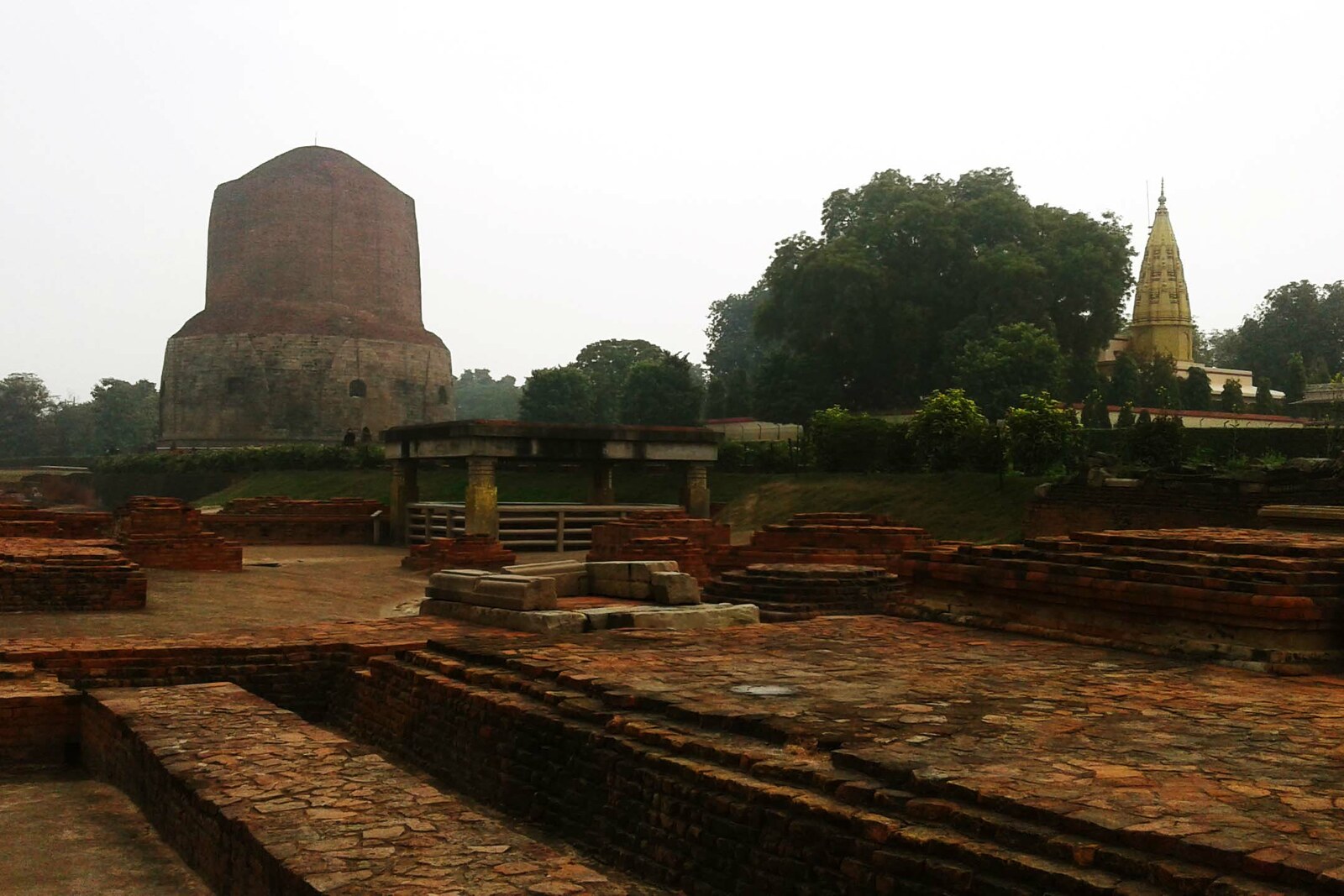
Look around first
What to notice
- Square foundation of the temple
- Thick brick walls
- Eastern entrance
- Foundations of side shrines
The story of the place
Thick brick walls outline the square of a former temple, and the eastern passage once led into its main space. Separate shrines adjoined this foundation on three sides; such heavy masonry was designed to support a tall building above it. Architectural details date the foundation to the Gupta period, between the fourth and sixth centuries. Of the whole temple, only the walls, the entrance, and the low outlines of the side rooms remain.
From December nineteen oh four to April nineteen oh five, Friedrich Oscar Oertel brought about two hundred excavators here. He did not make his living from archaeology: Oertel received a salary as an engineer in the Public Works Department, building roads and government buildings. The excavation was his own project. He obtained permission from John Marshall, head of the Archaeological Survey of India, secured government funding, and began clearing a site whose brick and stone had until recently been carted away for bridges, the railway, and new houses.
The workers uncovered the square foundation of a large temple, with its entrance facing east. Each side measured about twenty and a half meters, and the walls were as much as three meters thick. Separate shrines adjoined the temple on the north, west, and south. Such masonry could support a very tall structure above it. Oertel called the structure the Main Shrine. He found no inscriptions on these walls bearing its ancient name.
After Oertel’s season ended, he was transferred to Agra, and Marshall continued the excavation. In the spring of nineteen oh seven, he investigated the ground west of the shrine and recovered a seal bearing the name of Kirtti, a monk. The inscription said that Kirtti had donated a lamp to Mulagandhakuti—“the original fragrant cell.” Gandhakuti was the name for a special room intended for the Buddha or his temple image. Kirtti’s small gift preserved the building’s name, but the seal lay off to one side and did not indicate that it referred specifically to these walls.
Xuanzang, a Chinese monk who traveled to India for Buddhist manuscripts and teachings, left the second clue. Around six thirty-five, he found one thousand five hundred monks in Sarnath and described an enormous temple on a stone foundation. The brick walls contained niches with gilded images, and inside sat a Buddha with his hands held in the gesture of preaching. Xuanzang estimated the temple’s height at more than sixty meters.
He recorded his recollections only after returning to China. They contained no plan of Sarnath. But archaeologists matched his tall temple with the largest square foundation among the excavations, added the seal found by Marshall, and gave the Main Shrine the name Mulagandhakuti.
The Indian archaeologist Daya Ram Sahni, who compiled the first detailed guide to the excavations, went further: he linked these walls to the place where the Buddha meditated, and then to the place of the first sermon. The excavations did not prove this. Architectural details allow the foundation to be dated to the Gupta period, that is, the fourth through sixth centuries, many centuries after the Buddha’s lifetime.
Nothing remains of the tall tower or the gilded figures from the temple Xuanzang saw. What survives are the thick walls, the eastern entrance, the foundations of three side shrines, and a plaque bearing the name that archaeologists attached to these bricks on the basis of Kirtti’s seal and the recollections of the Chinese pilgrim. It is impossible to determine the exact place among the ruins where the Buddha himself sat.
Useful on site
The open-air ASI ruins have regulated access to the monument; ask on site that day about gate-entry and ticket rules.
Checked: June 26, 2026. Check the official source before visiting.View the ruins from the paths and imagine the walls continuing upward: the present level shows only the foundation of the former building. Do not climb onto the masonry for a better angle.