 Guide On Map
Knights' Valletta: from City Gate (Bieb il-Belt) to Fort St Elmo
From the landward entrance through the Barrakkas and palaces to the fort between two harbours
Guide On Map on your phone
Open the walk like a regular app
It takes about 10 seconds to install. No app store needed.
The whole path
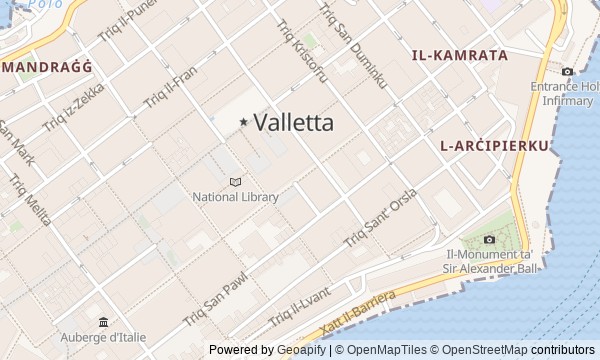
Route map
About the walk
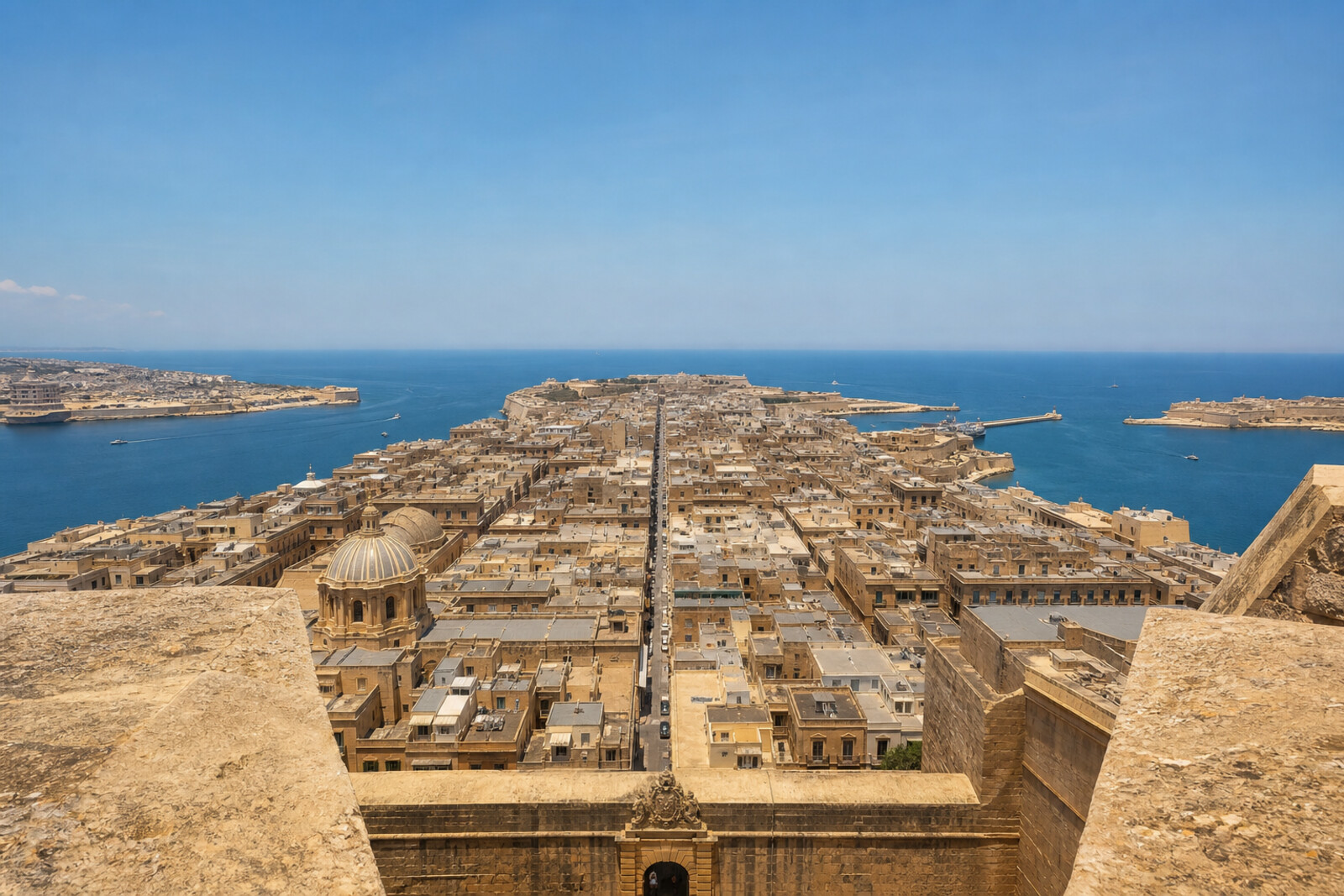
You will enter Valletta through the open passage of City Gate (Bieb il-Belt) and climb toward the auberge of a knightly langue. Then you will step onto a bastion above Grand Harbour, return to the city's grid for St John's Co-Cathedral and follow Republic Street to the palace. From there, the road leads back to the fortifications: through Lower Barrakka Gardens to Fort St Elmo at the tip of the peninsula.
This is not a survey of Baroque architecture, nor a roll call of knights' titles. You will read the city as a fortress, a residence and a place where decisions could rest on a single guard, a bell signal or a letter. Why could the main entrance not be opened one day? Why did ships need a blank shot? How did an artist's only signature end up before the people judging its author? The answers will emerge from documents, objects and human choices, without the Order's ceremonial legend.
By the end, Upper Barrakka Gardens, Lower Barrakka Gardens, Republic Street and the walls of Fort St Elmo will let you explain how defense shaped Valletta's plan and the fate of its main buildings.
Why this order
City Gate (Bieb il-Belt) begins the route at the only landward entrance. The climb to Auberge de Castille, Léon and Portugal immediately shows who was responsible for this front and why the knights lived beside the fortifications. From the auberge to Upper Barrakka Gardens, you will follow the same high ground and see how a bastion and battery took the place of the Ottoman guns after the siege. The route then enters the Order's church: after the shared military history comes the personal cost of knightly discipline. From St John's Co-Cathedral, you will step onto Republic Street and shift your view from the Order's internal court to the townspeople's demands. Along the same main street, you will reach Grand Master's Palace, where governing the island depended on guards, servants and access to weapons. From the palace, the descent to Lower Barrakka Gardens shifts attention from power to public memory. The final walk along the peninsula's edge leads to Fort St Elmo: its defense gave the defenders time to hold the fortifications on the opposite shore, and after the siege Valletta was built on the peninsula you have just crossed.
Those who want to understand Valletta's plan through its fortifications Lovers of dense history without the ceremonial legend Those willing to enter the co-cathedral, palace and National War Museum
Those looking for a short walk only through the streets Those mainly seeking cafés and views without a historical story Those who find sieges, executions and political violence difficult to hear about
Before you go
Decide in advance which interiors you truly want to visit: the co-cathedral, palace and Fort St Elmo take noticeably more time than viewing their facades, and access to particular rooms can change. Before you set out, check the current visiting rules for these three sites and whether the ceremony at Saluting Battery is taking place. Bring water, sun protection and comfortable shoes: the open bastions offer almost no shade, and the route includes slopes, steps and uneven paving. Paid admission is not essential at every stop to understand the route, but without the co-cathedral interior you will not see Michelangelo Merisi da Caravaggio's main Maltese work.
When to go
Start in the first half of the day if you want to combine the walk with interiors. Reach Upper Barrakka Gardens without a long pause, then save most of your time for the co-cathedral, palace and fort. After Republic Street, the pace naturally slows: ahead are two gardens, sea views and the large museum complex at Fort St Elmo.
Backup plan
If the co-cathedral is closed, take in its austere exterior and keep Michelangelo Merisi da Caravaggio's story as a contrast between the restrained facade and the inaccessible Oratory of St John's Co-Cathedral. You can read Grand Master's Palace from St George's Square as a place of continuous power, even without going inside. If Saluting Battery is unavailable, stay on the upper terrace: the guns' position and their sector of Grand Harbour are visible from above. If Lower Barrakka Gardens is closed, replace it with a view of the memorial and harbour from the nearest accessible point, without trying to pass through locked gates. If you do not have the energy for the full National War Museum at Fort St Elmo, still walk to the outer walls and the peninsula's tip: this is where the harbour's geography and the route's central story meet.
Route conditions
Surface. Paved — 2.3 km (data covers 95% of the route)
Stairs. Flights: 1, 23 m in total
Access. Wheelchair — no; stroller — limited (stairs)
Facilities. Toilets — 7; drinking water — 1
Elevation. Ascent — 12 m; descent — 55 m
OpenStreetMap extract of July 4, 2026: database data, not a check on the ground. Data © OpenStreetMap contributors, ODbL licence
Walk plan
Open in maps ↗- 1
City Gate (Bieb il-Belt)
Here you will understand why the main land entrance became an opportunity for the besieged and a trap for the conspirators. - 2
Auberge de Castille, Léon and Portugal
You will see how the Order's structure determined living quarters, offices, and the location of a residence on the fortified front. - 3
Upper Barrakka Gardens and the Saluting Battery
You will connect the terrain of the Great Siege of Malta with a battery that later served a peaceful port. - 4
St John's Co-Cathedral
You will see the limits of knightly patronage: the title did not save the artist from the judgment of his own brothers. - 5
Republic Street
Here you will move from the history of the Order of St John to the townspeople seeking self-government. - 6
Grand Master's Palace
Here you will see why seizing a single building could mean taking control of the island's government and weapons. - 7
Lower Barrakka Gardens
You will learn how the memory of a British commissioner became a matter of public subscription and shaped the layout of the garden. - 8
Fort St Elmo
The final stop will explain why an almost doomed fort influenced the outcome of the struggle for the entire island.
Route features
Everything you need stays in the browser
Progress, saves and your trip plan are stored on this device.
Add Guide On Map to your home screen so the walk opens outside the browser.
How we handle sources, maps and corrections: our editorial standards