 Guide On Map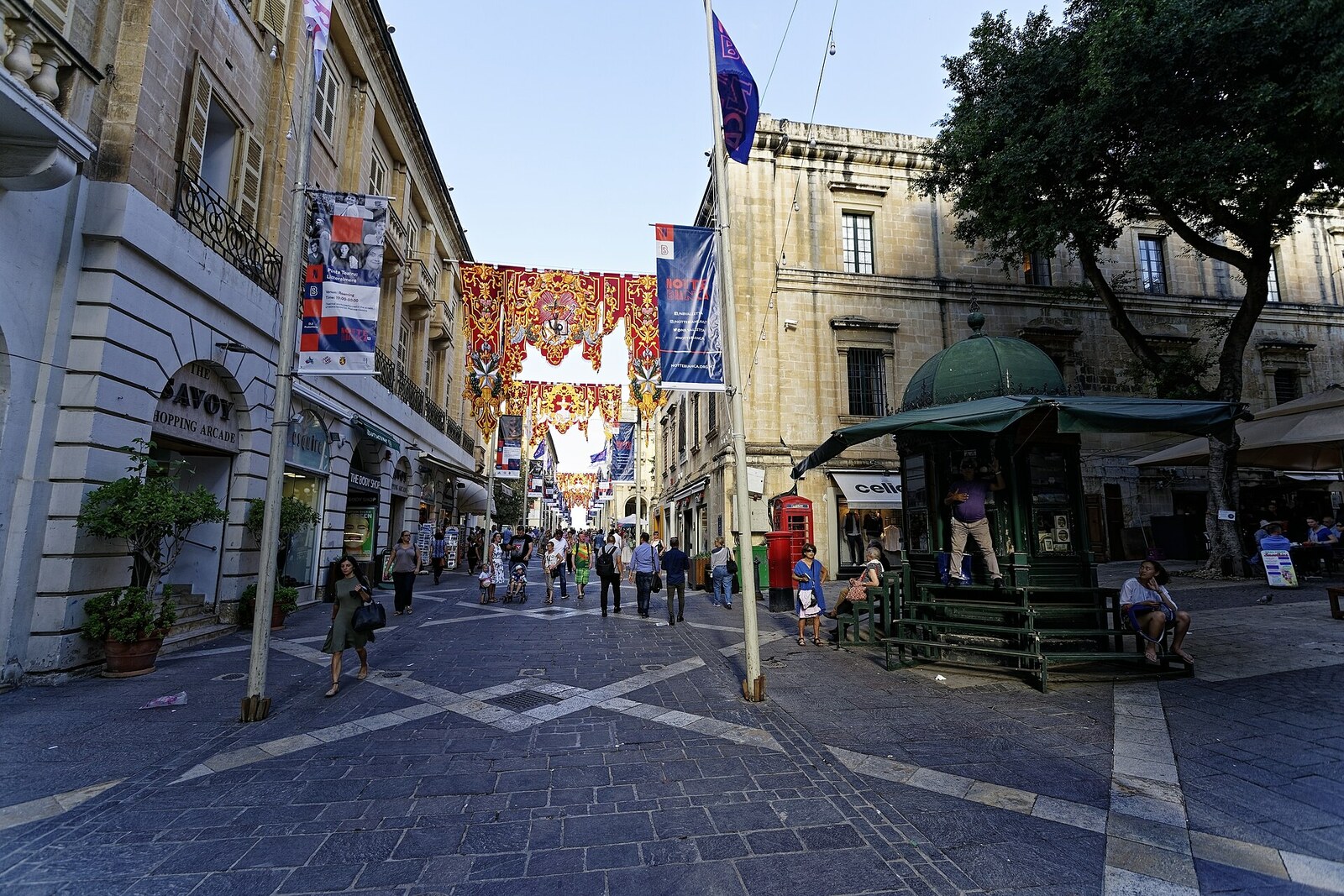
Look around first
What to notice
- Palazzo Ferreria
- Ruins of the Royal Opera House
- Sette Giugno Monument
- Lower floors with shops
The story of the place
Republic Street was laid out across all of Valletta—from City Gate to Fort St Elmo. It became the city's main thoroughfare: merchant houses, clubs, a court, palaces, and later parliament were located along it. That is why, in times of crisis, people came here rather than to one of the neighboring streets.
In nineteen nineteen, it was called Strada Reale—Royal Street. After the First World War, food remained expensive in Malta, especially bread. The Maltese accused grain merchants and mill owners of profiteering, and the British administration of covering for them. The National Assembly met at the corner of Strada Reale and St Lucia Street: its delegates sought self-government for Malta. On June seventh, a crowd came here to support them. People forced shopkeepers to close, tore down British flags, wrecked the editorial office of a pro-British newspaper, and ransacked the home of a major grain importer. Soldiers opened fire; three Maltese were killed.
The next day, a crowd gathered outside Palazzo Ferreria, a large palace at the beginning of Strada Reale, opposite the Royal Opera House. Colonel John Louis Francia, the owner of one of Malta's flour mills, lived there. He wanted to protect the house and summoned the military. People broke open a side door, burst inside, and began throwing furniture and silver out of the windows.
Carmelo Abela had not come there for the owner's silver. He earned his living as a boatman in Malta's harbors and supported his wife and six children. One of his sons was among the people who entered the palace, and Abela stood by the side entrance, calling for him and demanding that he come out.
By evening, sailors and marines were ordered to clear Strada Reale. Abela was told to leave, but he did not move. When two servicemen tried to arrest him, he resisted; one of them struck him in the stomach with a bayonet. Abela was taken to hospital, where he died on June sixteenth. A committee collecting donations for the victims later provided assistance to his widow and six children.
After the unrest, the acting governor, Walter Charles Hunter Blair, acknowledged in a report: concessions to the Maltese would look like weakness, but there was no other way out. In nineteen twenty-one, a new constitution established an elected Legislative Assembly and a cabinet of Maltese ministers.
The street received its present name in nineteen seventy-four, when a president replaced the British monarch as head of state and Malta became a republic. Palazzo Ferreria remains opposite the ruins of the Royal Opera House; shops now operate on its lower floors. Farther along the street, in St George's Square, Carmelo Abela's name is carved on the Sette Giugno Monument.
Useful on site
The public pedestrian route is accessible around the clock; individual buildings along it have their own hours.
Checked: June 24, 2026. Check the official source before visiting.Do not stand in the middle of the dense flow of people; for a calmer look at the façades, move to the edge of the street or into a side passage.