 Guide On Map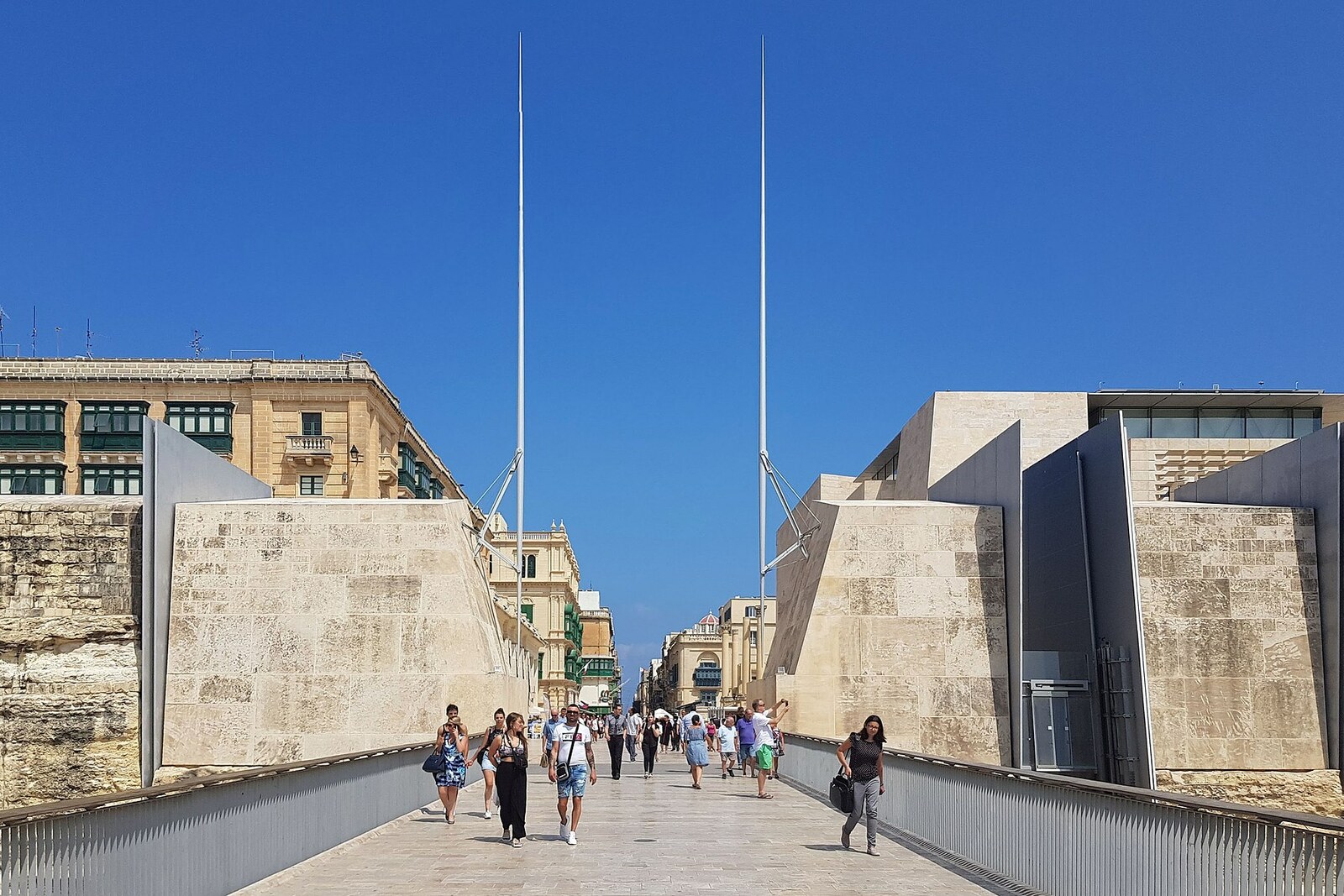
Look around first
What to notice
- The open passage between the stone blocks
- The bridge above the deep ditch
- St James Bastion and St John Bastion
The story of the place
The present gap in the stone wall became Valletta’s fifth entrance. It was made on the site of the dismantled Porta Reale: the bridge was restored to its former width, while an eight-meter passage open to the sky was left between the heavy stone blocks. Below, the deep ditch still lies in place, and on either side rise St James Bastion and St John Bastion—part of the fortifications with which the knights defended the capital from the land.
The Maltese name City Gate (Bieb il-Belt) literally means “city gate.” This is Valletta’s main land entrance: a bridge crosses a deep ditch, and the passage is cut between St James Bastion and St John Bastion. Today there is neither an arch nor gate leaves here. But in January seventeen ninety-nine, the outcome of the siege depended on the possibility of opening these gates.
At that time, Porta Reale stood on this site—the “Royal Gate” of sixteen thirty-three. The French who had captured Malta renamed it Porte Nationale. Half a year before the conspiracy, Napoleon’s army had forced the knights of the Order of St John to surrender the island. French officials then began seizing the Order’s property and church valuables. The Maltese rose in revolt, drove French units out of most of the island, and shut the garrison of Claude-Henri Belgrand de Vaubois inside Valletta and the neighboring fortified towns.
Valletta could not be taken by storm. The walls and ditch built by the knights to defend the capital protected the French garrison. The island’s main grain stores were also behind them. Maltese detachments stood outside; French soldiers and the residents who remained in the city were inside. The gates connected two parts of the revolt that could not reach one another.
The priest Mikiel Xerri taught philosophy at the Central School established by the French administration. He continued to obtain work inside the besieged city and led a conspiracy against the garrison there. The military plan was drawn up by Guglielmo Lorenzi, a former corsair and retired colonel with experience in wars against the Ottoman Empire. The conspirators intended to strike simultaneously at the general’s headquarters, the fortifications, and the city gates. The signal was to be the ringing of the main bell of St John's Co-Cathedral.
Porta Reale was assigned to Luigi Amato, a former infantry officer. He was to lead fifty to seventy men against the guard, throw open the main entrance, and let through the detachments waiting on the Floriana side. For Amato, it was familiar military work, except that no pay was due for it: if it failed, the French tribunal regarded the participants as rebels.
On the eve of the appointed day, a Genoese vessel broke through the naval blockade. It brought food and news of French army victories in Italy. The soldiers in Valletta greeted the news with shouts. The Maltese detachments outside the walls mistook them for the agreed signal and began the attack too early. Lorenzi postponed the action inside the city by one day, but some men were already hiding in the quarantine warehouses at Marsamxett, while another group was in Valletta’s ditch. A French patrol discovered the conspirators; in the morning, the people in the ditch were captured, and the command received a list of participants.
Lorenzi was executed by firing squad on January fourteenth, Xerri on the seventeenth, and Amato on the twentieth. In all, at least forty-three people were executed after the conspiracy failed. The gates remained closed, and the French garrison held Valletta until September eighteen hundred, when depleted supplies forced Claude-Henri Belgrand de Vaubois to surrender.
That Porta Reale was dismantled long ago. The present, fifth entrance was completed in twenty fourteen to a design by Renzo Piano. The bridge was restored to the dimensions it had at the gate of sixteen thirty-three, but an eight-meter passage open to the sky was left between the stone blocks. There is no longer anything here to seize or throw open: the gate leaves that Luigi Amato was meant to reach disappeared along with the old gate.
Useful on site
Public passage open around the clock; there are no special visiting hours.
Checked: June 24, 2026. Check the official source before visiting.Stop before the entrance to see the whole opening; the ruins of the theater can be viewed from outside.