 Guide On Map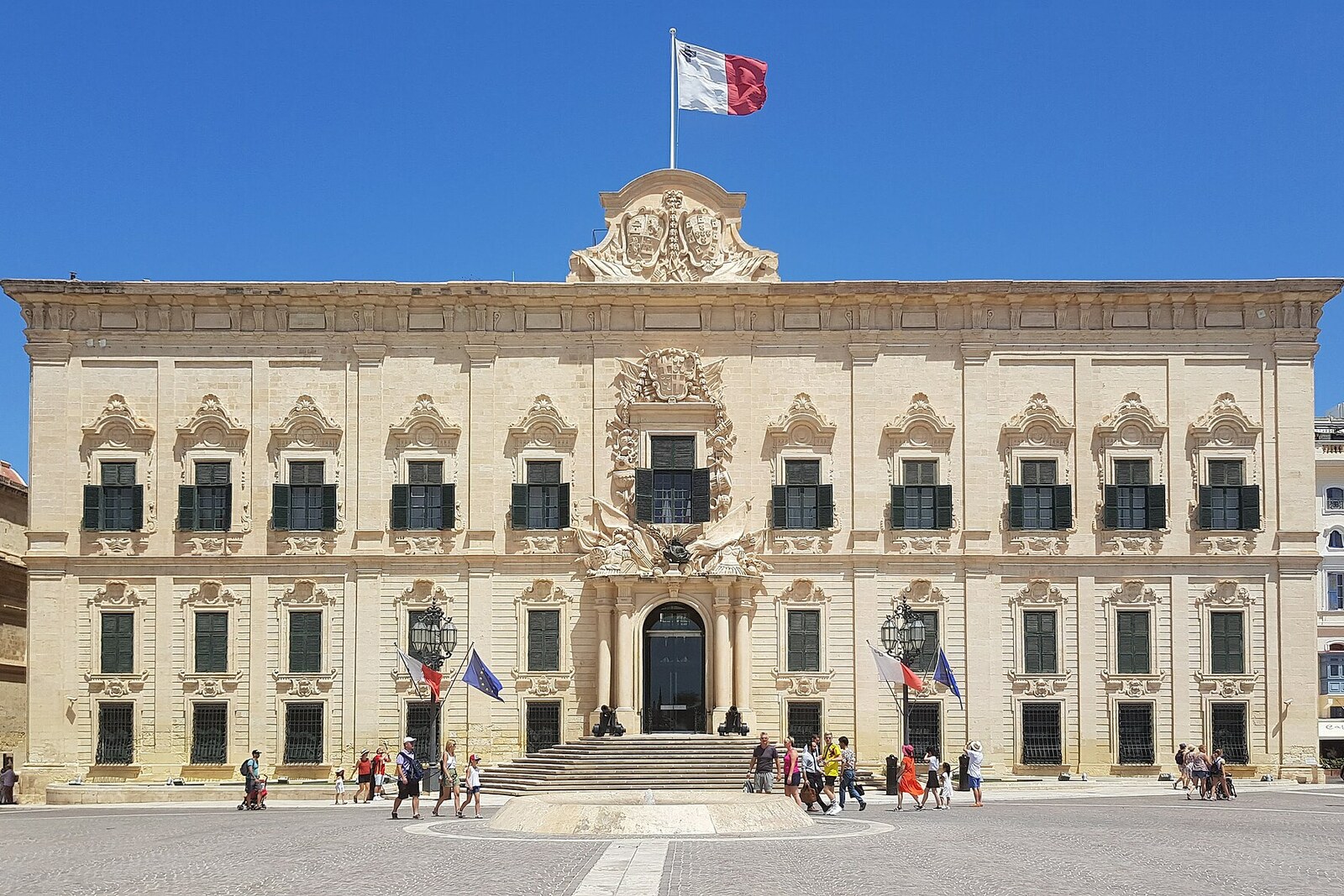
Look around first
What to notice
- Bust of Manuel Pinto da Fonseca
- Pinto's personal coat of arms with a closed crown
- Coats of arms of Castile, Leon, and Portugal
The story of the place
The coats of arms above the central window list this house's full name: Auberge de Castille, Léon and Portugal. This was the name of one of the associations of knights of the Order of St John. They were grouped by origin and language; the Castilians, Leonese, and Portuguese made up one “langue.”
An auberge was the shared house of this group. The knights received two rooms and a servant here free of charge, while the treasury allotted their senior member money or grain for the kitchen. They were required to appear at the shared table at least four days a week. The head of the langue dined separately, on a raised platform, with a carpet and a cushion under his feet. He also held the office of Grand Chancellor: he was responsible for registering and keeping the Order's laws, decrees, charters, and official letters. This is why the house was built on the highest part of Valletta's land front, beside the fortifications for which these knights were responsible.
In August fifteen sixty-nine, they were still living in the old capital of Birgu, and there they decided to build in Valletta. They bought the land, and covered the expenses with a special levy on their own members. A century and a half later, the old building seemed too cramped and modest to them. Manuel Pinto da Fonseca, a Portuguese knight of the same langue, became Grand Master in January seventeen forty-one and almost immediately ordered the old auberge demolished. He paid for most of the rebuilding himself. His bust was installed above the door, and higher still, his personal coat of arms with a closed crown. Pinto sought to make the residence of his association match the stature to which he aspired; he placed his own image directly between the entrance and the coats of arms of Castile, Leon, and Portugal.
Half a century later, the people whose emblems covered the façade lost this house. After the French capture of Malta, Spanish knights were allowed to leave the island on June twentieth, seventeen ninety-eight, and take their movable property with them. The rooms, kitchen, archive rooms, and the land itself remained. The French Commission of National Property moved into the auberge; it had been tasked with managing the real estate and possessions of the exiled Order. The knights took away their personal belongings; the institution that decided the fate of the property they left behind occupied their own residence. With the loss of Malta, the Order's old division into langues also came to an end.
The British military headquarters was then housed here. In March nineteen seventy-two, the building was transferred to the Office of Malta's Prime Minister. Today, government employees work behind Pinto's façade, and the Cabinet of Ministers meets there. The former residents have been gone for more than two centuries, but their three names still stand above the entrance.
Useful on site
The façade is accessible from the square; the building is the working office of Malta's Prime Minister, with no regular tourist entry.
Checked: June 24, 2026. Check the official source before visiting.This is a working government building: view the façade from outside and do not obstruct official access.