 Guide On Map
Along the Turia Riverbed to the City of Arts and Sciences
From Serranos Bridge through Turia Garden to Umbracle
Guide On Map on your phone
Open the walk like a regular app
It takes about 10 seconds to install. No app store needed.
The whole path
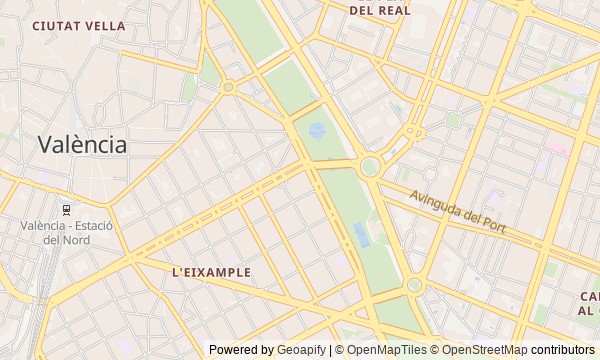
Route map
About the walk
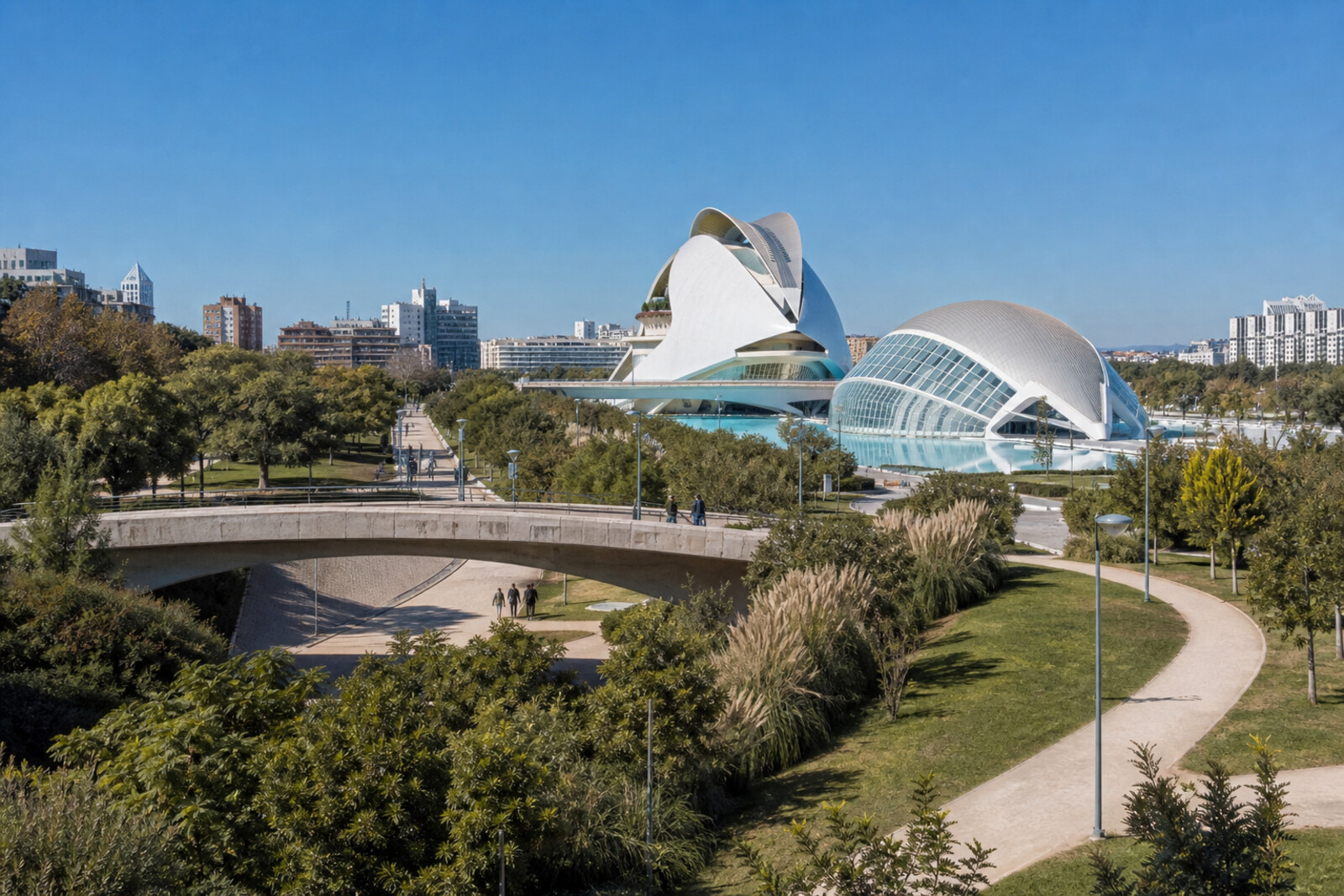
You will begin at the Serranos Gates and descend into the former bed of the Turia River. From there, the route follows a long garden: past the white arc of a bridge, the glass-walled Palau de la Música, and the enormous Gulliver, toward the opera house, Hemisfèric, Museu de les Ciències, and the arcades of Umbracle.
This is not a walk through the postcard views of the old center. It follows a place Valencia has rethought more than once. The river was given a new course. Cars were first planned for the riverbed; then came trees, stages, a children's figure, and a science complex.
The stories turn on small failures and decisions. Why were empty platforms left on an old bridge? How did an opera premiere that was called off finally get staged? And why was a lattice raised above the garden that greenery would never cover?
By the end, you will be able to trace a line on the map from the stone arches of the Serranos Gates to the white ribs of Umbracle—and explain why Valencia's main park occupies the site of a river.
Why this order
Serranos Bridge gives the route its starting point: an old crossing above a river that was still flowing. Descending from it into Turia Garden immediately reveals the central transformation—water and a planned road gave way to a public park in the riverbed. Exposition Bridge returns the walk to urban infrastructure and leads from the green space toward cultural buildings. Palau de la Música continues the story of how the riverbed was claimed, while nearby Gulliver shows how the same space was given to children. From the playground, the route naturally reaches the City of Arts and Sciences: first the opera house, then Hemisfèric and Museu de les Ciències, where the architectural ensemble meets the history of a changing program. Umbracle ends the route from above: beside the whole complex, you can see a design that the plants never brought to its intended appearance.
Those interested in urban transformation Those who enjoy long walks through parks Those who want to see the route from stone bridges to modern architecture
Those looking only for medieval streets and cathedrals Those who prefer a short loop without long stretches between stops Those more interested in museum interiors than the urban setting
Before you go
Prepare for a long walk outdoors: wear comfortable shoes, bring water, and use sun protection. Gulliver has many sloping surfaces, and the playground itself may close for surface repairs, so check its availability in advance and do not make it your only goal for the day. The concert halls, opera house, museum, and Hemisfèric operate as separate institutions: if you want to go inside, check the current program and visiting conditions separately. The route does not require entry to any buildings—the main stories can be read through the bridges, facades, gardens, and pools.
When to go
For an unhurried visit, choose daylight hours, when the masonry, cables, sculptural details, and reflections are easy to see. On a hot day, it makes sense to set out in the morning or closer to evening and pause in the planted sections. Do not build a performance, concert, or exhibition into the pace of the walk itself: it will noticeably change the length of the day.
Backup plan
If Gulliver or one of the buildings is closed, do not interrupt the route: you can examine the figure from outside the playground, and the stories of the cultural structures are clear from their shells and their place in the riverbed. If time is short, reduce the stops devoted to interiors and focus on the sequence of open spaces—the old bridge, the green floor of the river, and the final ensemble with its pools. In intense heat, move in short stretches between shaded areas; in bad weather, do not use the playground surfaces or try to complete the whole route at any cost.
Route conditions
Surface. Paved — 2.9 km; unpaved — 438 m (data covers 70% of the route)
Stairs. Flights: 4, 48 m in total
Access. Wheelchair — no; stroller — limited (stairs)
Facilities. Toilets — 10; drinking water — 25
Elevation. Ascent — 36 m; descent — 47 m
OpenStreetMap extract of June 18, 2026: database data, not a check on the ground. Data © OpenStreetMap contributors, ODbL licence
Walk plan
Open in maps ↗- 1
Serranos Bridge
Here you will learn why the city’s defenders destroyed their own chapels and statues. - 2
Turia Garden
This stop will show how residents succeeded in securing a park in place of a planned urban expressway. - 3
Exposition Bridge
The crossing will preserve the memory of a commercial undertaking, although the original bridge disappeared long ago. - 4
Palau de la Música
Here, the new concert hall will face the test the orchestra had waited decades for. - 5
Gulliver Park
This playground shows how the tradition of temporary festive figures was adapted for permanent urban play. - 6
Palau de les Arts Reina Sofía
This stop tells how a breakdown beneath the stage forced a scheduled premiere to be put together again from scratch. - 7
Hemisfèric and Museu de les Ciències
Two neighboring buildings show what remained of the original scientific program and what had to be created anew. - 8
Umbracle
The final stop will compare the calculated architectural framework with the green roof that never appeared.
Route features
Everything you need stays in the browser
Progress, saves and your trip plan are stored on this device.
Add Guide On Map to your home screen so the walk opens outside the browser.
How we handle sources, maps and corrections: our editorial standards