 Guide On Map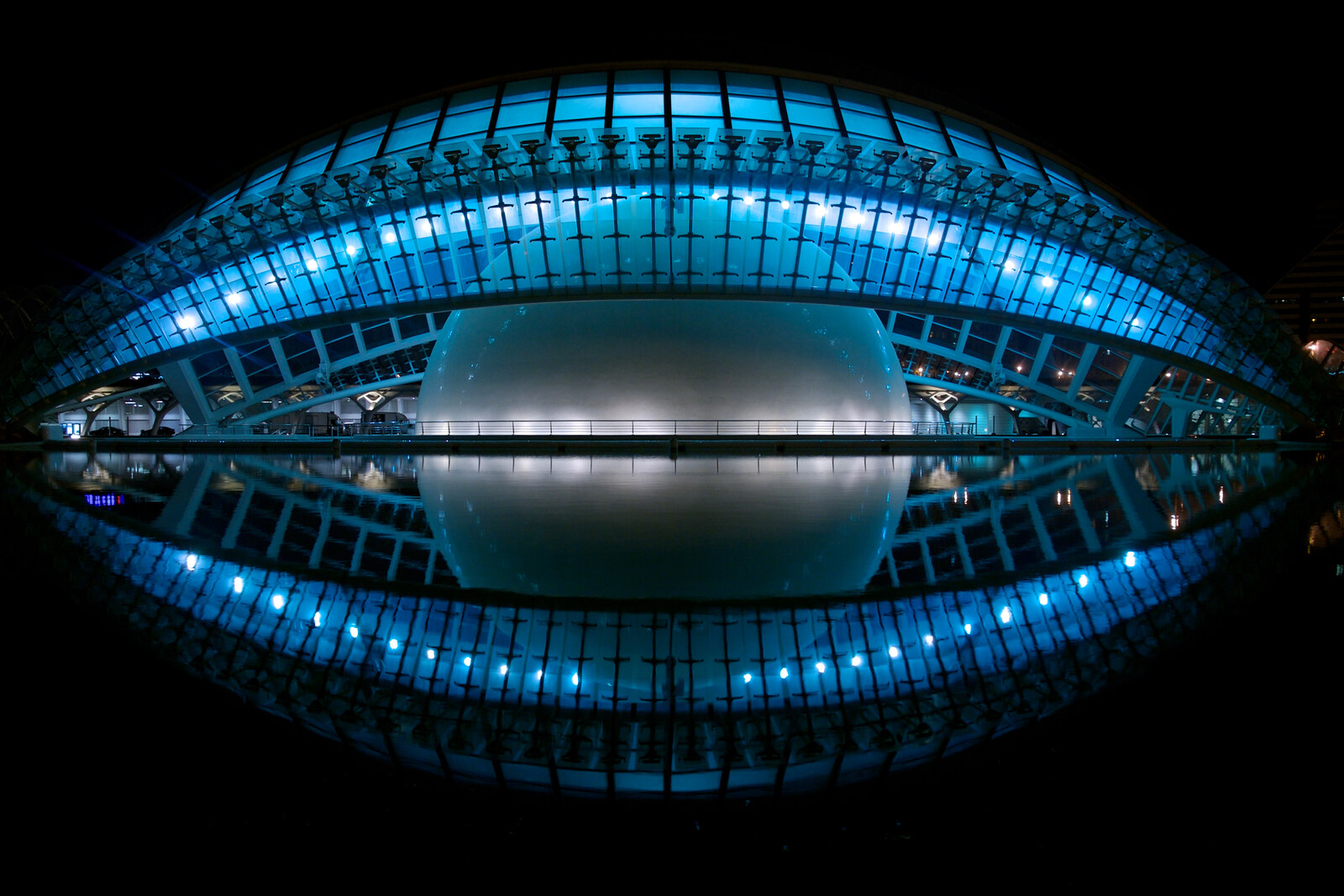
Look around first
What to notice
- The concrete body of the Hemisfèric
- Vertical metal slats
- The domed screen
- The white ribs of the Museu de les Ciències
The story of the place
By the pool lies the concrete Hemisfèric with a concave domed screen twenty-four meters in diameter: large-format films, three-dimensional cinema, and planetarium programs are shown beneath it. Vertical metal slats rise above the structure, and the reflection in the water gathers the silhouette into something like an eye. Nearby, the white ribbed framework of the Museu de les Ciències shelters enormous halls for temporary exhibitions, experimental areas, and demonstrations. Among the installations, a thirty-meter pendulum moves, showing the rotation of the Earth.
In nineteen eighty-nine, the physicist and science-museum specialist Antonio Ten Ros was commissioned to develop activities and exhibitions for Valencia's future science center. Ten Ros wanted visitors to conduct experiments, understand the consequences of new technologies, and become acquainted with the region's scientific heritage. He brought together more than fifty scientists, museum professionals, and designers. The medical historian José María López Piñero prepared a section on the history of science. At the end of nineteen ninety-one, the team delivered thirty-two volumes to the clients—a detailed description of what was to take place in each hall.
At the same time, the Valencian architect Santiago Calatrava was commissioned to build a telecommunications tower nearby. The project leaders combined the two ideas and asked him to design the entire science complex: a museum and a planetarium with a cinema. Ten Ros remained a university lecturer, but under a separate contract he was to carry his museum program from paper to opening. In nineteen ninety-three, he left the project because of disagreements with its leaders. For him, this meant losing the opportunity to realize four years of work; he returned to teaching science museology at the University of Valencia.
The original exhibition program was then discarded. Ten Ros later wrote that only the idea of a cinema with a hemispherical screen had survived from it. This very fragment was the first to become a finished building.
On April sixteenth, nineteen ninety-eight, staff welcomed visitors to the Hemisfèric. The name means “hemispherical” and directly points to the hall's design: inside is a concave domed screen twenty-four meters in diameter. Large-format films, three-dimensional cinema, and planetarium programs are shown here.
Calatrava placed the screen inside a concrete eye. The dome became the pupil, the vertical metal slats a rising eyelid, and the reflection in the pool completes the sphere. This image is connected here to the building's literal function: people sit beneath a hemisphere and watch an image that fills almost their entire field of vision. The Hemisfèric proved to be the only part of the original scientific program that Ten Ros could recognize without explanation.
The large Museu de les Ciències had to begin again from scratch. Its director became the science journalist Manuel Toharia, who was left with Calatrava's enormous halls and the task of filling them after the thirty-two-volume plan disappeared. Toharia declined to assemble his own collection of valuable museum objects. Instead, the staff prepared temporary exhibitions lasting from a few months to a few years, experimental areas, and demonstrations. Toharia's short rule was: “Not touching is forbidden.” Visitors were to set the installations in motion, rather than walk past display cases.
On November thirteenth, two thousand, museum staff welcomed the first visitors. The exhibitions beneath the white ribs have been replaced many times since then; among the things that have remained is a thirty-meter pendulum whose movement shows the rotation of the Earth. Beside it still lies the hemisphere of the Hemisfèric—the one element of the vanished plan that received its own shell.
Useful on site
The exteriors are freely accessible; the museum usually opens at 10:00, and closing depends on the season. Hemisfèric screenings and ticket offices require checking the calendar; ticket offices close before the museum.
Checked: June 28, 2026. Check the official source before visiting.The pools are part of the architectural composition, not a passageway; the film screening and museum exhibition require separate time and visit arrangements.