 Guide On Map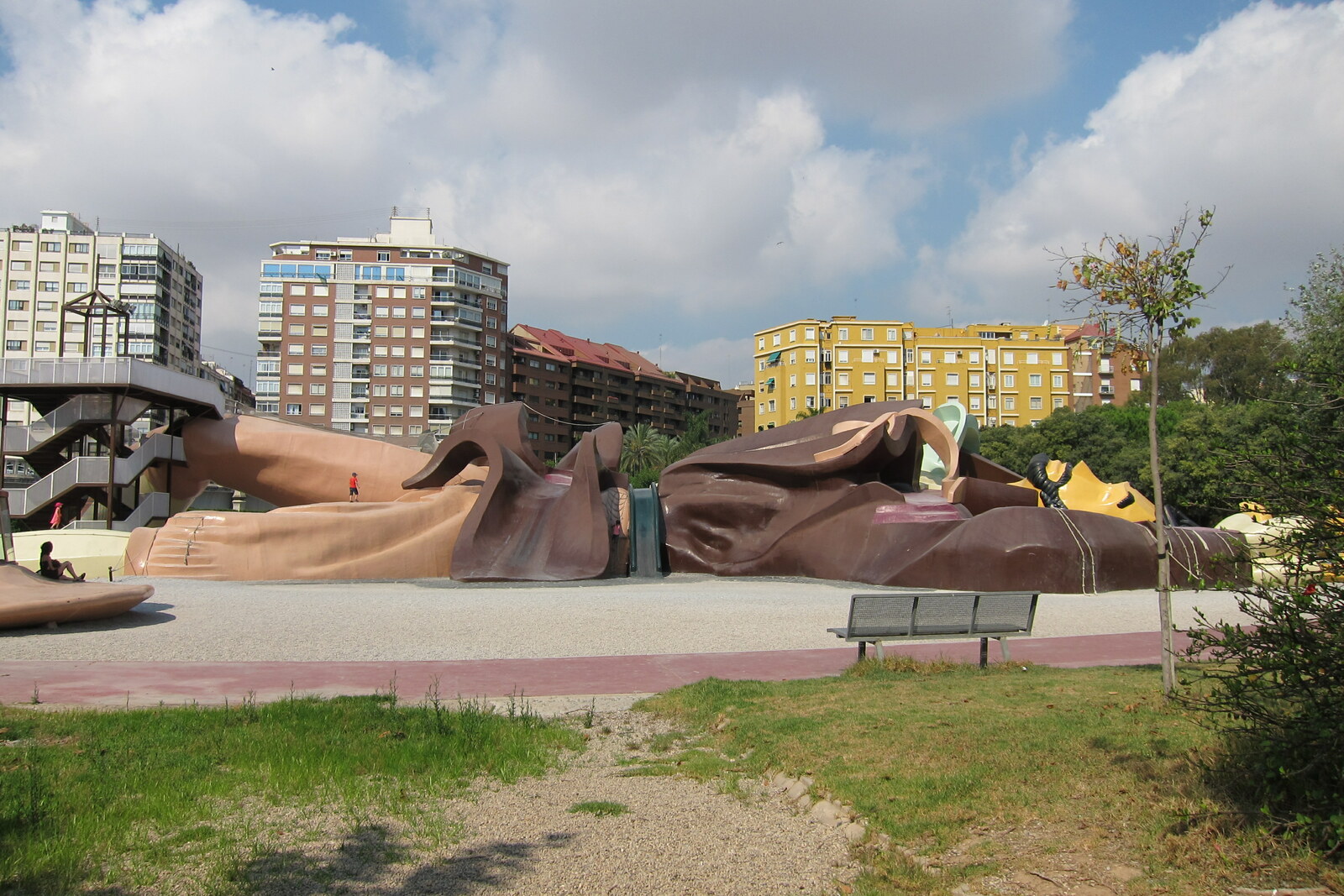
Look around first
What to notice
- The figure of the reclining giant
- Rope handrails
- Folds of clothing
- Locks of hair
The story of the place
In the former bed of the Turia River lies an almost seventy-meter giant transformed into a landscape for play. Its body is supported by a metal frame hidden beneath concrete, polyester, and fiberglass; folds of clothing lead into descents, locks of hair become paths, and ropes serve as handrails. You can move across the figure by different routes, without one single correct path. When the riverbed became a garden, the open plot received this unusual playground.
One of the main tasks for this park was set by a girl whose name the creators did not record. In the mid-nineteen eighties, the municipal architect Rafael Rivera was asked to devise a playground. He began asking schoolchildren how they played. The children spoke of running, hide-and-seek, and freedom, not swings. One girl asked them not to install benches: then her grandfather would not be able to watch her all the time.
Rivera conceived a playground without a prescribed order, where a slide, a fold of clothing, or a lock of hair allows different games. Its form was suggested by Lemuel Gulliver, the hero of a novel by the Irish writer Jonathan Swift. After a shipwreck, Gulliver fell asleep on the shore of Lilliput, and its tiny inhabitants tied up the giant. In the park, his ropes became handrails and climbing structures, his clothes became slopes, and the children were given the role of Lilliputians.
The first design was half the size of the current figure and did not fit the allocated budget. Officials rejected it. In nineteen eighty-seven, Rivera left city hall but did not abandon the drawings. He approached Manolo Martín, a Fallas artist—makers of enormous festive figures that are built in workshops and burned every March. Rivera proposed that he make a figure that would not be burned and that children would climb over. Martín agreed; the comic-book artist Sento Llobell drew the giant's face, clothing, and pose.
The project could still have remained a folder on a shelf. During a visit to the workshop, it was discovered by Andrés García Reche, who was responsible for industry, trade, and tourism in the regional government. He secured funding under the River of Children program, and the municipality provided a site in the former bed of the Turia River. That is how the giant ended up here: the new children's area required open urban space, and the drained riverbed was already being turned into a garden.
Manolo Martín divided the work among six or seven workshops of the City of Fallas Artists. More than one hundred craftspeople made parts as large as the gates of their workshops, then assembled them here. Concrete was applied over a metal frame, then polyester with fiberglass was laid over it. The creators themselves tested the descents; toy-safety specialists and firefighters separately checked the materials. The playground opened on December twenty-ninth, nineteen ninety.
Today's Gulliver stretches for almost seventy meters. Rafael Rivera managed to ride down every descent and, decades later, returned here with his grandchildren. Manolo Martín never dared to go down a single one: the maker of huge figures was afraid of heights. The giant made by his hands remained lying in the riverbed—the first Fallas figure on this scale built for children's feet rather than for March fire.
Useful on site
Free entry. Seasonal hours change; the city page also states that it closes for maintenance on the first Tuesday of the month, or on the following Wednesday if there is a holiday. After rain, the play surfaces may be closed.
Checked: June 28, 2026. Check the official source before visiting.The surface is sloped and intended for active play; observe the restrictions on site and do not go onto the figure if the playground is closed.