 Guide On Map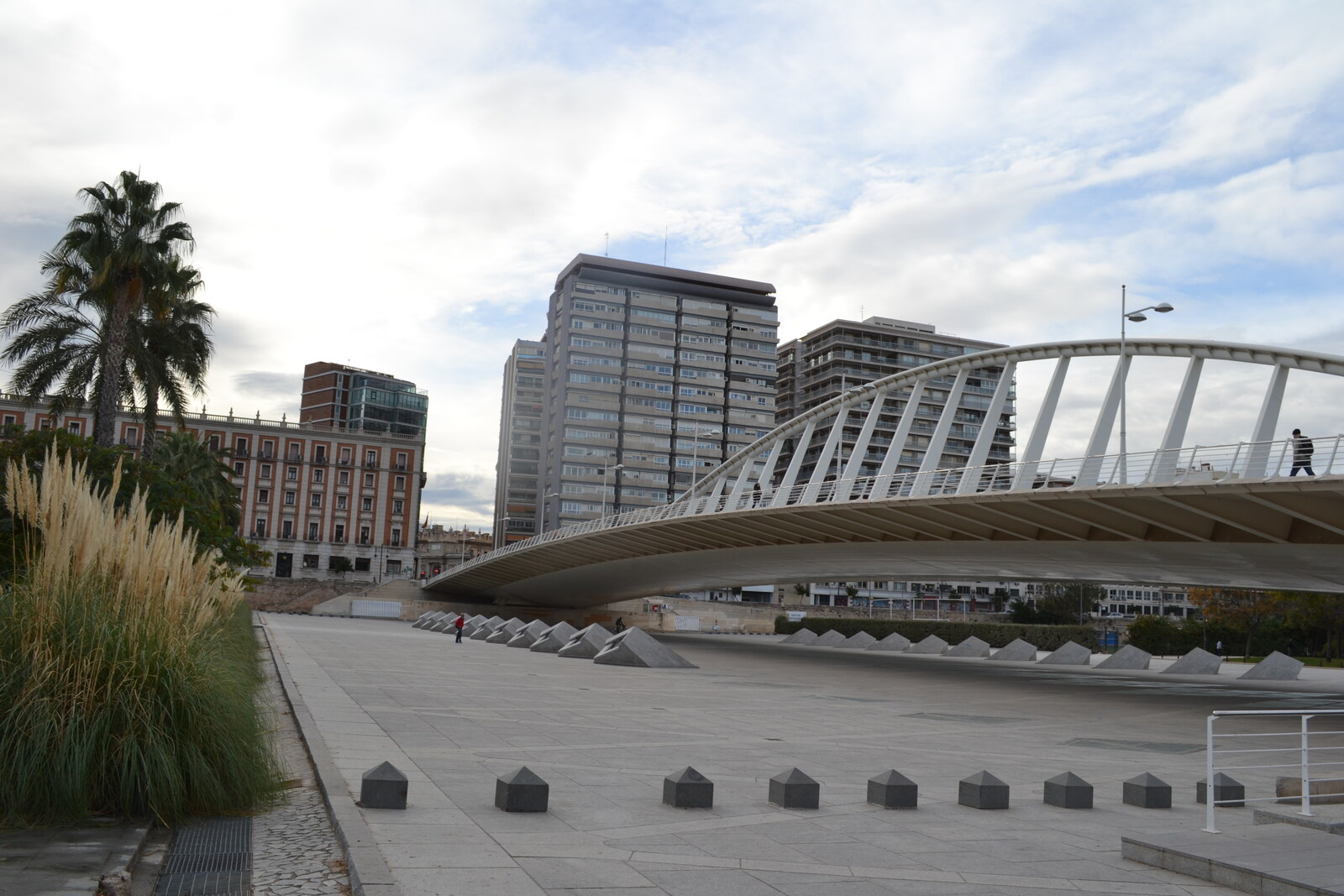
Look around first
What to notice
- The inclined steel arch
- The road deck
- The pedestrian section
- The entrance to Alameda station
The story of the place
One tall steel arch stands beside the roadway and carries it without a second support on the other side; residents recognize a woman's comb in this silhouette. The crossing was conceived together with Alameda station, arranged directly beneath it. While the station was being built in its permanent location, the metal bridge was assembled nearby and then moved whole above the tracks. Now cars and pedestrians cross the former Turia River riverbed on the upper level, while below, passengers descend to the trains.
The official name of this bridge is almost a century older than its white steel arch. It remained from the fair for which a permanent crossing over the Turia River appeared here in the first place.
At the beginning of the twentieth century, Tomás Trénor Palavicino, president of the Valencian association of merchants and entrepreneurs, Ateneo Mercantil de Valencia, campaigned to hold a major regional exhibition. He intended to show that Valencia knew how to produce and sell, from agricultural goods to fertilizers, machinery, and railway equipment. Trénor knew this world from the inside. His family owned a sulfuric-acid and fertilizer factory and invested in railways, banks, and ships.
The organizers set aside a site for the exhibition by the Alameda, on the riverbank opposite the city center. Visitors needed a direct entrance from the city side. So the engineer José Aubán Amat built a pedestrian bridge here—the first bridge in Valencia made of reinforced concrete. It opened together with the exhibition in nineteen oh nine. Along this crossing, people reached pavilions containing machinery, furniture, electric lighting, and goods from Valencian factories.
The following year, the regional exhibition continued as a national one. Its outcome for Trénor was twofold. Alfonso XIII, King of Spain, granted the organizer the title of Marquis of Turia. At the same time, the exhibition left a deficit, and Trénor had to cover part of it from his own fortune. The fair, conceived as a demonstration of commercial success, caused its principal organizer considerable financial loss.
Most of the exhibition pavilions were later dismantled, but the bridge continued to link the center with the Alameda. It stood until the flood of nineteen fifty-seven, when the current destroyed the crossing. Another pedestrian crossing was later built here, and in the early nineties it was replaced by the present bridge.
The Valencian engineer and architect Santiago Calatrava was commissioned to design both the bridge and Alameda station directly beneath it. While the builders constructed the station in its permanent location, the bridge's steel structure was assembled nearby. The completed crossing was then moved and installed over the station. The inclined arch supports the deck from one side only; because of its shape, residents nicknamed the bridge La Peineta—a woman's comb.
Now cars and pedestrians cross the old riverbed on the upper level, while below them passengers descend to the metro trains. Nothing remains of José Aubán's concrete spans. Calatrava's bridge stands at the site of the first entrance to the exhibition pavilions, but its plaque retains the name of Tomás Trénor's undertaking, which brought him the title of Marquis of Turia and a bill paid from his own fortune.
Useful on site
Open as a city crossing; the metro station beneath the bridge operates on a separate transport schedule.
Checked: June 28, 2026. Check the official source before visiting.From outside, the structure's main gesture is visible; Alameda station beneath the bridge is part of the operating transport system.