 Guide On Map
El Carme: Gates, Walls, and Layers of the City
From Quart Towers through museums and Tossal to Serranos Towers
Guide On Map on your phone
Open the walk like a regular app
It takes about 10 seconds to install. No app store needed.
The whole path
Route map
About the walk
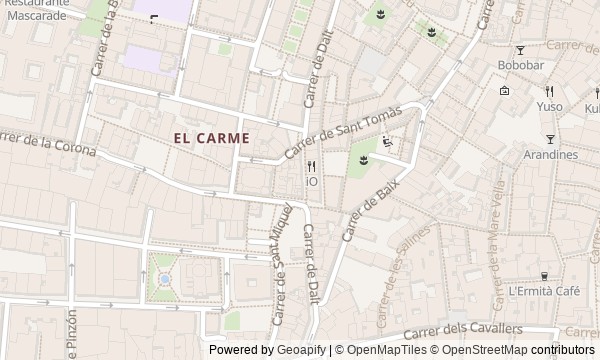
You’ll cross El Carme from Quart Towers to Serranos Towers. First, you’ll retrace the old western entrance, then turn toward IVAM – Valencian Institute of Modern Art and enter the monastic courtyards of Centre del Carme Cultura Contemporània. Afterward, you’ll descend to Tossal, find a surviving passage through the Islamic wall, and emerge onto Carrer dels Cavallers, a street of palaces.
Along the way, heavy gates will open before a cannon shot. The design of a burial chamber will tell you where the first settlers came from. A museum will receive its name before its building exists. And beneath the square, a gate wall will remain—the place where a confident assault ended in a trap.
The story rests on objects and people’s decisions: a cannon, grave goods, an heiresses’ contract, a punched-through exit, an architect’s refusal, rice husks. It separates a discovery from a guess, and old masonry from later reconstruction.
After the walk, you’ll be able to trace the line of a Roman road and two medieval walls through El Carme, and tell from the two pairs of towers which boundaries Valencians defended in different centuries.
Why this order
Quart Towers provide the starting point: the western opening in the Christian wall. Passing beneath the arch brings you onto Quart Street, showing that the gate served an older road leading from the Roman city toward the necropolis. Returning to the towers and turning along Guillem de Castro Street moves the route from the road to the line of the demolished wall, where IVAM – Valencian Institute of Modern Art stands. The next short stretch into the inner blocks brings you to Centre del Carme Cultura Contemporània, where two neighboring art institutions can be compared: a purpose-built museum and a former monastery with a school. From the monastic courtyards, Alta Street descends to Tossal, where the Islamic wall appears beneath the square. After the underground fragment comes Portal de la Valldigna: the same belt now appears not as an excavation, but as a surviving passage between houses. From there, the way out to Carrer dels Cavallers moves the route from the edge of the Moorish quarter to a street of nobles and city power. Carrer dels Cavallers leads to Carrer de Manises, while Carrer dels Serrans continues the ceremonial route to the northern gates. The finale returns to towers, but not to the defensive western entrance: to the main entrance from the Turia River.
Those who want to understand how El Carme works, rather than collect its main postcards Lovers of urban archaeology and rescue stories Those interested in museums as part of the city’s history
Those looking first and foremost for a route of cathedrals and markets Those who do not enjoy a dense historical narrative Those who care more about museum interiors than the streets between them
Before you go
Check access to Quart Towers and Serranos Towers, Galería del Tossal, Centre del Carme Cultura Contemporània, and IVAM – Valencian Institute of Modern Art in advance: each place keeps its own visiting hours, and individual spaces may be temporarily closed. Allow extra time beyond the walk itself for the museums and towers. Comfortable shoes will help on old paving and stairs; inside historic buildings, follow visitor restrictions and do not expect every room to be open at once.
When to go
2–3 hours
Backup plan
If the archaeological gallery, museums, or towers are closed, keep the route’s sequence and treat it as an outdoor reading of the neighborhood. Look at the marks of shelling on Quart, the direction of the streets around Tossal, the arch of Portal de la Valldigna, the palace façades of Carrer dels Cavallers, and the outward contrast between IVAM – Valencian Institute of Modern Art and the old buildings. At Centre del Carme Cultura Contemporània and Serranos Towers, pause by accessible entrances without trying to enter closed areas. This version leaves out interiors and collections, but its central thread—from the city boundary to new uses for old walls—remains clear.
Route conditions
Surface. Paved — 2.5 km; unpaved — 23 m (data covers 95% of the route)
Stairs. Flights: 2, 8 m in total
Access. Wheelchair — no; stroller — limited (stairs)
Facilities. Drinking water — 10
Elevation. Ascent — 16 m; descent — 18 m
OpenStreetMap extract of June 18, 2026: database data, not a check on the ground. Data © OpenStreetMap contributors, ODbL licence
Walk plan
Open in maps ↗- 1
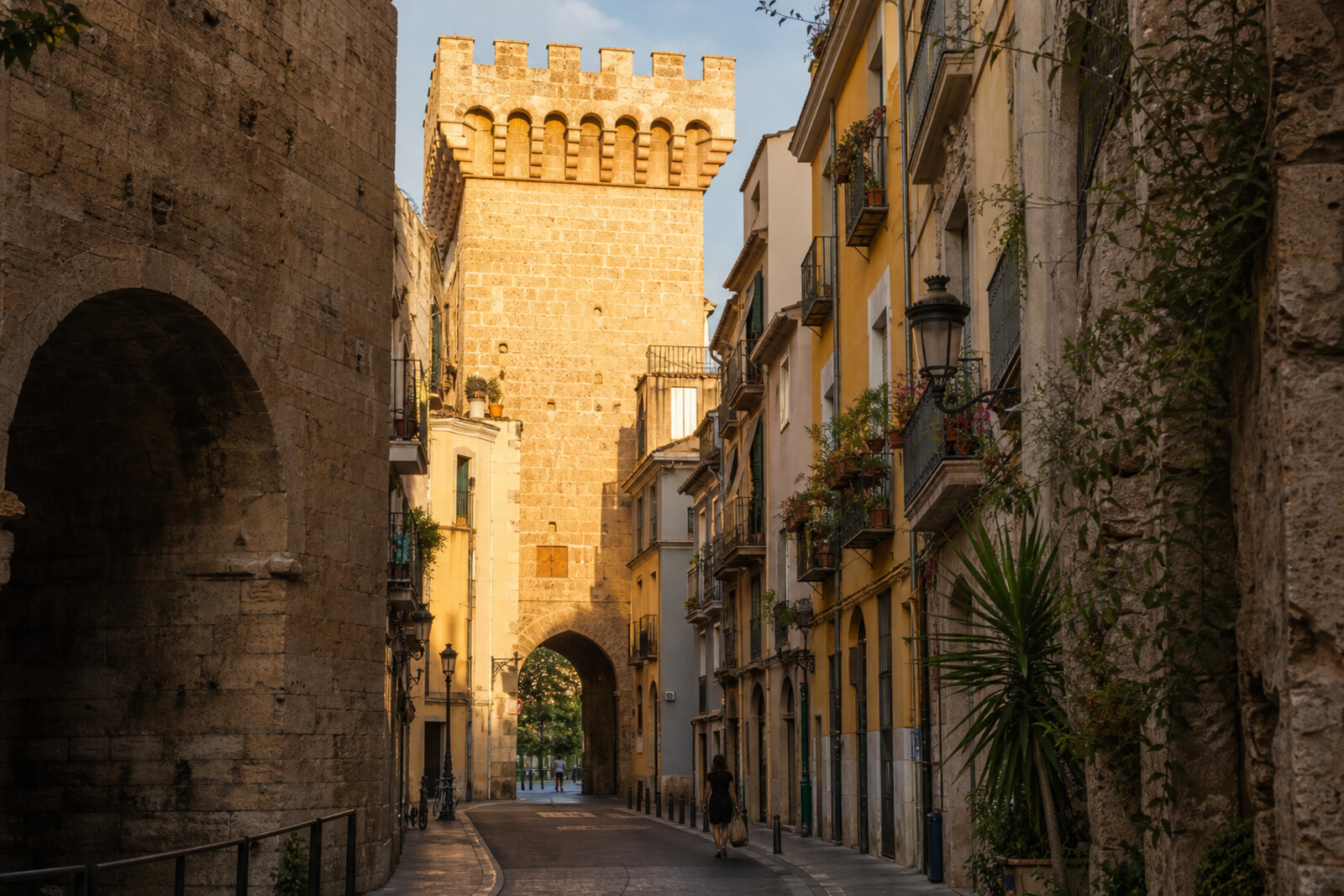
Quart Towers
The defense of 1808 shows how, for one day, a city passage became an artillery position. - 2
Quart Street
Archaeological finds will link the present-day street to a Roman road and the necropolis of the first settlers. - 3
IVAM – Valencian Institute of Modern Art
The history of a family collection will show how the collection shaped the future museum even before construction. - 4
Centre del Carme Cultura Contemporània
The story of Sorolla’s education will link the monastery rooms with professional art education. - 5
Plaça del Tossal and Galería del Tossal
Underground remains connect the present-day street junction with the western entrance to Muslim Balansiya. - 6
Portal de la Valldigna
The rebuilding of 1942 shows how a medieval passage was preserved inside new residential buildings. - 7
Carrer dels Cavallers
The episode with the procession will show how the street of nobles became a line of political confrontation. - 8
Serranos Towers
A military evacuation will link the Gothic gate to the fate of the Museo del Prado collection.
Route features
Everything you need stays in the browser
Progress, saves and your trip plan are stored on this device.
Add Guide On Map to your home screen so the walk opens outside the browser.
How we handle sources, maps and corrections: our editorial standards