 Guide On Map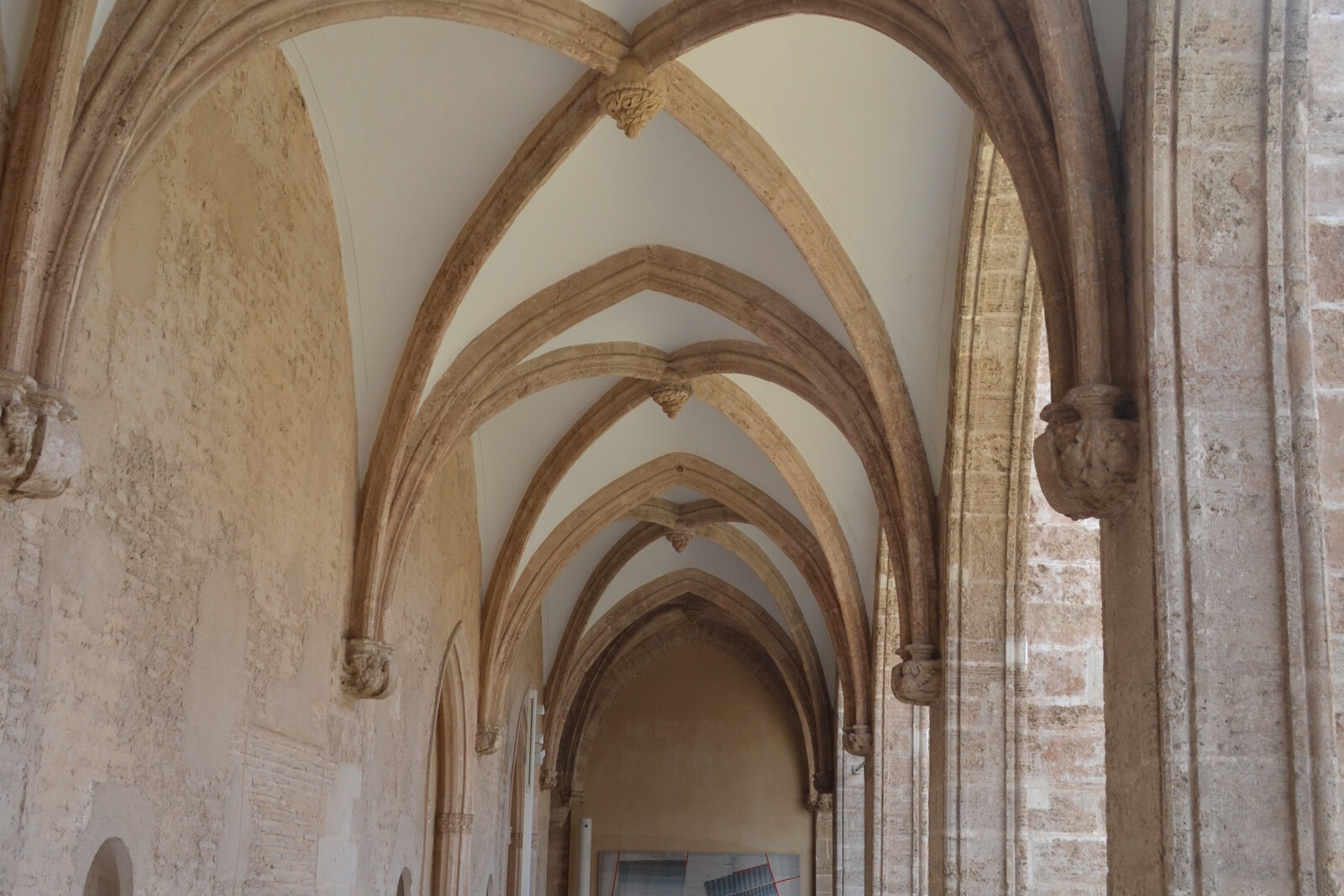
Look around first
What to notice
- Gothic cloister courtyard
- Pointed arches
- Renaissance courtyard
- Covered galleries
The story of the place
The name El Carme preserves the memory of the Carmelite religious house that once stood beyond the city wall and later gave its name to the neighborhood that grew around it. The covered galleries of the Gothic courtyard, with their pointed arches, lead to another, Renaissance courtyard; deeper inside, the refectory and the former monks’ dormitory have survived. Today, exhibitions, performances, film screenings, and artists’ work change between these two courtyards.
Fifteen-year-old Joaquín Sorolla combined his classes within these walls with work in his uncle José’s locksmith’s workshop. After his parents’ early death, his uncle raised him and taught him a trade that could support the family. Sorolla sought a different future: he enrolled in the San Carlos School of Fine Arts, which occupied the former El Carme monastery.
The school arrived here after the forced closure of Spanish monasteries in the eighteen thirties. Professors from the San Carlos Academy and members of the provincial commission brought paintings and sculptures from the abolished religious houses to the emptied El Carme. They collected about six hundred works, catalogued them, and established Valencia’s first museum of painting. The academy itself and its school were then moved here. The monastery rooms filled with teaching studios, while paintings saved from closed churches hung nearby. Its role as a museum spared the complex from the demolition that befell other Valencian monasteries.
Sorolla studied under the landscape painter Gonzalo Salva, who took students out to paint from life. Among Sorolla’s fellow students was the son of Antonio García Peris, one of Valencia’s leading photographers of the time. This acquaintance gave the young artist paid work in a photography studio and a place to work in the workshop on the roof of García’s house. There Sorolla also met the photographer’s daughter, Clotilde, his future wife.
At twenty-one, he attempted to win a provincial scholarship to study in Rome. Candidates were required to complete three competition assignments. After the second, two remained; Sorolla’s final work was a large historical scene about Valencians’ resistance to the French invasion. The jury members chose him unanimously. The scholarship enabled Sorolla to leave locksmithing behind and go to Italy already as a professional artist.
The centre’s name is older than this story. “El Carme” is the Valencian form of the word “Carmen.” In twelve eighty-one, the Carmelites founded the Royal Monastery of Our Lady of Carmel here. It stood beyond the city wall; later, a part of the city grew around it and took the name El Carme. What remains of the religious house are the Gothic cloister courtyard with its covered gallery, the refectory, the former monks’ dormitory, and a second, Renaissance courtyard.
The academy and museum left the complex in nineteen forty-six, and the art school in nineteen eighty-six. Today, the rooms between the two cloister courtyards host temporary exhibitions, performances, film screenings, concerts, children’s activities, and artist residencies. Most projects are selected through open calls and juries. Sorolla’s student easels are not here; what remains is the former monastery and the work of artists that has continued within it.
Useful on site
Exhibitions and accessible rooms may change, so check the program separately. Speak quietly in the cloisters and do not go beyond temporary barriers.