 Guide On Map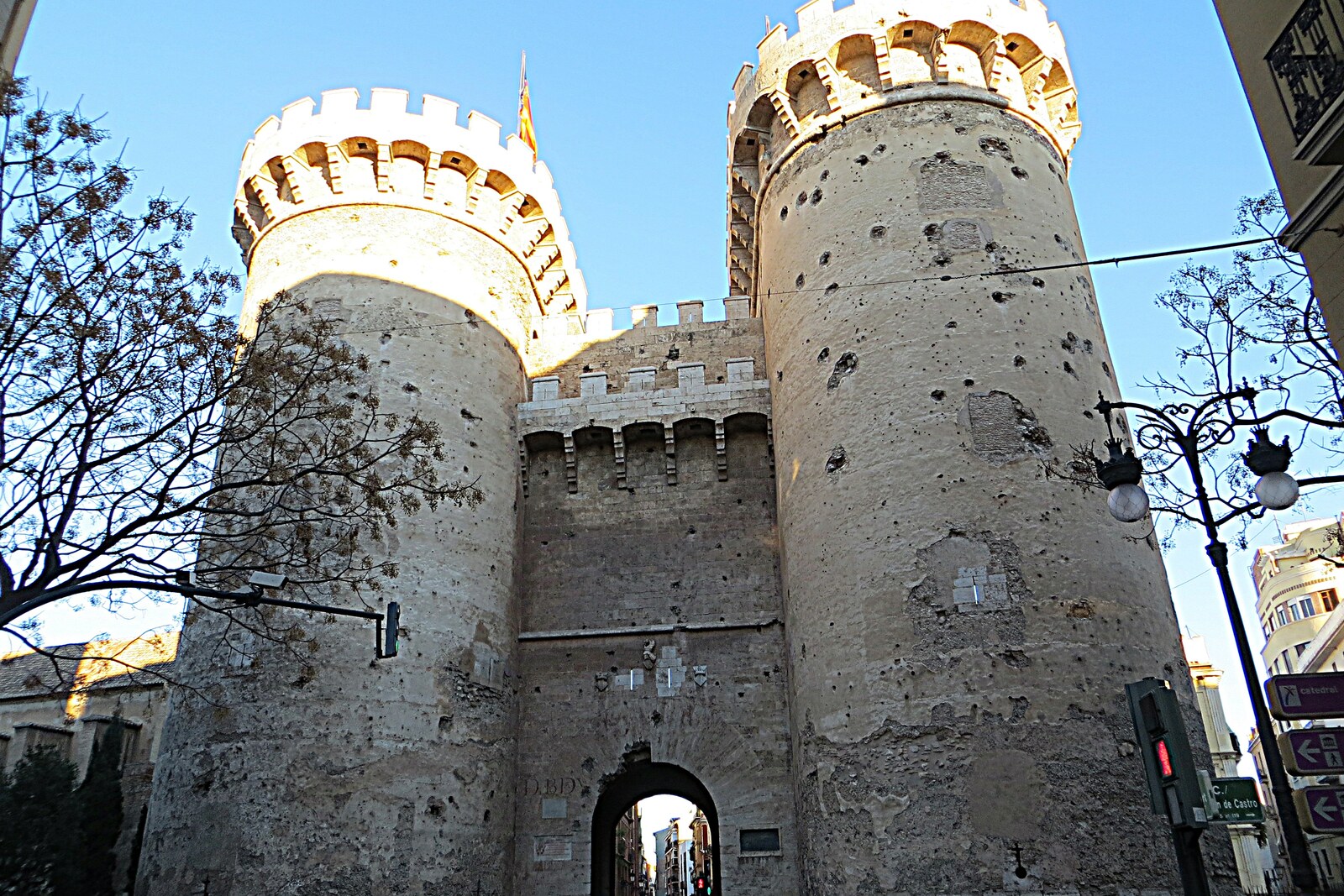
Look around first
What to notice
- Shell marks on the outer plaster
- The passage arch
- Two round towers
The story of the place
From the west, the medieval city was closed off by two round towers joined by a tall passage arch. Through this passage, the road led to Quart de Poblet and farther on, toward Castile; the settlement by the road gave the gate its name. Almost all the wall surrounding them disappeared in eighteen sixty-five, but the towers were left standing. Old shell marks are still visible on the outer plaster.
On June twenty-eighth, eighteen oh eight, the artilleryman Pedro de Soto ordered these gates opened before an advancing French column. Behind the leaves stood a gun aimed along the road. It fired, people slammed the gates shut, the crew reloaded the gun—and the leaves opened again. Any mistake in this sequence left the artillerymen without cover from infantry that had already reached the ditch and the barriers.
Quart Towers were the western gate of medieval Valencia. From here, the road ran through Quart de Poblet toward Castile; the settlement gave the gate its name. French Marshal Bon Adrien de Moncey, sent to take the city, arrived by this road. The day before, his soldiers had defeated a hastily assembled detachment at Quart de Poblet, so the next battle began at the city wall.
Military engineers and townspeople dug a ditch in front of the gate, set up barriers, and positioned two guns. Pedro de Soto operated the lower one. Artillery Captain José Ruiz de Alcalá directed the fire of the second gun from the upper level. Alongside professional soldiers, armed residents and veterans still fit for service occupied the towers.
French batteries began shelling in the morning. Around noon, the infantry advanced toward the gate and reached the barriers, but could go no farther: defenders fired from above, while the guns fired along the narrow approach. After several unsuccessful attacks, Moncey shifted the assault to other sections of the wall. When the defenders themselves came out through the gate, French soldiers quickly drove them back. Behind the wall, the ditch and the towers gave them an advantage; in the open field, it disappeared.
By evening, the marshal stopped the assault, and the next day he withdrew the army from Valencia. The city held out then, although three and a half years later it capitulated to another French army.
Almost the entire medieval wall was demolished in eighteen sixty-five. Quart Towers were spared. Shell marks remain on their outer plaster, and beneath the arch is the very passage before which Pedro de Soto's men opened the heavy leaves for the next shot.
Useful on site
The marks on the facade can be viewed from the street. Treat going inside as a separate visit and check access in advance; do not hurry on the stairs.