 Guide On Map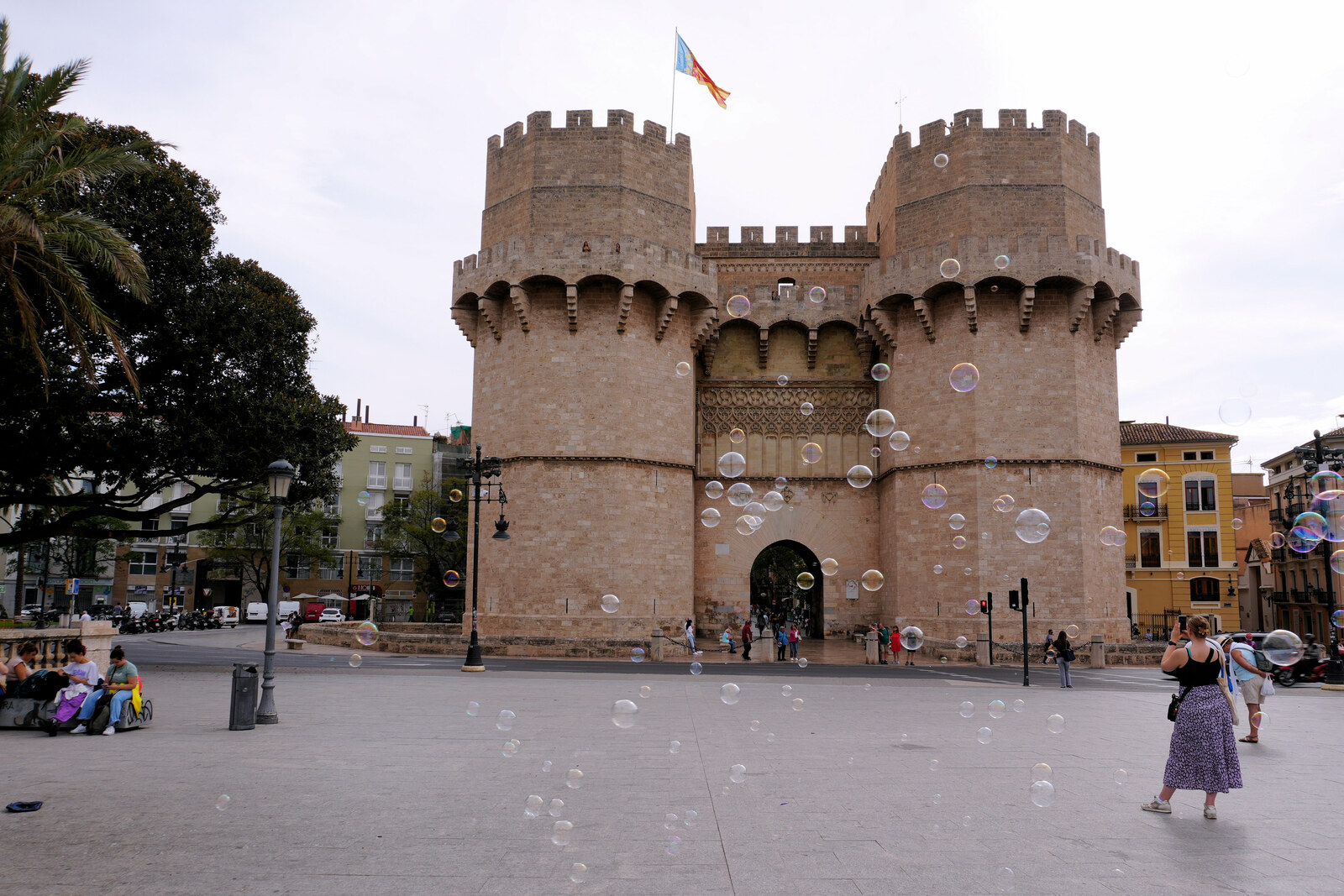
Look around first
What to notice
- Two many-sided towers
- Central arch
- Open galleries on the city side
- Stone vaults of the lower level
The story of the place
On the city side, galleries open out at the gate, while beneath the central arch lies the lower level with its stone vaults. The thick walls once made the inner rooms a protected repository: a temporary reinforced-concrete ceiling was built above the vaults and covered with rice husks and earth. This protection was later dismantled, so in the open halls you can no longer see either the additional vault or the layers that concealed them from within.
Two many-sided towers are joined by a single arch: these are the main northern gate in Valencia's Christian wall. City councilors commissioned the master mason Pere Balaguer to build them between thirteen ninety-two and thirteen ninety-eight. Roads from Saragossa, Barcelona, and the mountainous region of Los Serranos met here. The origin of the name has not been conclusively established: it is more often linked to travelers arriving from there, whom Valencians called serranos; another version concerns the Serranos family, who lived nearby.
On November fifth, nineteen thirty-six, the management of the Museo del Prado received an order to evacuate its principal works from Madrid. Bombs were already falling on the capital. The first nighttime convoy left for Valencia under military guard on November tenth, and six days later direct hits damaged the Museo del Prado building itself. The danger that prompted the evacuation was entirely literal.
At the Serranos Towers, José Lino Vaamonde met the cargo. He was the Museo del Prado's architect-curator, responsible for the collection's engineering protection. The thick medieval walls offered shelter from shrapnel, but stonework alone was not enough. In a direct hit, the upper vaults could collapse onto the crates of paintings. Yet if the damp rooms were sealed shut, humidity would damage the canvases and wooden stretchers.
Vaamonde placed the works on the lower level and, in December, ordered an additional reinforced-concrete vault, ninety centimeters thick, to be built above them. A meter of rice husks, capable of cushioning the impact of falling debris, was spread over the concrete, followed by a meter of earth. Another layer of earth was laid on the level above, the terraces were covered with sacks, and electric instruments were installed in the rooms to monitor humidity and temperature. The result was a protected repository inside a Gothic gate.
Hundreds of canvases were kept in one tower, including Goya's The Second of May 1808, Diego Velázquez's Christ Crucified, and Titian's Venus. Palace tapestries were laid out on a specially constructed platform in the other. For Vaamonde, an error in calculation would have meant the collection's destruction, either by an explosion or by the protection itself, if the concrete, earth, or dampness reached the works before a bomb did.
In the summer of nineteen thirty-seven, Frederic Kenyon, former director of the British Museum, inspected the repository. The paintings, books, and tapestries had remained in sound condition. In the spring of the following year, the front line drew closer to the roads to Catalonia, and the curators loaded the collection onto vehicles again. It left Valencia for Catalonia, then Geneva, and on September ninth, nineteen thirty-nine, returned to the Museo del Prado with almost no losses.
Vaamonde's reinforced-concrete vault was later dismantled along with the rice husks and earth. This protection is no longer present in the open halls today. The paintings stood on the lower level of these very towers, beneath a temporary ceiling that people built inside a medieval gate and removed after it had fulfilled its sole task.
Useful on site
The main volume is easy to view from outside. If you decide to climb up, check access in advance and keep the stairs in mind; even without going inside, the story of the wartime repository is still clear from the scale of the walls.