 Guide On Map
Old Tomsk: Wooden Neighborhoods and the University Riverbank
From Voskresenskaya Hill through Tatarskaya Street and Krasnoarmeyskaya Street to Lagerny Garden
Guide On Map on your phone
Open the walk like a regular app
It takes about 10 seconds to install. No app store needed.
The whole path
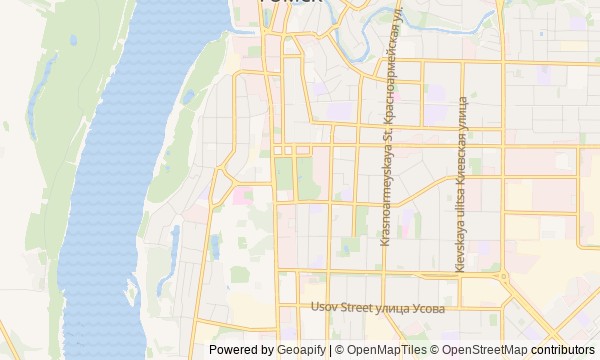
Route map
About the walk
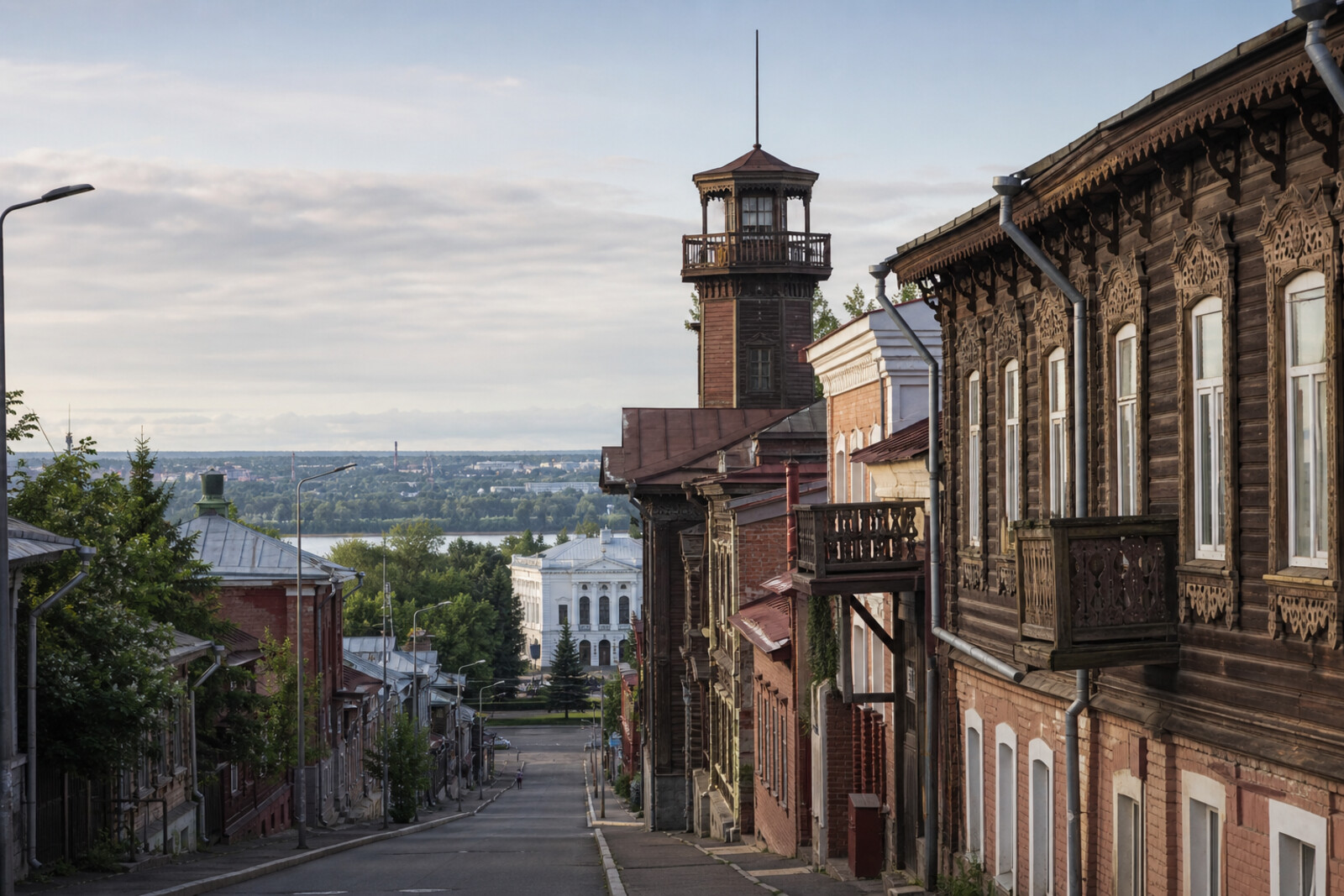
You will begin on Voskresenskaya Hill, where an old address will prove less reliable than a paper balloon. From the fortress headland, you will descend to the Ushaika River and Vtorov Passage. Then you will leave the stone commercial center for the wooden neighborhoods of Tatarskaya Street and Krasnoarmeyskaya Street. Here, gates will need a wide carriageway, firebirds a residential bay window, and seven dragons archival paper.
Next, the route will bring you to an architect's house that will argue with firefighters over a mansard roof, and to a university built before final permission to open it had been granted. The ending will come above the Tom River, on terraces where the ground first yielded a mammoth and then took away the excavation site.
The story will test plaques, legends, and familiar attributions against documents and visible traces. By the end of the walk, you will read Tomsk through a brick stamp, gates for horses, gray paint in a dragon's eye, and a slope that kept moving.
Why this order
The house on Bakunin Street will first cast doubt on the precision of a city address. A few steps along the same street will take you to the headland, where the very place Tomsk was founded will require separating genuine traces from later reconstructions. The descent to the Ushaika River will continue this test at Vtorov Passage: after the fortress hill, it becomes clear how the center shifted toward trade and street politics. From the stone store, the route will move into Zaistochye, to an estate with gates for horses, then to two neighboring houses on Krasnoarmeyskaya Street. Their proximity will make it possible to see the cost of exterior restoration first, then trace how the archives returned a house to its owner. After the decorative estates, Kryachkov House will show wood as an engineering experiment. From there, the road naturally continues to the university quarter: the architect-teacher gives way to the history of the institution for which Tomsk rebuilt its own future. The final crossing through University Grove to Lagerny Garden ends the route on the riverbank, where university science began with a find on a moving slope.
Those who want to see household life and homes behind carved facades Lovers of city legends, archival revelations, and architectural details Those interested in Tomsk's path from fortress to university city
Those expecting a short loop around a single block Those who find long walks over city climbs and descents difficult Those looking only for wooden architecture without political and scientific history
Before you go
The route is linear and long, so choose comfortable shoes and save some energy for the university quarter and Lagerny Garden. Check separately before your walk whether museums and other buildings can be entered: part of the story still unfolds only from outside, while residential houses, courtyards, and service areas require respect for private boundaries. A camera zoom or small binoculars will help with the carvings—birds, snake heads, and roof details are high up. On Voskresenskaya Hill and by the Tom River, account for wind, slippery surfaces, and the terrain. In Lagerny Garden, stay on open paths, do not go beyond barriers, and do not approach damaged edges of the slope.
When to go
The full route, including visits to two museums, is planned for 4 hr 30 min — 5 hr. If you view the buildings mostly from outside, allow about 3 hr 40 min: the transitions between the distant parts of the route will still remain.
Backup plan
If you cannot enter a museum or public building, do not cross the stop off your list: at the fire tower, Vtorov Passage, Kryachkov House, and the university, an important part of the story can be read from the silhouette, materials, and position in the city. In rain, snowfall, or icy conditions, shorten your exploration of the slopes and do not descend to the lower sections of Lagerny Garden; the route's final thought can be gathered from a safe upper platform with a view of the Tom River. If time is short, split the walk into two parts: early Tomsk and merchant houses separately, then wooden mansions, the university, and the riverbank separately. Do not replace closed courtyards and residential premises with unauthorized entry.
Route conditions
Surface. Paved — 7.9 km; unpaved — 46 m (data covers 85% of the route)
Stairs. Flights: 2, 28 m in total
Access. Wheelchair — no; stroller — limited (stairs)
Facilities. Toilets — 6; drinking water — 4
Elevation. Ascent — 95 m; descent — 75 m
OpenStreetMap extract of July 4, 2026: database data, not a check on the ground. Data © OpenStreetMap contributors, ODbL licence
Walk plan
Open in maps ↗- 1
Radishchev House
This is where the city’s memory begins to be tested: the plaque preserved the precise story but linked it to the wrong building. - 2
The Hill of the Fortress, Rebellion, and Fire Alarm
This spot shows how one height served as a construction site, a place of resistance, and a city lookout. - 3
Vtorov Passage
Here, the grand façade stands alongside an episode that happened even before the shop opened. - 4
Horse Trader's Palace
The estate shifts the conversation from a merchant façade to the layout of the yard, where horses were traded and kept. - 5
Firebirds of the House with Firebirds
This stop lets you compare the restored postcard with everyday life behind the carved bay window. - 6
Bystrzhitsky’s Seven Dragons
An archival investigation will show why the famous façade had to have its owner identified anew. - 7
Kryachkov House
Here, wooden architecture becomes an engineering dispute over height, warmth, and modern housing. - 8
A University Built Before Anyone Was Certain
This stop connects the creation of Siberia's first university with the struggle over control of its future students. - 9
The Mammoth’s Shore and Moving Earth
The finale brings together a scientific discovery and the fate of the bank that first exposed the find and then destroyed the excavation.
Route features
Everything you need stays in the browser
Progress, saves and your trip plan are stored on this device.
Add Guide On Map to your home screen so the walk opens outside the browser.
How we handle sources, maps and corrections: our editorial standards