 Guide On Map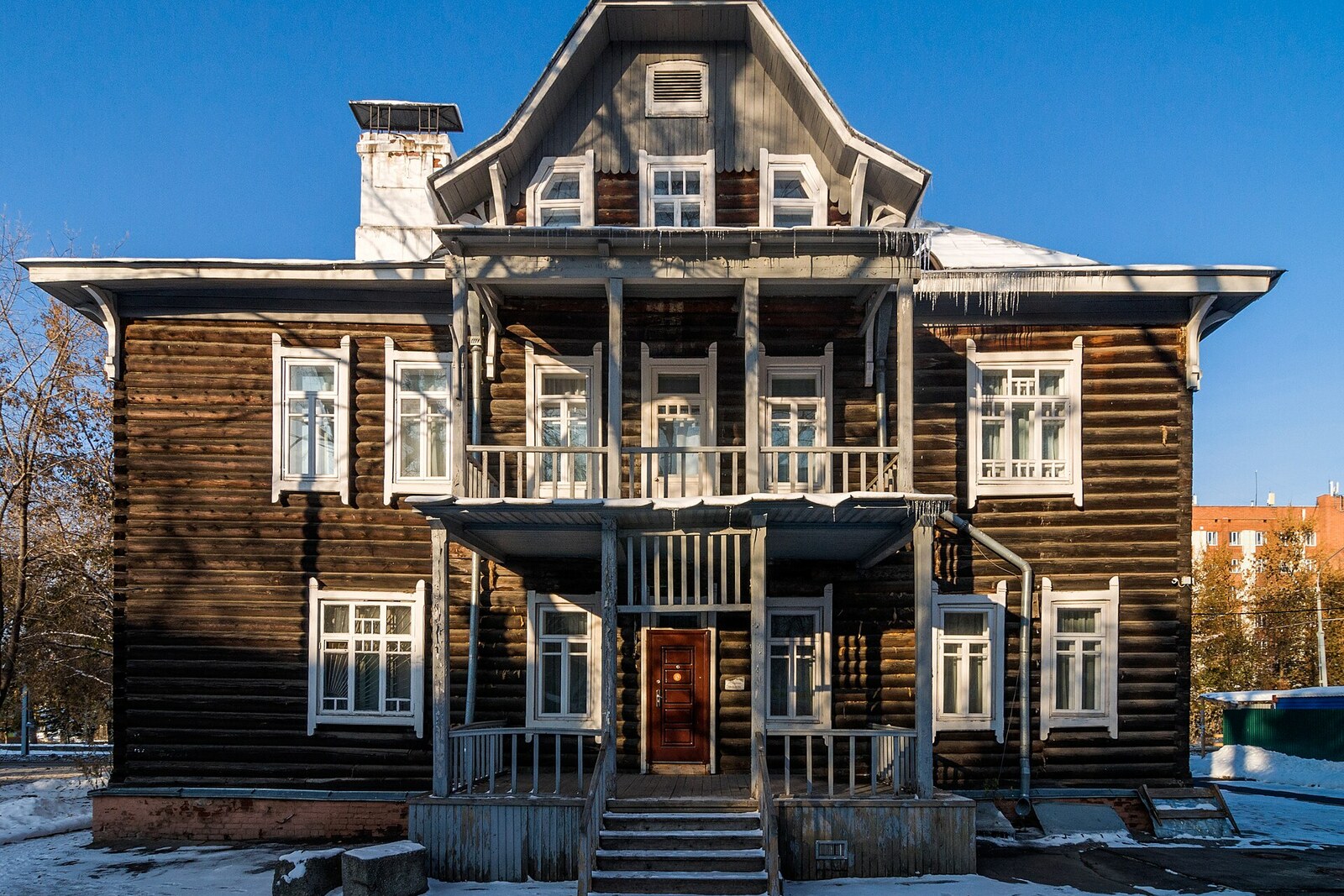
Look around first
What to notice
- High roof
- Attic level
- Brick plinth
- Log walls
The story of the place
A brick plinth supports a large house of pine logs; one family lived in it, while instructors at the technological institute rented the rooms on the second floor. Under one roof stood living quarters, the library of the Society of Engineers, and spaces for drafting work, so people came here for more than just home. The house received its own boiler room, heating, electricity, running water, local sewage, bathrooms, and toilets—a rare set of features for a Siberian wooden building. Later, the rooms were reshaped for evacuated families, and after restoration the Museum of Wooden Architecture opened here.
The high roof of Kryachkov House conceals a third, attic level. Because of it, Tomsk firefighters nearly banned the entire building: the rules allowed wooden residential houses to be built only two stories high.
The author of the design, engineer and instructor at Tomsk Technological Institute Andrei Kryachkov, intended to settle his family here. After his marriage, he continued living in rented apartments, and two sons were born one after the other. Kryachkov earned money through design work and teaching. His own house gave him a chance to test an idea he had written about as an architect: Siberia has plenty of forest, but builders use wood too cautiously. Kryachkov wanted to prove with his own money that wooden housing could be spacious, warm, and equipped with modern amenities.
In nineteen oh nine, he submitted a design for a plot on Bulvarnaya Street—today's Kirov Avenue. Tomsk Fire Department was responsible for construction safety and refused to approve the third level. Kryachkov secured a review of the project by the Technical and Construction Committee in St Petersburg, a state commission that considered disputed construction solutions. After lengthy approvals, the firefighters yielded. The architect made corrections, and he was instructed to use cast-iron cookstoves in the kitchen.
By nineteen eleven, a pine-log structure stood on a brick plinth, with a boiler room, central heating, electricity, running water, local sewage, bathrooms, and toilets. For a wooden Siberian house, such a set of features was considered almost impossible. Kryachkov tested the design through everyday life: his family occupied the first floor, while he rented the rooms on the second to institute instructors. Under the roof were the library of the Tomsk Society of Engineers and drafting rooms where people came to work. The large house simultaneously supported its owner with rental income, served as a home, and received colleagues.
Kryachkov expected to turn the experience into a repeatable type. In nineteen sixteen and nineteen seventeen, following the model of this mansion, he prepared a group of wooden houses for the garden city of the Kolchuginskaya Railway. They were not built because of the Russian Civil War. Kryachkov erected no more wooden buildings, and the Tomsk house remained his only realized experiment of this kind.
After the architect was transferred to Novosibirsk, the house continued to be used as housing. During the Great Patriotic War, twelve evacuated families were settled here; they divided the rooms with partitions, and the original layout disappeared. In the nineteen eighties, the building burned twice. Restorers later replaced the rotted log courses, floors, stairway, porch, windows, and doors. The load-bearing log walls remained unchanged.
The Museum of Wooden Architecture now operates here. The rooms in which the Kryachkov family and their tenants lived no longer survive in their former form. But beneath the high roof, that very attic level remains—the one for which the architect carried his dispute with the Tomsk firefighters all the way to St Petersburg.
Useful on site
Tuesday–Sunday 10:00–18:00; Monday — closed; ticket office until 17:30.
Checked: June 24, 2026. Check the official source before visiting.Plan a visit to the exhibition separately; even when the museum is closed, the house's structure and unusual height are clearly visible from outside.