 Guide On Map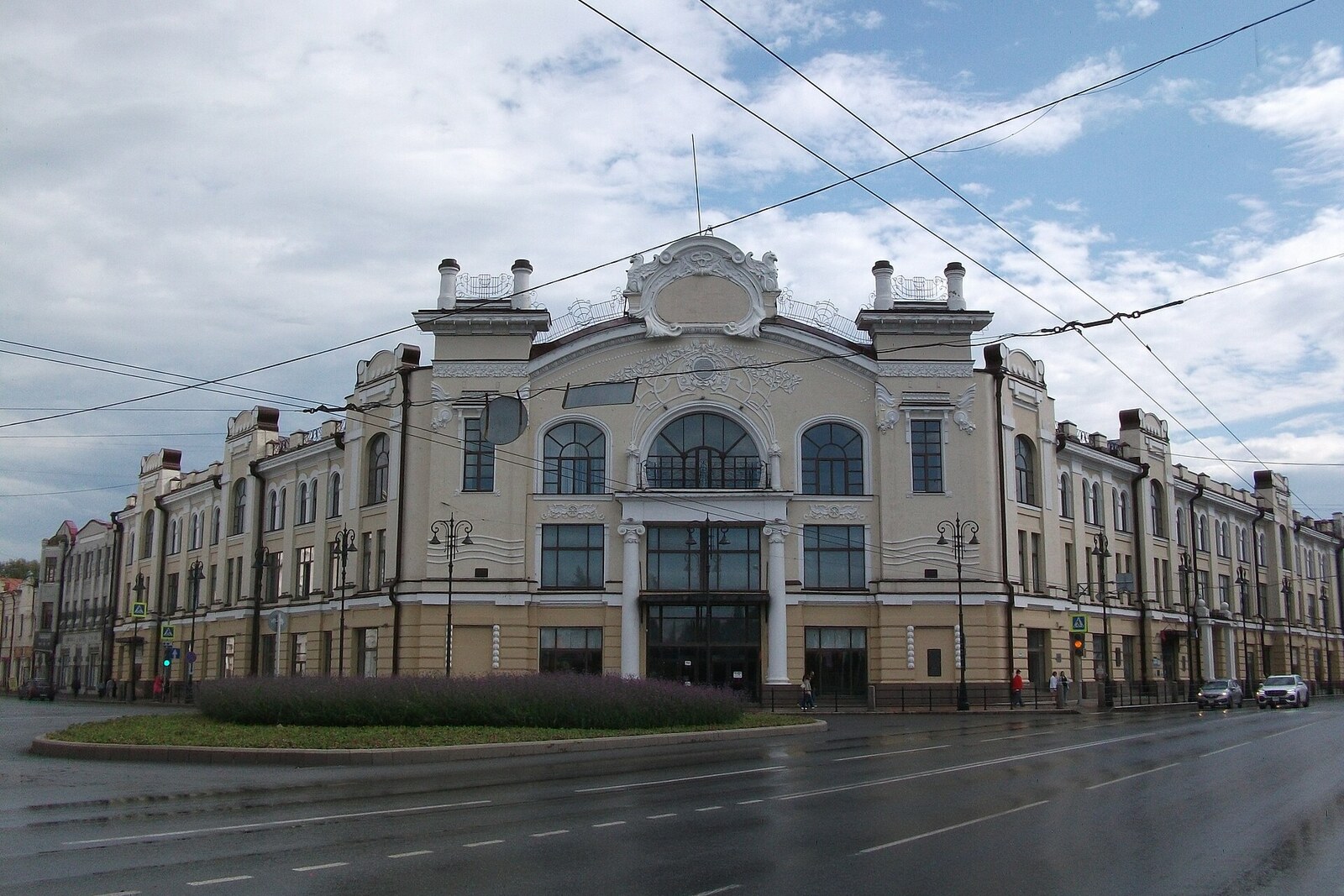
Look around first
What to notice
- Griffins above the central entrance
- Cartouche on the façade
- Memorial plaque
The story of the place
When printer Iosif Kononov came to this corner, the passage had not yet begun trading. Construction was underway inside, while above the central entrance the façade was already rising, intended to be crowned with a cartouche bearing griffins.
On January thirty-first, nineteen oh five, under the current calendar, more than three hundred workers, students, and school pupils walked down Pochtamtskaya Street—the name then used for this section of Lenin Avenue. Nine days earlier, a procession to the imperial palace had been fired on in St Petersburg. In Tomsk, they decided to respond with a demonstration. Kononov, who earned his living at a printing house, carried one of four red banners and pressed for an open protest against the tsarist administration.
The route led to the bridge over the Ushaika River. Beside the passage under construction, Blagoveshchensky Lane joined Pochtamtskaya Street—today's Batenkov Lane. Police officers and Cossacks emerged from there to cut across the demonstrators' path. When ordered to disperse, armed participants in the procession answered with revolver shots. A shootout and a chase began. People tried to escape through the unfinished Vtorov building, but their pursuers went in after them.
Kononov was killed during the clash. A boy who happened to be nearby was also killed; dozens of people were wounded, and one hundred twenty-one participants were arrested. Later accounts differed greatly over the number of casualties, but the banner bearer's fate is known precisely. His funeral drew about two thousand people and turned into another procession. The printer, whom the police had tried to prevent from taking to the streets with other printing-house workers, became after his death a man for whom even more Tomsk residents took to the streets.
Trade opened here only in November of that same year. Alexander Vtorov, founder of the Siberian Trading Partnership, envisioned a department store; his son Nikolai bought up four neighboring properties for the construction. The Vtorovs called such large stores passages—hence the building's purpose and the name on its façade. The ground floor sold fabrics, clothing, furs, and perfume, with purchases delivered to customers' homes. Hotel Europa and a restaurant operated upstairs, and one of Siberia's first passenger elevators ran between the floors. The project author's exact name has not survived; construction on site was supervised by engineer Vladimir Sukhorovsky.
Now, behind the restored interiors, is the Tomsk Center for Contemporary Culture: exhibition halls, a bookshop, and co-working spaces. A plaque about the clash remains on the façade. It hangs beneath the cartouche, with those same griffins seated on either side; in January nineteen oh five, behind this wall there was still no shop or hotel—only the construction site where people fled from the chase.
Useful on site
A guide for the common spaces: daily 09:00–21:00; bookshop 10:00–21:00, exhibition hall 11:00–21:00, according to 2GIS as of the check date.
Checked: June 24, 2026. Check the official source before visiting.The main features can be seen from outside; whether you can enter depends on the current use of the spaces and any events taking place.