 Guide On Map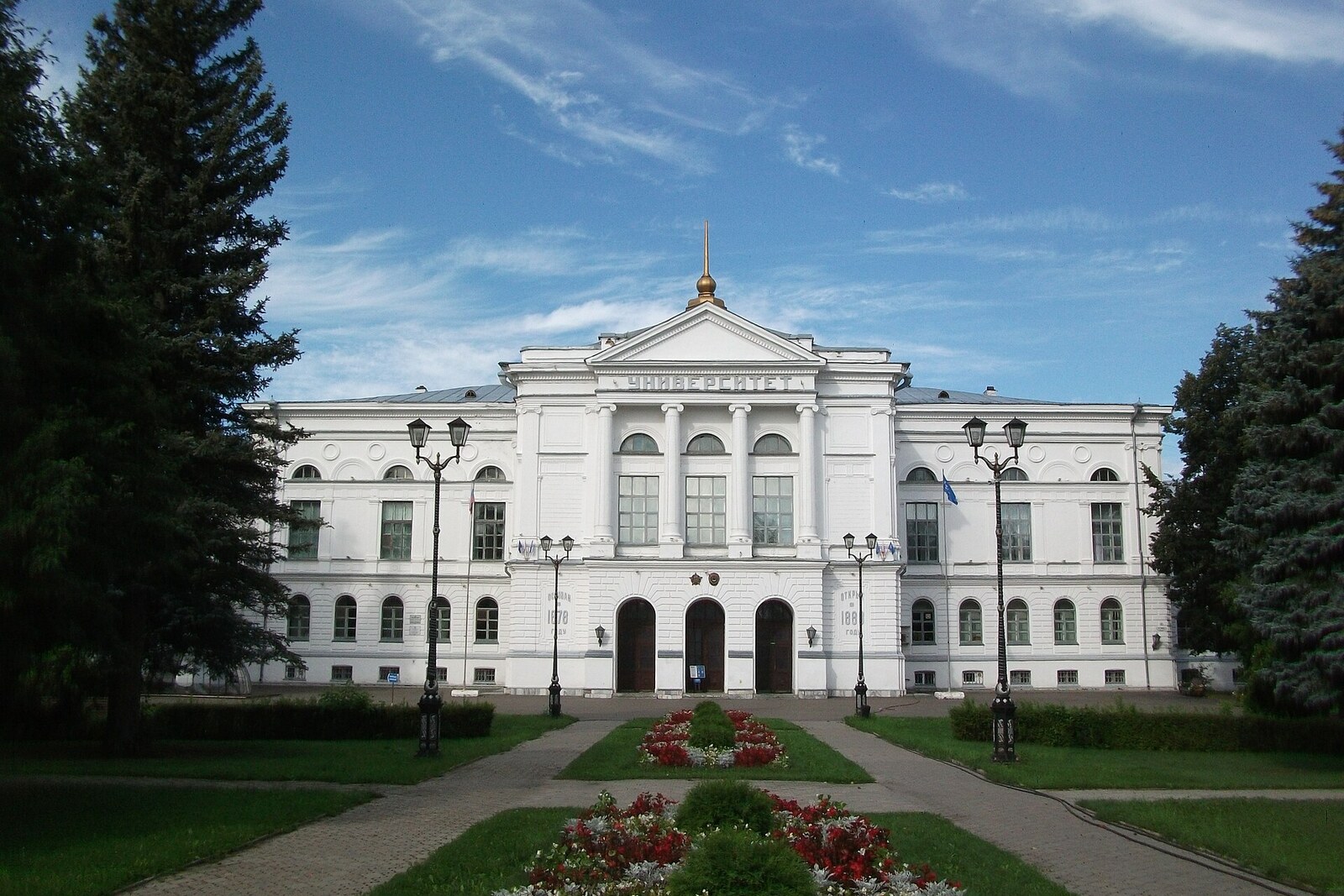
Look around first
What to notice
- Main Building
- South Wing
- Second-floor windows
- University Grove
The story of the place
The plans for the Main Building, amid University Grove, included lecture halls, laboratories, museums, and a library. The upper floor of the south wing housed the official apartment of the trustee of the educational district. Books and collections were gathered there, and the library began admitting city residents free of charge even before students appeared. Those collections gave rise to today's Museum of the History, Archaeology and Ethnography of Siberia, which occupies the second floor of the Main Building.
On August third, eighteen eighty-eight, by the current calendar, entry to this building was by invitation only. Representatives of almost every Tomsk institution received invitations. The editorial office of Sibirskaya Gazeta was excluded from the list.
This was ordered by Vasily Florinsky, an obstetrics professor and an official of the Ministry of Public Education who had sought the opening of Siberia's first university. Sibirskaya Gazeta, Tomsk's first private publication, had sought the same thing: for many years, its staff had argued that the city needed a university. The editorial office's absence from the ceremony was a deliberate decision by the man without whom the ceremony itself might not have taken place.
Emperor Alexander II authorized the establishment of Siberian University in Tomsk as early as eighteen seventy-eight. Four faculties were planned. Florinsky was sent on assignment to ensure that the builders prepared the building for real lecture halls, laboratories, and museums. He spent summers in Tomsk and returned to Kazan in the autumn to lecture: his professor's salary remained his income, while the construction was an official assignment.
By eighteen eighty-five, the Main Building had been finished. Florinsky was appointed trustee of the West Siberian Educational District and moved into an official apartment there, on the second floor of the south wing. He hired a librarian, gathered books and collections, and invited future instructors. The library began to open free of charge to Tomsk residents. The university premises were already serving some of their functions, although students had not yet been admitted to them.
Under Alexander III, influential officials considered the project of the previous reign dangerous: the university might attract political exiles and people with opposition views. When Tomsk asked for money for a new gymnasium—the term then used for a secondary school—the State Council proposed housing it in the completed university building. No one still believed the university would open there soon.
In eighteen eighty-seven, Florinsky went to St Petersburg to persuade the ministers. He secured an audience with Konstantin Pobedonostsev, the emperor's closest adviser and an opponent of the opening. In his diary, Florinsky recorded Pobedonostsev's question: “Who needs a university, and what is it needed for?” The conversation ended in a refusal. Florinsky continued visiting government departments and agreed to a reduced version: instead of four faculties, one medical faculty would open first.
Permission followed in May of eighteen eighty-eight. In the autumn, seventy-two students and two non-degree students began classes. The first three years were assigned to theory, with clinics expected to be built during that time. The building intended for gymnasium classrooms was kept for the university.
Yet Florinsky himself shared the suspicions that had delayed the opening. He feared that editors and political exiles would influence the students, so he barred Sibirskaya Gazeta from the celebration. The newspaper published an issue devoted to the university anyway. Soon, by telegraphic order from St Petersburg, it was suspended for four months and then closed; Florinsky was the initiator.
The south wing, with Florinsky's former apartment, survives. On the second floor of the Main Building is now the Vasily Florinsky Museum of the History, Archaeology and Ethnography of Siberia, which grew out of the collections he began gathering for a university that still had no students. Sibirskaya Gazeta's issue on the opening became one of its last.
Useful on site
The Main Building is an operating university; the façade and grove can be viewed from public walkways, while entry inside depends on access rules and events.
Checked: June 24, 2026. Check the official source before visiting.This is an active academic building: do not disrupt classes, and do not count on free access to the interior spaces.