 Guide On Map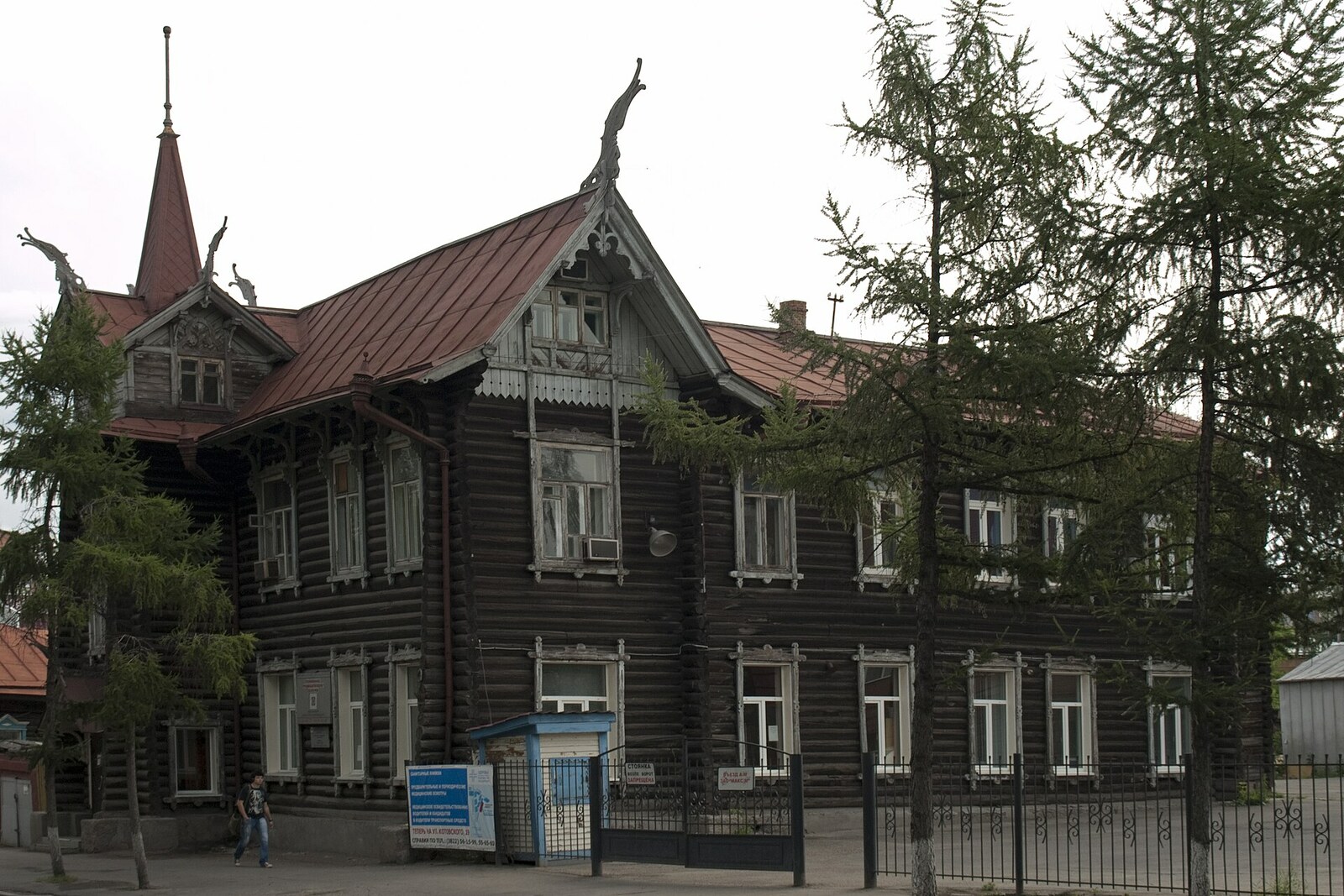
Look around first
What to notice
- Seven dragon heads
- Corner tower
- Restored entrance
- Façade gables
The story of the place
The seven carved heads are not placed on a single cornice: three crown the gables of the corner tower, another three look out from the façades, and the last one rises above the entrance. This wooden house survived from a former estate with two two-story buildings; the other was eventually dismantled, and a parking lot took its place. Norwegian wooden churches and the northern European dragon style served as models for the carvings, while the later story about the Chinese calendar remained a local version. After alterations and a fire, the figures were restored from a surviving fragment and traces of old paint; the house now contains an outpatient department of a medical center.
For a long time, the name Bystrzhitsky was attributed to the wrong person. Two brothers who were teachers lived in Tomsk. The elder, Iosif Bystrzhitsky, taught mathematics and physics, sat on the city council, and took part in charitable societies. He was better known, so the unusual house on Soldatskaya Street was attributed to him. Its true owner was the younger brother, Bronislav Bystrzhitsky, a teacher of German at the boys’ and girls’ gymnasiums.
He made his living by teaching, and he bought the estate on credit. In nineteen ten, Bronislav paid seventeen thousand rubles for the land and a two-story house, borrowing the entire sum from a merchant. Two years later, he mortgaged the property to a bank for another ten thousand. It is assumed that this money was needed for new construction. By nineteen fifteen, documents already listed two two-story buildings, including the present-day House with Dragons.
The design is associated with the Tomsk architect Vikenty Orzheshko, but no drawings or construction papers have survived, so the author cannot be named with certainty. The seven heads on the roof ridges come from northern European architecture: similar dragons decorated medieval wooden churches in Norway and buildings in the so-called dragon style. The story about the Chinese calendar and a gift for Tomsk’s three-hundredth anniversary appeared much later and remains a local version.
Bronislav died in nineteen seventeen, soon after the house appeared. After nineteen twenty, the estate was nationalized. One of its buildings was later dismantled; a parking lot now stands in its place. The house with seven heads survived, but its owner’s name had to be established anew. The bibliographer Andrei Yakovenko found a city council resolution on the reassessment of mortgaged property. The document directly names Bronislav Bystrzhitsky as the owner of the house on Soldatskaya Street. The mortgage document returned the mansion to the younger brother.
By the mid-nineteen seventies, the main entrance had been converted into a window, the canopy had disappeared, and one of the seven heads vanished with it. After a fire, the surviving parts of the dragons were removed. The restoration architect Larisa Romanova received a fragment of an old head and looked for a way to restore the original appearance. Gray paint survived in the round recess of its eye: later painters had not reached that high spot. Romanova found the same shade on the logs inside the stairwell. She chose it for the house’s details and developed a template by which the dragons were recreated.
Today, the building houses an outpatient department of a medical center. Three heads crown the gables of the corner tower, another three crown the gables of the façades, and the seventh stands above the restored entrance, where an old photograph showed an empty space.
Useful on site
View from the street; institutions operate in the building, and there is no unrestricted museum entry.
Checked: June 24, 2026. Check the official source before visiting.The best view is from the street; the roof figures are high up, so do not approach the building too closely just to take a photograph.