 Guide On Map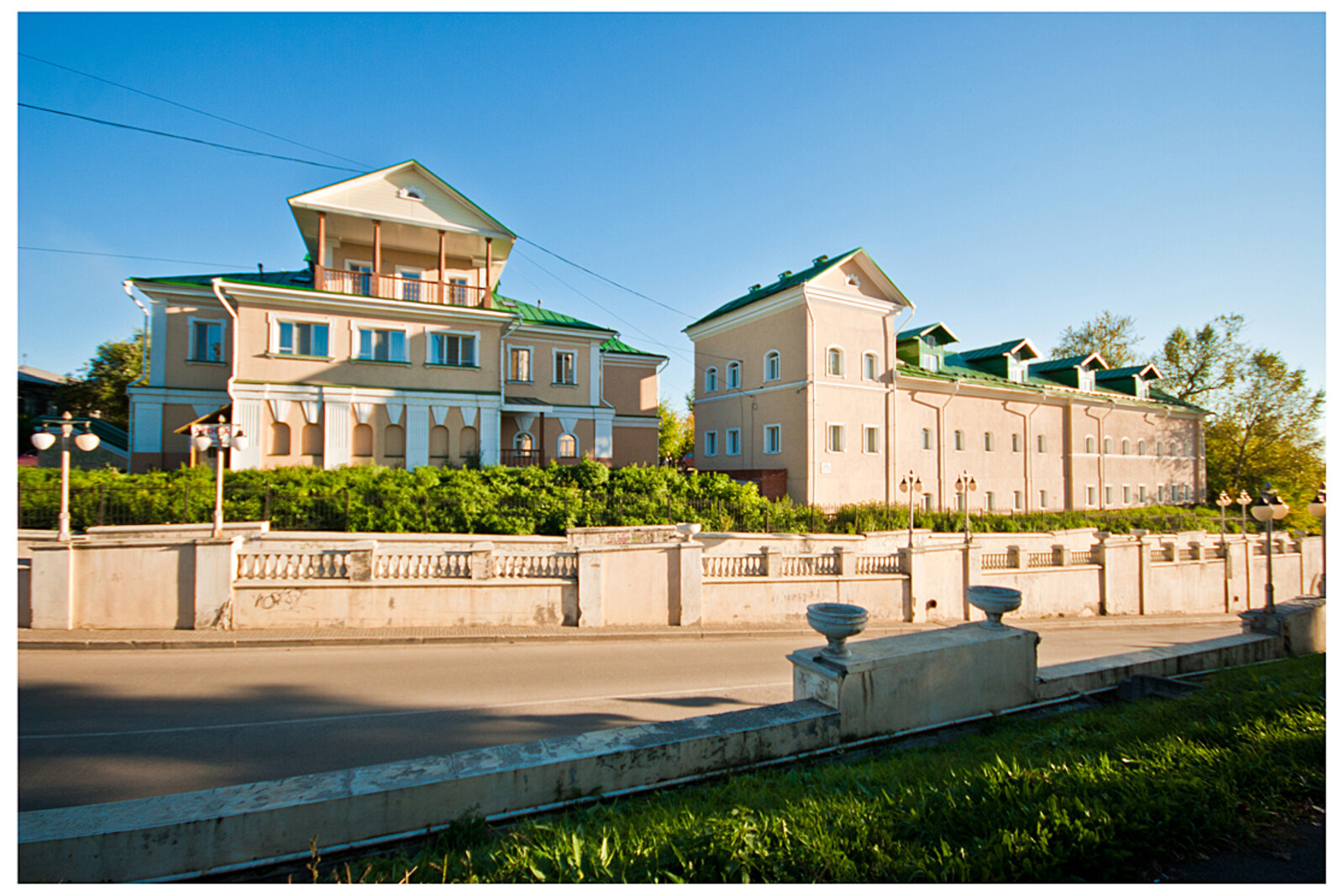
Look around first
What to notice
- Memorial plaque
- Brick masonry of the first floor
- Mezzanine
The story of the place
At the upper edge of Resurrection Hill, among the old buildings, stands a brick house with a mezzanine, and old masonry is still visible on its lower level. It was once half-timbered, but the fire and years of neglect left only the foundation of the earlier structure, while the upper part was rebuilt in brick. Various organizations now work here; nearby on this site once stood the official residence of the city commandant, though researchers have not yet established its exact location.
In August seventeen ninety-one, Alexander Radishchev arrived in Tomsk not as a traveler. For his book Journey from St Petersburg to Moscow, he was sentenced to death; this was then commuted to ten years of exile in Ilimsk Ostrog. On the way, the carriages broke down, his wife’s sister traveling with him fell seriously ill, and his two younger children were with them. The family needed lodging, treatment, and time for repairs.
They were received by Thomas de Villeneuve, the Tomsk commandant—the city’s military commander. His official residence stood on Resurrection Hill, at this end of what is now Bakunin Street. The exile lived with the commandant for more than two weeks.
Here Radishchev glued together a small balloon from thin paper and filled it with hot air. Many years later, his son Pavel, who had been beside his father at the time, recounted the launch. He remembered that the balloon was released specifically in de Villeneuve’s courtyard, and that Siberia had not seen such a spectacle before.
In August, balloon experiments violated an imperial decree: Catherine II allowed them only in winter, officially out of fear of fires. De Villeneuve made the courtyard of his own residence available to a man being taken to serve a sentence for a dangerous book. Later researchers saw the launch as an act of demonstrative disobedience. This is an interpretation, not Radishchev’s own explanation: his son’s recollections preserve the paper balloon, the hot air, and the commandant’s courtyard.
The balloon rose, but it did not change its creator’s situation. After the carriages were repaired, Radishchev and his family continued on to Ilimsk. De Villeneuve was dismissed two years later. He was a Frenchman in Russian service, and his name does not appear in the published lists of compatriots who, at the empress’s demand, agreed to renounce the French Republic and swear a new oath. Advanced age may also have been the reason for his dismissal; there are no documents linking it to the balloon launch. In seventeen ninety-four, de Villeneuve died. When Radishchev, after his amnesty, stayed again at the same residence in the spring of seventeen ninety-seven, his host was already dead.
Later, this story was attached to house number twenty-six. In nineteen seventy, a plaque was installed on its wall stating that Radishchev had stayed precisely here. However, a study of the masonry revealed on the bricks of the first floor the stamp of the Tomsk Prisoner Companies—units of prisoners whose brickworks appeared only in the eighteen fifties. The house’s architecture also dates from the middle of the nineteenth century. Radishchev could not have lived in a building constructed several decades after his death.
The commandant’s residence really was on this part of Resurrection Hill or very nearby, but its exact location has not yet been established. The half-timbered house to which the Radishchev story was assigned was rebuilt after a fire and a long period of neglect: only the masonry of the first floor was retained, while the upper floor and mezzanine were rebuilt in brick. Various organizations now have offices inside. The paper balloon rose from the courtyard of de Villeneuve’s Official Residence; the brick mansion before you appeared later and was assigned another building’s place in history.
Useful on site
View from the street at any time; the buildings are in use, so do not go inside or beyond the fences.
Checked: June 24, 2026. Check the official source before visiting.View the house from the street and do not try to enter the courtyard; the connection with Radishchev belongs to the site, not to reliably preserved rooms.