 Guide On Map
Three Cultures on Toledo's City Ridge
From Puerta de Bisagra through the Alcázar of Toledo to two synagogues
Guide On Map on your phone
Open the walk like a regular app
It takes about 10 seconds to install. No app store needed.
The whole path
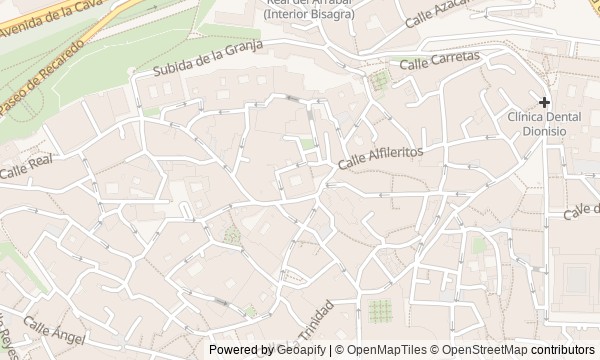
Route map
About the walk
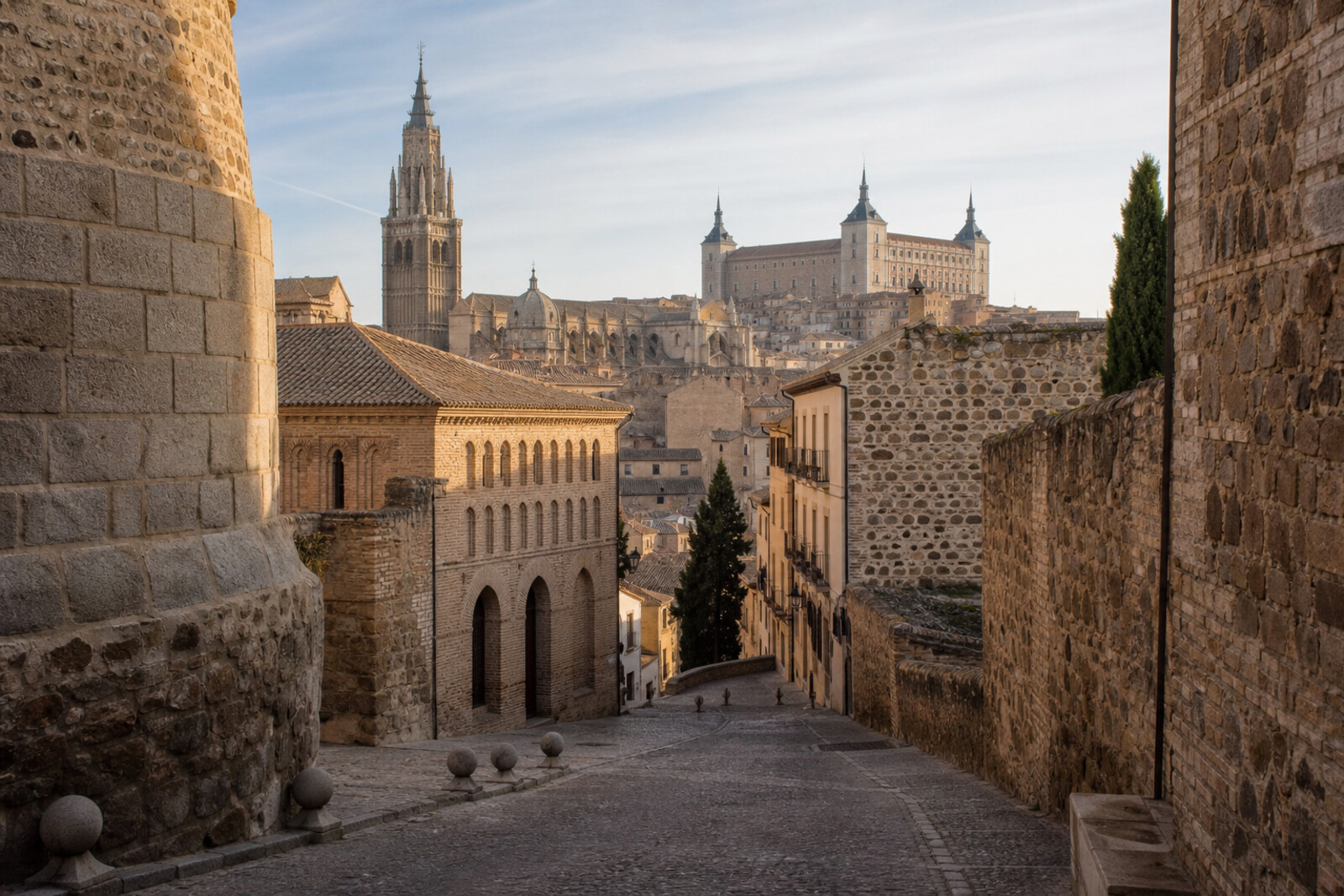
You will enter Toledo through Puerta de Bisagra, climb to a small former mosque, cross Plaza de Zocodover and the Alcázar of Toledo, then head west—to Toledo Cathedral, Santo Tomé, and two synagogues in the Jewish quarter.
This is a walk through a high stone city where Islamic, Christian, and Jewish buildings become places of difficult choices. At the gate, coins will turn up with an unexpected purpose. In a line of brickwork, a name hidden beneath whitewash for nine centuries. In the square, a condemned surgeon will draw a queue of patients. In the fortress, a single phone call will clash with a later legend. In a church, the payment for a painting will continue an older dispute over sheep and chickens.
The story rests on documents, inscriptions, and surviving objects. A tradition will remain a tradition, and a disputed version a disputed version. By the end of the walk, you will read Toledo through the people who promised, paid, judged, and took space from those who had held it before.
Why this order
Puerta de Bisagra comes first because the route enters Toledo through its northern point of control and collection. The climb along the wall leads straight to the mosque by the old gate—from the city boundary to a building where Islamic and Christian layers overlap. Then the narrow streets open onto Plaza de Zocodover: an intimate place of prayer gives way to a square that demanded crowds and public display. A short climb from there reaches the Alcázar of Toledo at the top of the hill—from the city court to military power. The descent from the fortress to Toledo Cathedral continues the conversation through a treaty and church authority. Then the route heads west to Santo Tomé, where sweeping change gives way to a parish dispute over money and memory. Down Calle de San Juan de Dios lies El Tránsito and the story of a royal treasurer. The final stretch along Calle de los Reyes Católicos links his private synagogue to the community's main synagogue—and carries the route from the patronage of one courtier to the loss of a place by an entire quarter.
Those who want to connect Toledo's main landmarks through one historical question Lovers of documents, inscriptions, and courtroom stories Those who care about the line between established fact and later legend
Those expecting an easy overview of architectural styles Those who do not want to hear about religious violence and persecution Those who find long walks uphill and on cobbled streets difficult
Before you go
The route's main evidence is unevenly distributed: Puerta de Bisagra, Plaza de Zocodover, and the Alcázar of Toledo can be meaningfully explored from outside, while Santo Tomé, El Tránsito, and Santa María la Blanca lose almost all their meaning without going in. Toledo Cathedral also needs a separate reserve of attention: its stories are hidden inside a vast, densely layered space. Check access for the day of your walk in advance, taking services and museum hours into account, but do not try to turn the route into a full visit to every collection. Speak quietly inside religious buildings, and do not block passage for a photograph. Toledo's climbs and stone paving call for comfortable shoes; pick up water before you disappear into the old city's narrow streets.
When to go
Walk the route in one continuous sequence, while it is still easy to hold the echoes between buildings in mind. Leave the beginning for exterior architecture and the mosque's short interior, the middle for the square, the Alcázar of Toledo, and the cathedral's most demanding visit, then save your remaining attention for the painting and the two synagogues: that is where the earlier observations come together into one conclusion.
Backup plan
If an interior is closed, do not replace it with a random neighboring landmark. At the Mosque of Cristo de la Luz, read the inscription on the façade and compare the square body with the later altar section; at the Alcázar of Toledo, work with its silhouette, towers, and the visible wholeness of the rebuilt structure; at Toledo Cathedral, focus on its position in the city and continue the route. Santo Tomé can be skipped if you note the link between the painting, a will, and a legal dispute. El Tránsito and Santa María la Blanca are better moved to another time: the inscriptions, ceiling, rows of arches, and loss of the original decoration cannot honestly be replaced by an exterior view. If you are tired, shorten the museum displays, but keep the order of the final two stops.
Route conditions
Surface. Paved — 2.5 km
Stairs. Flights: 4, 59 m in total
Access. Wheelchair — no; stroller — limited (stairs)
Facilities. Toilets — 5; drinking water — 4
Elevation. Ascent — 86 m; descent — 45 m
OpenStreetMap extract of July 4, 2026: database data, not a check on the ground. Data © OpenStreetMap contributors, ODbL licence
Walk plan
Open in maps ↗- 1
Puerta de Bisagra
Here, a city levy links a commercial gateway to the fate of people beyond the border. - 2
Mosque of Cristo de la Luz
A chance repair will restore the building’s date, patron, and state protection. - 3
Plaza de Zocodover
The plaza will become the scene of a clash between an official verdict and the trust of the city’s patients. - 4
Alcázar of Toledo
Here, the documented ultimatum will be separated from the words added to it by later retellings. - 5
Toledo Cathedral
This stop examines how the promise to preserve the main mosque gave way to the new church authority. - 6
Santo Tomé Church
Two lawsuits connect a grave, bequeathed provisions, and the price of an El Greco painting. - 7
El Tránsito Synagogue
The hall will reveal the cost of royal patronage, preserving side by side the treasurer’s name and praise for the king who confiscated his property. - 8
Santa María la Blanca Synagogue
The final stop will show what remained of the main synagogue after the pogrom, its consecration, and changes of use.
Route features
Everything you need stays in the browser
Progress, saves and your trip plan are stored on this device.
Add Guide On Map to your home screen so the walk opens outside the browser.
How we handle sources, maps and corrections: our editorial standards