 Guide On Map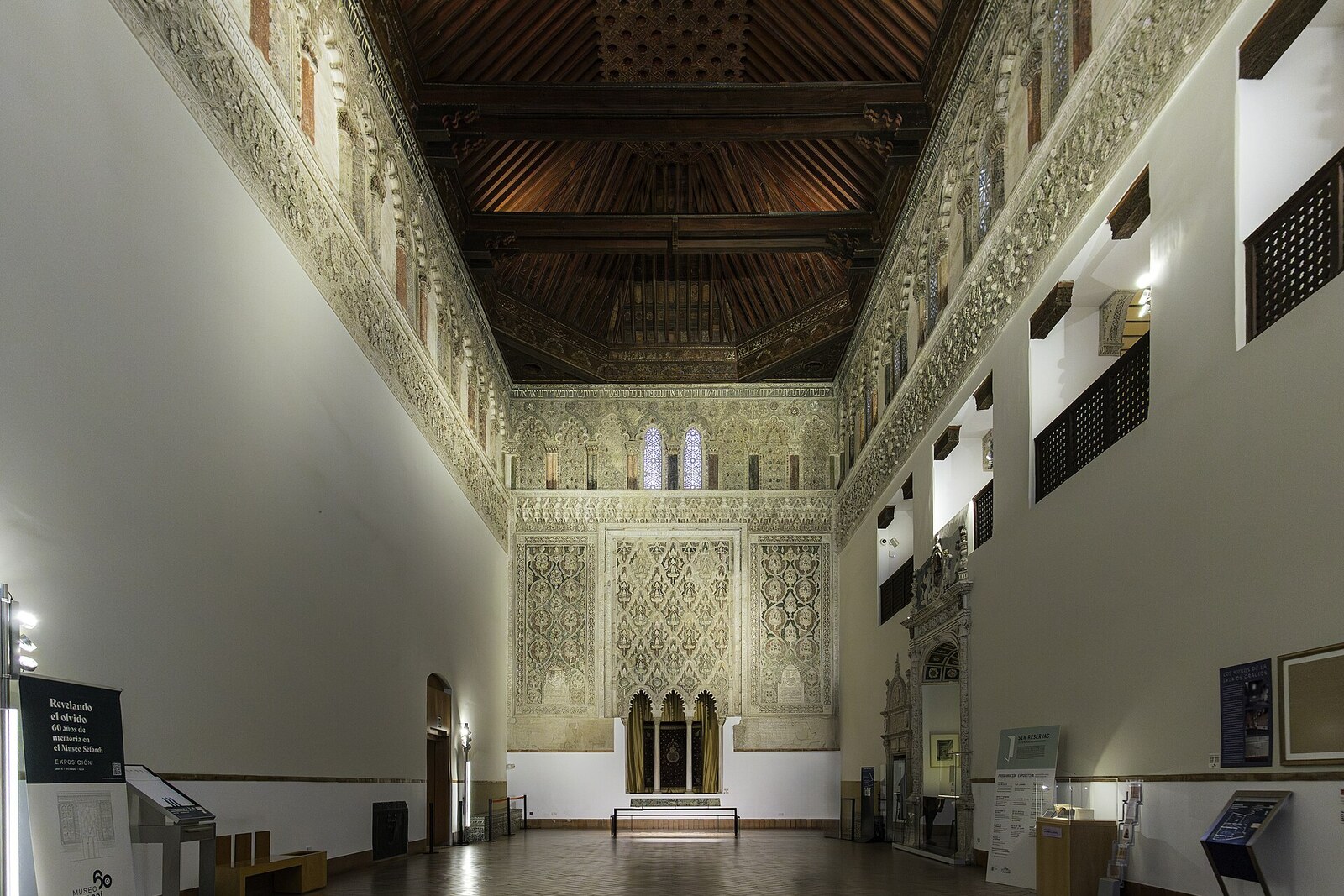
Look around first
What to notice
- Niches in the eastern wall
- Coats of arms of Castile and León
- Hebrew inscriptions
- The stone arch above the commander’s grave
The story of the place
The eastern wall of this tall hall is cut with niches, and above them the Castilian coats of arms and Hebrew writing stand side by side. The Jewish community of Toledo prayed here, and after the expulsion of the Jews, the room was transferred to the Order of Calatrava, which turned it into a church and a burial place for knights. Its present name remains from a painting of the death of the Virgin Mary, once hung above the grave of one of the commanders; the painting itself has long been kept in Museo del Prado. The former prayer hall now forms the heart of the Sephardic Museum.
In the fourteenth century, Samuel ha-Levi could come here directly from his own house: a separate passage connected his residence to the synagogue. Samuel was the chief treasurer of the Castilian king Peter I. He collected royal revenues, kept property taken from rebellious nobles, and provided money for military campaigns. His position and wealth depended on the trust of one person—the king.
Building new synagogues was then permitted only as an exception. Samuel obtained such permission from Peter and, in the late fourteen fifties, built this prayer hall beside his house. Torah scrolls were kept in the niches of the eastern wall, with the coats of arms of Castile and León and Hebrew inscriptions placed above them. One hails Peter as a great sovereign and asks God to preserve him. Another calls Samuel himself the support of the house of Levi and the house of Israel. The patron inscribed both the protector who allowed him to build and himself into the walls.
In thirteen sixty, shortly after the synagogue was completed, Peter accused the treasurer of embezzling money. Samuel was arrested, taken to Seville, and tortured for information about hidden wealth. He died under torture, and the king confiscated his property. On the wall of the prayer hall, the name of the man killed on Peter’s orders and praise for Peter himself have survived side by side.
The hall continued to serve as a synagogue until the expulsion of the Jews from Spain in fourteen ninety-two. Then the monarchs Ferdinand and Isabella transferred the building to the military Order of Calatrava. The Church of San Benito was established here, and the former prayer hall also became a burial place for knights.
Its present name comes from one of these burials. In the mid-sixteenth century, Iñigo de Ayala y Rojas, a commander of the Order of Calatrava, commissioned a painting from the artist Juan Correa de Vivar for the chapel in which he intended to be buried. The painting depicted the death of the Virgin Mary—her passage from earthly life, in Spanish, “tránsito.” The canvas was placed beneath a stone arch above the commander’s grave. By the seventeenth century, the church came to be called the Church of El Tránsito after this painting; the Christian name remained with the former synagogue as well.
It is now the Sephardic Museum, and its main exhibit is considered to be the prayer hall itself. The painting that gave it its name is in Museo del Prado. What remains in Toledo are the burial niche intended for it, the name El Tránsito, and Samuel ha-Levi’s Hebrew inscriptions.
Useful on site
Tuesday–Saturday 09:30–20:00; Sunday and holidays 10:00–15:00; Monday closed. General ticket 3 euros.
Checked: June 24, 2026. Check the official source before visiting.Do not limit yourself to the overall view: the meaning lies in the texts and the upper levels of the decoration. See the museum exhibition after the hall itself.