 Guide On Map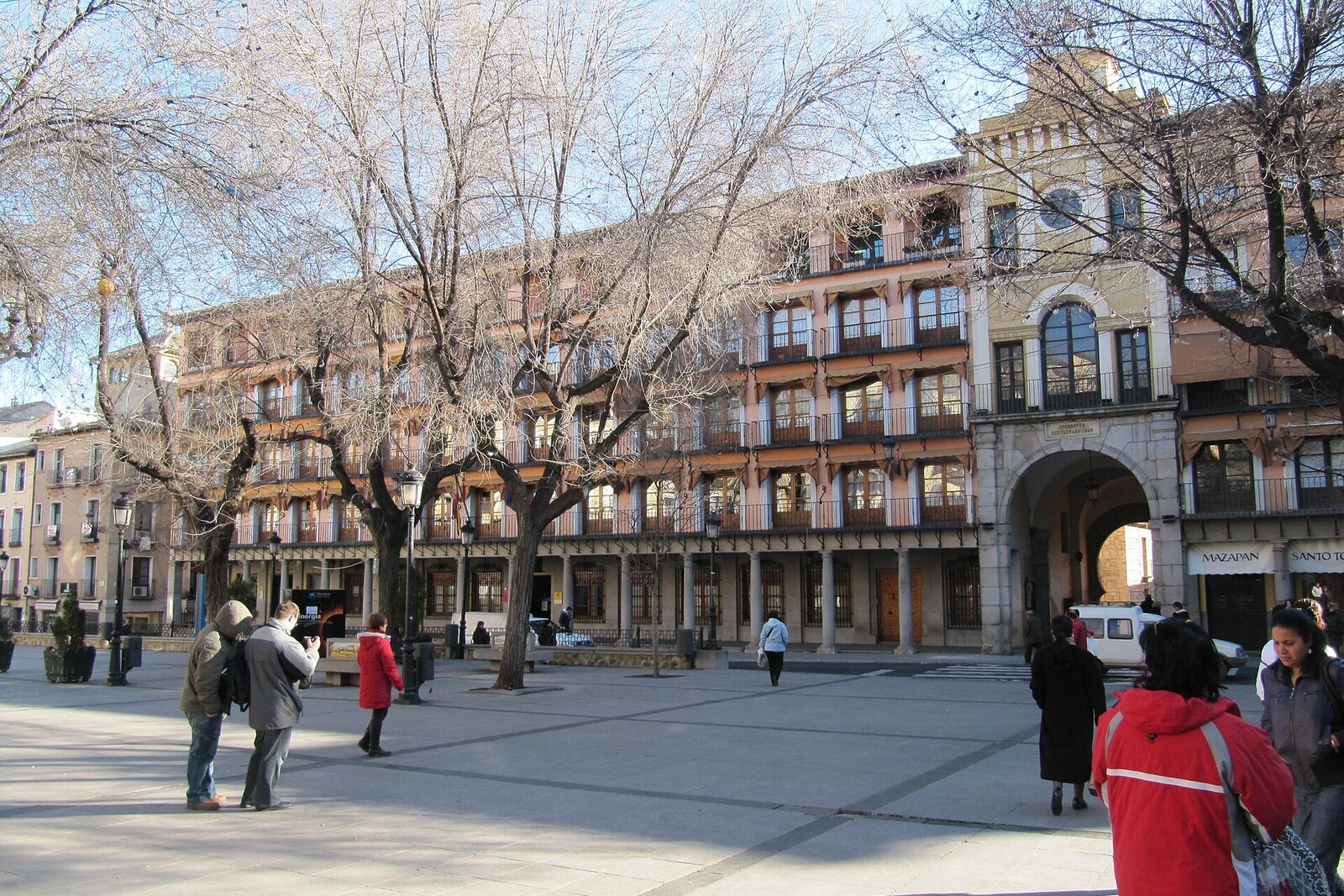
Look around first
What to notice
- Arcades
- Surrounding facades
- The plaza’s open space
The story of the place
People still arrange meetings, hold celebrations, and set up temporary stages at Plaza de Zocodover today. The plaza’s name describes its former trade: the Arabic “suq ad-dawabb” means a market for pack animals. Sellers, buyers, and drovers all converged here. In fourteen sixty-five, King Henry the Fourth of Castile permitted Toledo to hold a weekly fair here. It took place on Tuesdays and acquired the short name “Martes”—“Tuesday.” Trade continued on the plaza into the twentieth century.
The same flow of people drew the city court and the Inquisition here. At Plaza de Zocodover, sentences were read out and autos-da-fé were held—public ceremonies of penance and condemnation. Executions took place later, elsewhere. Spectators were needed here.
On Sunday, December eighteenth, fifteen eighty-eight, the surgeon Eleno de Céspedes was led onto the platform. In the trial records, the name changes: “Elena,” “Eleno,” “Elena, otherwise Eleno.” Céspedes had called himself Eleno since fifteen seventy-five; that is what we will call him here.
Eleno was born in Alhama de Granada, the child of an enslaved woman, and gained freedom while still a child. He earned a living by sewing, served as a soldier, then settled in Madrid with an acquaintance who was a surgeon and studied wound treatment for three years. After being accused of practicing illegally, Eleno did not flee but took examinations before the royal medical commission. He received two documents: the right to practice surgery and separate permission to bleed patients and prescribe purgatives. Among property later confiscated were twenty-seven books—works on anatomy and medicine in Spanish and Latin. This person lived by his craft and could defend himself with professional knowledge.
In Ciempozuelos, Eleno met María del Caño, the woman he wanted to marry. A church official doubted that the beardless groom was a man and demanded an examination. Eleno was then examined by two court physicians. Both declared him a man, after which the church permitted the marriage. In fifteen eighty-six, Eleno and María were married in Yepes.
A year later, the spouses moved to Ocaña: there was no surgeon there, and Eleno expected to gain patients. A former comrade from military service, now a court bailiff, recognized him. He reported that the person living as a man and married to a woman had been born a woman. Eleno was arrested, and the civil case was transferred to the Toledo Tribunal of the Spanish Inquisition.
At the trial, Eleno maintained that he had been a hermaphrodite and had a male body at the time of the wedding. The physicians who had previously permitted the marriage withdrew their finding. The inquisitors declared Eleno a woman, considered the wedding a deception, and accused him of insulting the sacrament of marriage. Because the accusers needed to explain how the earlier examinations had produced the opposite result, the case also came to include an alleged pact with the devil.
Eleno was led to Plaza de Zocodover in penitential clothing and a tall cap bearing signs of the accusations. The sentence was announced here. The next day, the convicted person received one hundred lashes in the streets of Toledo, then another one hundred in Ciempozuelos. The final part of the punishment was ten years of unpaid work in hospital wards.
Eleno was sent to the Royal Hospital of Toledo. However, as early as March fifteen eighty-nine, its superintendent complained to the Inquisition: so many people were coming to the convicted surgeon that the hospital became overcrowded. The court ordered Eleno transferred to the hospital in the town of Puente del Arzobispo. What happened to him afterward is unknown.
The platform at Plaza de Zocodover was temporary. In the autumn of that same year, a fire destroyed most of the houses surrounding the plaza; the present facades and arcades appeared after later reconstructions. The space itself and its market name survived. The judges displayed Eleno here so that the whole city would see him. Three months later, the hospital asked for the same person to be taken away because townspeople continued to come to him for treatment.
Useful on site
The plaza is open around the clock; in June 2026, the government delegation building on the plaza is surrounded by scaffolding.
Checked: June 24, 2026. Check the official source before visiting.Walk around the edge of the plaza and look at it from several points: its layout is easier to read through the flows of people than from the center.