 Guide On Map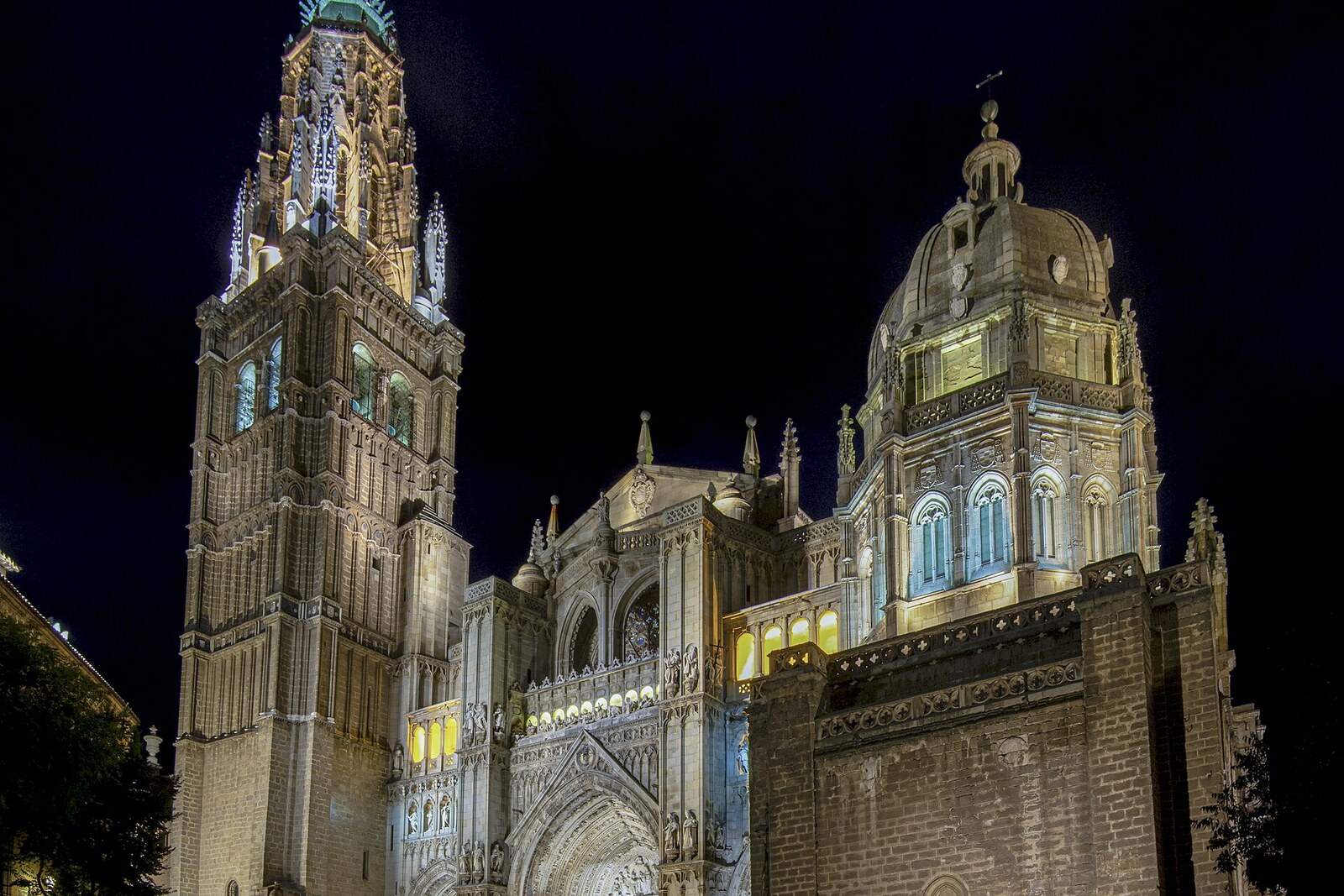
Look around first
What to notice
- Gothic façades
- Column from the former mosque
- Capital from the former mosque
- Archbishop's cathedra
The story of the place
The archbishop's cathedra and daily service remain on the site that was once the main place of prayer in Muslim Toledo. The present Gothic church rose later, while the earlier building was dismantled almost entirely. In the Chapel of Saint Lucy, a column and a capital that remain from it are set into the wall.
In one thousand eighty-five, Alfonso VI, king of León and Castile, received Toledo under an agreement with the city's Muslim rulers. One of the conditions was that the main Friday mosque be preserved—the Muslim community gathered here for communal prayer. The king needed a city that would submit without another war, so the promise concerned a building whose loss could have roused the inhabitants against the victor.
The king's wife, Constance of Burgundy, sought something different. She supported French monks of the Cluniac Order and the introduction of the form of worship accepted in Rome. Her ally was Bernard of Sédirac, a French abbot who was to become Archbishop of Toledo. For the new church hierarchy, the city's principal church had to be the main mosque itself.
What is known of how the seizure occurred comes from a chronicle by Archbishop Rodrigo Jiménez de Rada, written about a century and a half later. No account contemporary with the events survives, so the details of this scene cannot be treated as an indisputable record. According to the chronicler's version, Constance waited for her husband to leave, and Bernard entered the mosque at night with armed horsemen. The people were driven out, a Christian altar was set up inside, and bells were hung on the minaret.
On learning that the agreement had been broken, Alfonso hurried to Toledo and threatened to burn his wife and Bernard. For the Muslim community, such punishment was more dangerous than losing the building: the queen's relatives and Christian townspeople might later take revenge on those for whose sake they had been punished. According to the same chronicle, the inhabitants met the king near the village of Magán, asked him to spare those at fault, and released him from his promise to preserve the mosque. The account clearly removes responsibility for breaking the agreement from Alfonso, but documents confirm the outcome.
On December eighteenth, one thousand eighty-six, the king was already taking part himself in the consecration of the former mosque as Toledo Cathedral. He granted the new cathedral lands, vineyards, mills, and property that had previously supported the mosque. These revenues sustained the cathedral clergy and the archiepiscopal administration. Bernard became archbishop, and two years later Pope Urban II recognized him as primate—the first in honor among the bishops of the Christian kingdoms on the peninsula. This is where the word “Primatial Cathedral” in the cathedral's official name comes from.
The Muslim building continued to serve as the Christian cathedral for about a century and a half: the archbishop's cathedra stood here, and the liturgy was celebrated. Then that same Rodrigo Jiménez de Rada, who preserved the story of the nighttime seizure, began construction of the present Gothic church together with King Ferdinand III in one thousand two hundred twenty-six. The builders dismantled the old mosque.
In the Chapel of Saint Lucy, a column and a capital from the vanished mosque are built into the wall. Nothing else of the building remains; daily services and the archbishop's cathedra remain on the site that Alfonso promised to preserve for Muslim prayer.
Useful on site
Cultural visits usually: Monday–Saturday 10:00–18:30, Sunday 14:00–18:30; entry closes 30 minutes earlier. Basic ticket 12 euros.
Checked: June 24, 2026. Check the official source before visiting.The interior calls for selectivity: stick to the route's three details and do not try to take in the entire cathedral catalogue at once; during services, do not enter areas in use.