 Guide On Map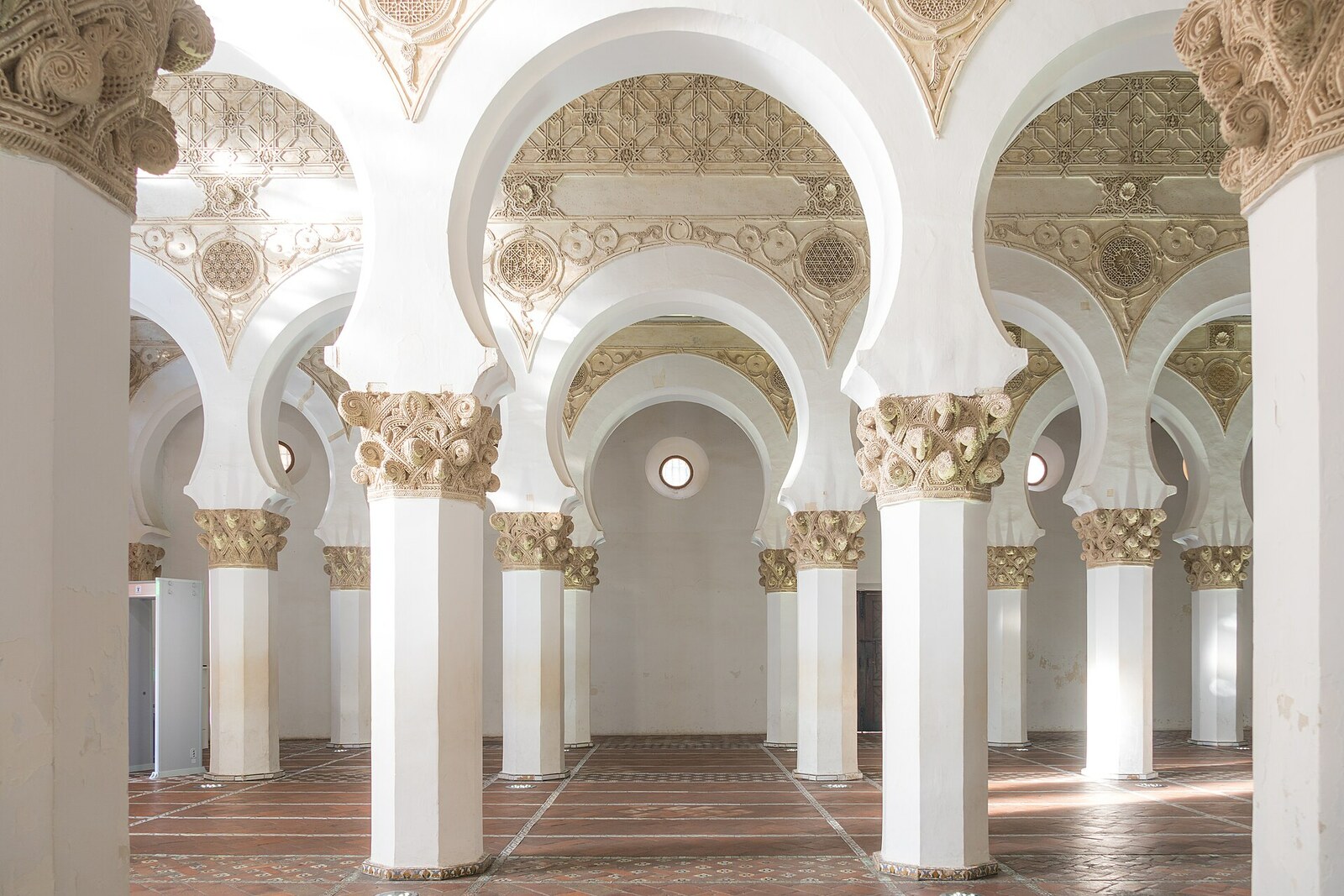
Look around first
What to notice
- Five naves
- Octagonal supports
- Horseshoe arches
- White walls
The story of the place
The white walls of Santa María la Blanca do not explain its name: it remained from the statue of the Virgin Mary that once stood inside. Five naves rest on octagonal supports, with horseshoe arches running between them—the arrangement of the old synagogue hall outlasted its furnishings and changes of use. Now there are neither scrolls nor places for worshippers here, nor the statue that gave the building its name; the hall is preserved as a historical monument.
On June twentieth, thirteen ninety-one, a pogrom began in Toledo. This building then served as the main synagogue of the Jewish community: people prayed here, read the Torah, and studied it. The community was deprived of the building, and later Christians turned the prayer hall into a church.
The violence in Toledo was part of violence that swept across Castile. Ferrán Martínez, archdeacon of Écija—a church judge from near Seville—had for years called for synagogues to be destroyed and Jews to be baptized. King Juan I demanded that these sermons stop. After the deaths of the king and the Archbishop of Seville, who had also restrained Martínez, Martínez intensified his campaign. On June sixth, a crowd devastated Seville's Jewish quarter; two weeks later, the pogrom reached Toledo.
A Jewish elegy about the Toledo catastrophe reports ten desecrated or destroyed synagogues and five houses of study. Some residents were killed, others fled, and many accepted baptism to save their lives. When the danger had passed, they could no longer openly return to their former faith: the church regarded baptism as irreversible. City documents soon began to use the formula “where the Jewish quarter once stood.”
Here, the consequences of the pogrom were fixed in the very arrangement of the hall. Christian clergy removed the platform from which the Torah was read, the ark for the scrolls, and the places for worshippers. The exact year of the consecration is disputed: sources name the early years of the fifteenth century and fourteen eleven. Later tradition attributed the seizure of the synagogue to Vicente Ferrer, a Dominican preacher who sought the conversion of Jews. In this version, he comes here with an armed crowd. There is no reliable evidence of such a scene; even the Archdiocese of Toledo emphasizes that Ferrer did not take the building from the community.
At the consecration of the new church, Christians placed inside it a statue of the Virgin Mary—a copy of the White Virgin in the choir of Toledo Cathedral. The church received the name Santa María la Blanca from this figure. The statue remained here until the building was turned into barracks, and then it disappeared.
Today, visitors enter this place as a historical monument. There are no synagogue furnishings, and there is no Christian statue either. Five naves, octagonal supports, and rows of horseshoe arches have survived. The whiteness of the walls coincides with the name by chance: Christians named the church after the lost figure, while the arrangement of the hall was preserved by the synagogue where the Jewish community stopped praying after the pogrom of thirteen ninety-one.
Useful on site
Daily 10:00–18:45; individual ticket 4 euros; the ticket office closes 10 minutes before closing time.
Checked: June 24, 2026. Check the official source before visiting.This stop is worth seeing from inside and without rushing: first take in the rhythm of the whole space, then look for traces of its later uses.